

A few years ago, AI in customer experience meant assistance, with copilots suggesting responses, bots answering questions, and context that evaporated the moment a session ended. That era is over, and I don't say that as a prediction. Last week, Neeraj Verma, our VP of Product Management, and I spent an hour with thousands of CX, technology, and operations leaders unpacking what's replaced that time.
The shift shows up across every dimension of technology. AI that could only assist has become agentic AI that resolves issues end to end. Context that resets after every session has become Experience Memory that compounds. Autonomy with limited oversight, the era of hallucinations and off-the-rails bots, has become governed, auditable action. And the fallback human role has become human and AI collaboration by design.
When we polled our audience, 19% said they're already live with proactive AI outreach across multiple channels. The majority have it on the roadmap. This post and the webinar that inspired it address that gap between where most organizations are and where the technology has already gone.
Why point AI existed, and why it's ending
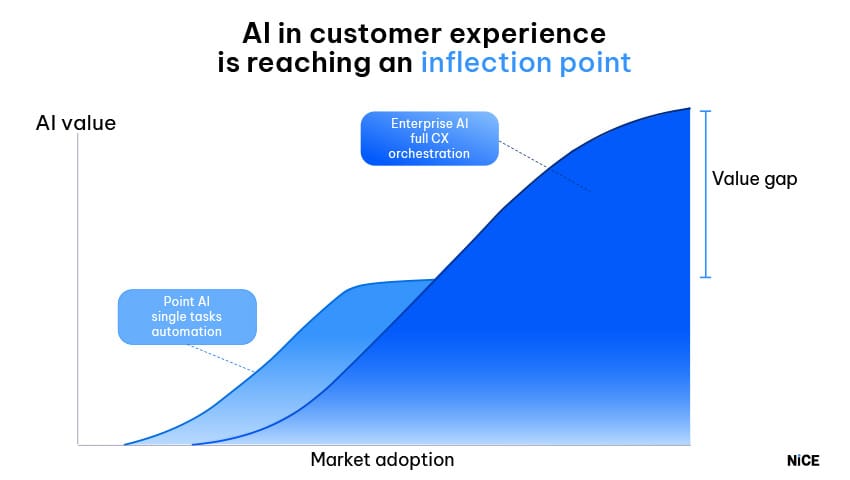
Neeraj gave the clearest technical explanation for why the first wave of CX AI looked the way it did. "Why did you have point AI solutions? Because a year ago, two years ago, large language models had very small context windows," he explained. Discrete tasks were all the technology could reliably hold: a copilot here, knowledge retrieval there. As context windows expanded and reasoning improved, models became capable of orchestrating entire automation flows.
But bigger context windows alone don't create value. "You've got a huge amount of context. What do you dump into it? What do you store?" Neeraj asked. The right context, at the right moment, drawn from the right memory is the difference between an AI agent that converses and an AI agent that resolves.
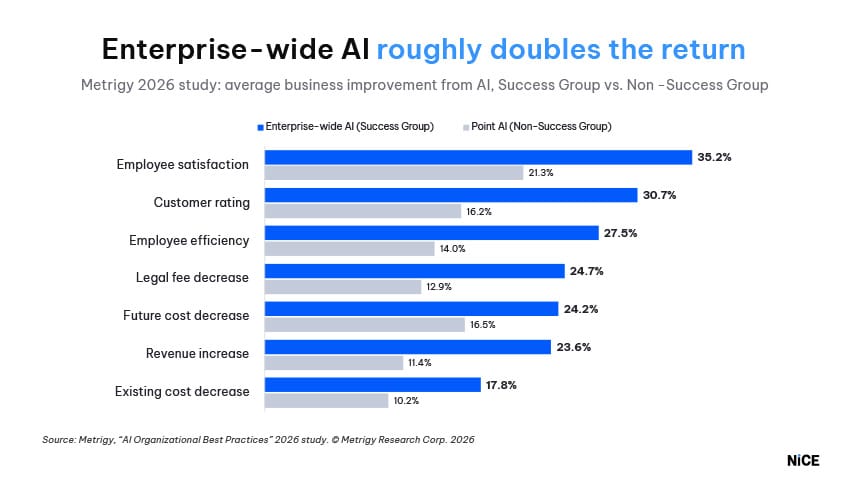
The business results confirm the architecture argument. A 2026 Metrigy study found that organizations running enterprise-wide connected AI strategies see roughly double the improvement of point-AI organizations across every metric that matters, including employee satisfaction, customer ratings, efficiency, revenue, and cost. The value gap between point AI and orchestrated AI isn't theoretical anymore. It's showing up in the data.
What orchestration looks like when it matters
We built our demo around the scenario every CX leader dreads. A storm grounds flights nationwide and contact volume spikes 300%. Most operations break there. In the demo, the platform scaled instead. AI agents expanded capacity instantly to handle rebookings while human agents shifted to the complex, high-emotion moments, like a traveler racing to reach a sick family member. Context transferred between AI and human with no repetition. Supervisors managed one blended workforce from a single workspace. Behind the scenes, analytics detected the surge pattern and recommended a dedicated AI rebooking agent with preapproved policies, simulation-tested and live in minutes. Two days later, when the weather shifted again, impacted travelers were notified proactively before they ever picked up the phone.
That's the difference between automating tasks and orchestrating outcomes. Here's what makes it possible.
One engagement across every agent and channel
Customer journeys now involve more participants than ever: consumers, their personal AI assistants, enterprise AI agents, and human employees, often within a single interaction. The Agentic Engagement Plane is the mediation layer that holds all of it together as one continuous engagement from intent to resolution, not a trail of fragmented contacts stitched together after the fact. "You need a unification for how those platforms communicate with your customers," as Neeraj put it. The same context, memory, and guardrails apply no matter which AI is talking.
Measure resolution, not deflection
The next generation of AI agents, powered by Cognigy technology now native to our platform, executes tools and takes action in enterprise systems. And they're becoming truly multimodal in the CX sense. An agent that talks with you on a call while texting a two-factor code, sharing a map, or accepting a photo and digital signature after a car accident. In our demo, the AI checked fare rules, found the flight, preserved preferences, and completed the transaction. The unit of value moves from contacts deflected to work completed. And that should change how you measure everything.
Memory that makes every interaction smarter
Experience Memory gives every AI agent, application, and human the same living picture of the customer, such as preferences, history, past events, and open commitments, available instantly at the start of every engagement. It also solves a problem most leaders haven't confronted yet: context poisoning. More context isn't better; the right context is. Reliable, continuously updated memory is what lets each engagement begin smarter than the one before.
Governance is the gas pedal
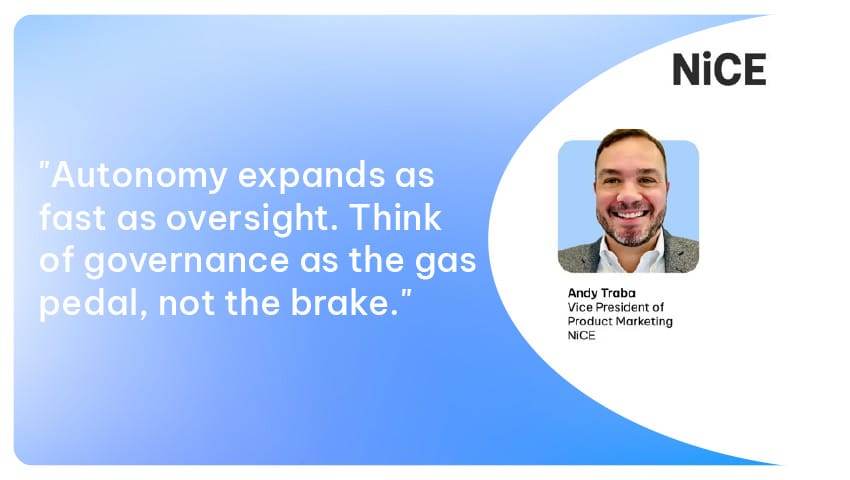
A point made in the webinar that I’d like to reiterate. Autonomy expands as fast as oversight, so think of governance as the gas pedal, not the brake. Guardian AI moves oversight from after-the-fact dashboards to runtime, monitoring conversations in real time and steering an agent back on track before a problem becomes an incident. It's no accident that some of our fastest-moving AI customers come from regulated industries. They already had the policies, and now they have a system that enforces them. Observability was the buzzword of the last few years. Governed action at runtime is what replaces it.
Analytics that act
Agentic Analytics flips analytics from a system of insight to a system of action. Fleets of AI agents analyze every piece of platform data and then act, updating agent instructions and even building new AI agents directly from engagement data when a new call type emerges. Neeraj's line on this deserves to be framed. "You cannot have compounding value without putting pennies in the same piggy bank." That's why the platform matters. Compounding requires everything in one place.
One workforce, human and AI
The workforce now includes both people and AI agents, and everything about workforce management changes as a result. Quality for an AI agent isn't measured like quality for a human, and staffing models look different when capacity can expand instantly. As AI absorbs routine execution, human work concentrates in complexity, ambiguity, empathy, judgment, and trust. My advice is to update your hiring profiles, coaching models, and quality frameworks before the rollout, not after.
Where to start
The innovations that matter are the ones that resolve, remember, and are governed. They fit together as one operating model orchestrated across the full customer experience, open to third-party systems. Foundations come first, data and integrations, because garbage in is still garbage out. Measure resolution, not deflection. And scale autonomy exactly as fast as your oversight can follow.
Neeraj's closing advice is the right note of caution, "Data is probably the most important, most overlooked item when implementing an AI solution. Creating point solutions is not hard. What is hard is operating them at scale." Mine is the right note of ambition. Don't automate a password reset. Think big.
The real dividing line for CX leaders right now is whether AI in your organization acts as one connected system. The future of CX AI belongs to the organization that can orchestrate intelligence across every interaction and turn that intelligence into continuously compounding value.
Watch the full Orchestrating Intelligence webinar, and if you want to pressure-test your own roadmap against this operating model, my team would love to talk.