

When I sat down with guest speaker Max Ball, principal analyst at Forrester, for our recent CX AI Unplugged: Featuring Forrester on the State of Conversational AI in 2026 webinar, I asked him to describe the conversational AI market in one word. His answer: “wild.” And he meant it.
There are 650+ vendors selling conversational AI for customer-facing use cases alone. Billion-dollar valuations. A three-way battle between CCaaS platforms, CRM giants, and AI-native players that will take years to shake out. The lines between self-service and assisted service are blurring, and generative AI has fundamentally changed what's possible to automate.
Most CX leaders already feel this. What's harder to find is a clear read on what to do about it. After spending an hour with Max going deep on Forrester's latest research, three things stood out as separating organizations that are moving forward from those stuck in evaluation mode.
1. Why most AI pilots never reach production (and how to fix it)
During our conversation, Max revealed that Forrester conducted 27 interviews with companies that recently deployed conversational AI. The pattern was consistent: vendors built a working bot in a week. Companies then couldn't go live for a month or a quarter. The technology was ready, but the data wasn't.
Even a straightforward FAQ deployment surfaces content that's outdated, inconsistent, or legally sensitive the moment someone actually looks at it. And legal review is its own obstacle. One contact center leader Max spoke with put it plainly: "We're all ready to go, we just can't get it past legal." When your AI can't guarantee word-for-word what it will say to a customer, getting sign-off takes longer than the build.
This is something we see consistently with customers, too. The organizations making real progress don't wait for perfect conditions. They start with tactical use cases, like FAQs, scheduling, and simple transactions, then use that runway to design the strategic roadmap in parallel. Getting something small to production builds the organizational muscle you need for everything that comes next.
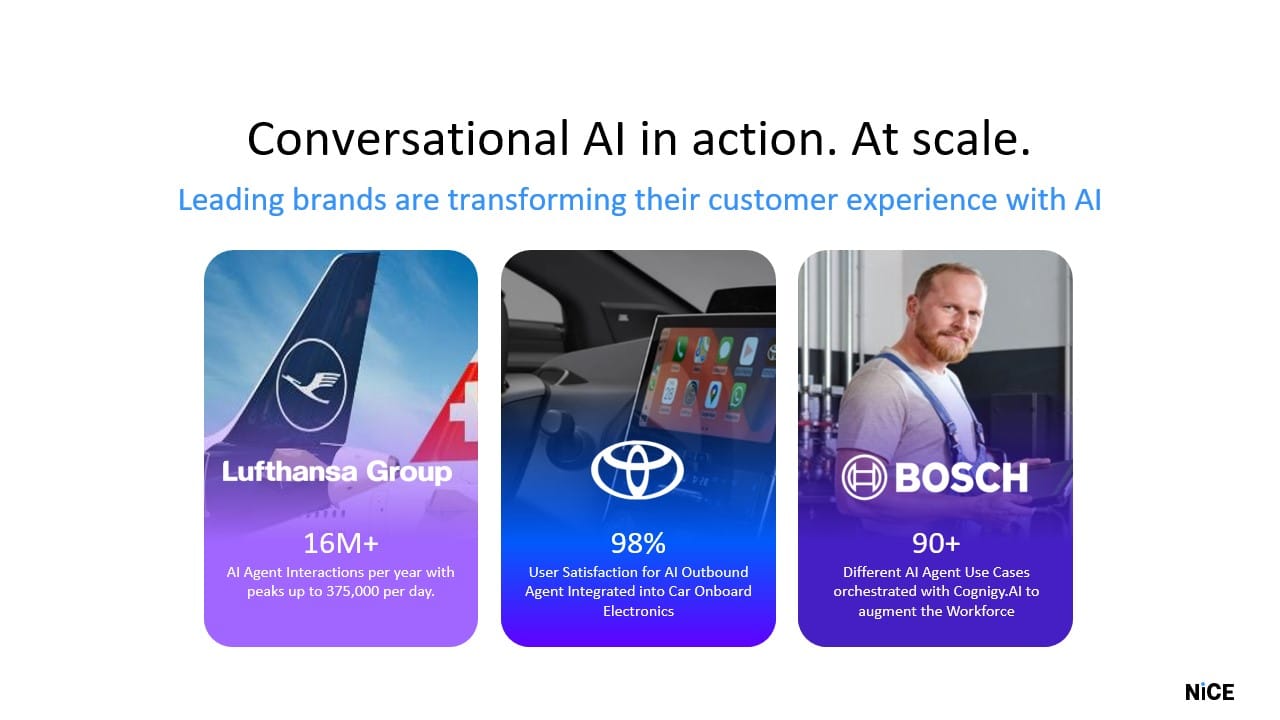
The strategic wins are real. Lufthansa Group, for example, handles more than 16 million AI agent interactions per year across multiple airlines in the group (Lufthansa, Swiss, Austrian, Brussels) with peaks of up to 375,000 concurrent sessions per day. They got there by standardizing on one platform and building reusable templates across business units.
2. How to start deploying agentic AI with the right framework
At Enterprise Connect in 2025, Max left the show and wrote a blog called "The Agentic Curmudgeon." His frustration was specific: every vendor had the word "agentic" plastered across their booth, but when you looked under the hood, there was nothing there. No real tool-calling. No autonomous decision-making. No actual frameworks. Just rebranded chatbots with a new label. His point was that the market was running ahead of the substance of agentic AI, and CX leaders deserved a more honest read.
A year later, his assessment changed. Real agentic frameworks are now standard across leading platforms. The hype caught up to something worth paying attention to.
This is what Max had to say this year: "Just because it's an agentic framework doesn't mean you have to do crazy generative AI customer-facing applications. You've got that infrastructure and tool there when you're ready. You can do simple things, you can do safe things, but you want the agentic framework because this is the structure going forward."
That framing matters. The entry point for agentic AI doesn't have to be full customer-facing autonomy. Routing and orchestration — using AI to qualify an incoming interaction, pull relevant context, and hand it to the right workflow or human agent — is lower risk, faster to production, and genuinely useful. The infrastructure is there when you're ready to go further.
Bosch is a good example of what this looks like in practice. They standardized on one platform early, built a center of excellence, and now run 90+ AI agent use cases across different business units, including deep integrations with warehousing systems that allow the AI to actually resolve issues, not just answer questions. That kind of scale comes from a deliberate architecture decision.
There's also a compounding effect that tends to get overlooked in vendor comparisons. When automation, agent assistance, and engagement orchestration all run on a shared data layer, each interaction — human or AI — makes the system smarter. That loop doesn't exist when you're stitching together point solutions. It's one of the reasons the unified CX AI platform matters more.
3. The contact center workforce is already changing — are you ready?
According to Max, Forrester's research on contact center workforce changes, led by vice president and principal analyst Kate Leggett, projects that frontline agent volume will decrease over the next two to five years while new roles emerge that are more specialized and more expensive. The net financial impact isn't as simple as headcount reduction. The overall shape of the contact center changes.
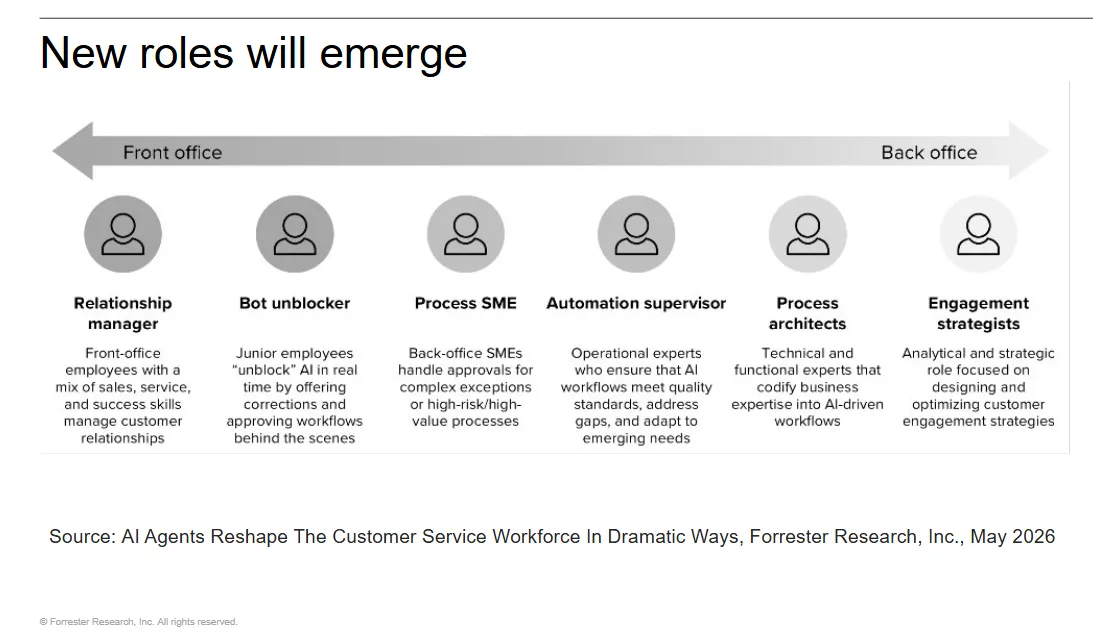
One role Max described that most CX leaders haven't thought through yet is what Forrester is calling the "bot unblocker." When an AI agent hits a situation outside its authority, say, a loan exception that exceeds its approval limit, it pings a human in the background via chat rather than transferring the call. That human never talks to the customer directly. They coach multiple AI conversations simultaneously, asynchronously. As Max put it: "Over time, that role goes down because the bot learns and it doesn't need those sorts of questions anymore."
It's a transitional function, but it needs someone to own it, and most organizations haven't named that person yet.
I worked in a call center myself when I was a student. We knew most of the processes inside out. But there was always a percentage of information shared that wasn't quite accurate. It's only human. What's interesting when you think about the bot unblocker model is that it's creating a new structure for applying human judgment more precisely, at scale.
The organizations handling this transition well are making workforce decisions now, while they still have runway to be deliberate. Reskilling existing agents, redesigning workflows, and defining which situations call for human judgment takes longer than the technology deployment does.
3 agentic AI questions that reveal where you stand
The through line across deployment, agentic AI, and workforce is that the organizations making real progress have stopped treating them as separate workstreams. Data readiness affects how fast you can go agentic. Your agentic framework determines what your workforce actually needs to do. And your workforce strategy shapes what you can realistically automate and when. These things compound in both directions.
Before wrapping up the webinar, I left the audience with three questions that cut to the heart of where most organizations stand right now:
- Do your AI agents share intelligence with your full CX operation?
- Can you see human and AI work in one unified view?
- Is every interaction making your operation smarter?
If the answer to any of those is no, the gap is worth understanding. It's a signal that the foundation needs attention before the next layer gets added.
Watch the full recording of my conversation featuring Forrester’s Max Ball for his unfiltered take on the market, the workforce research, and the full Q&A, including a useful breakdown of how to think about ROI as you scale.
To read the 2026 Forrester Wave™ for Conversational AI Platforms for Customer Service, Forrester’s latest evaluation of the conversational AI vendor market, visit this link.