
Two years ago, most enterprise conversations about conversational AI were about potential. The pilots were running, the demos were compelling, and the roadmaps were ambitious. What was harder to find were production deployments that held up under real operating conditions: high volumes, legacy integrations, multilingual environments, and the governance requirements that come with regulated industries.
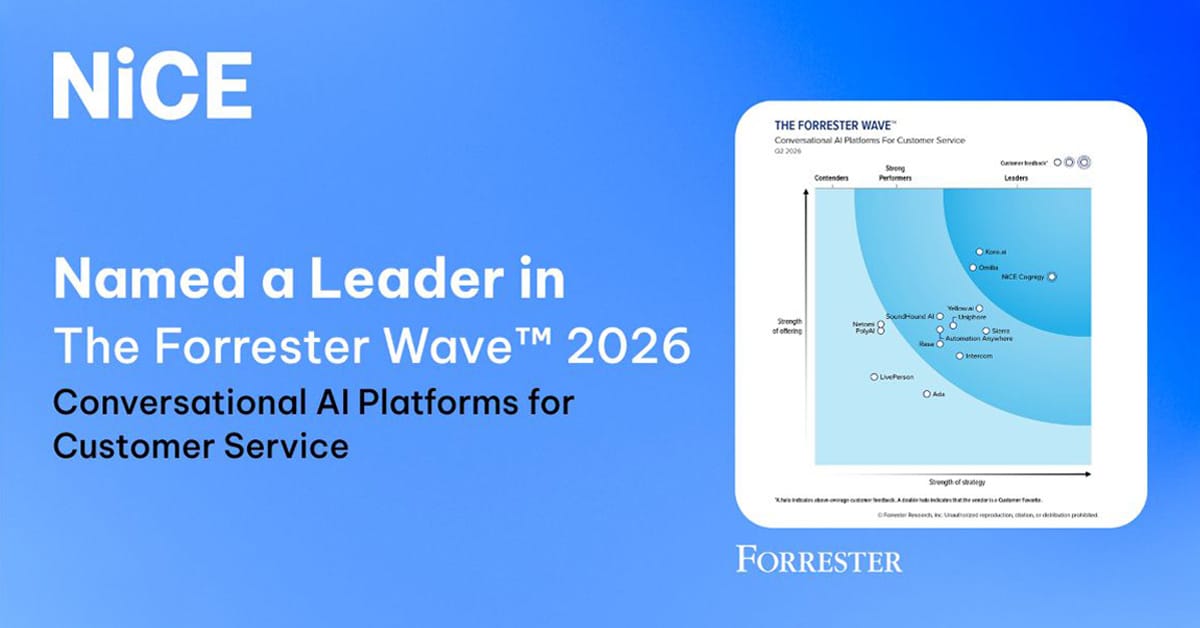
That context matters when reading The Forrester Wave™ for Conversational AI Platforms for Customer Service, Q2 2026. Forrester evaluated 14 vendors not on what their platforms might do, but on what they can demonstrably deliver in enterprise environments today. NiCE Cognigy received the highest combined score of all vendors evaluated, the top score in Strength of Strategy, and the only above-average customer feedback scores in the report.
Here’s what I think the results actually reveal.

The criteria that mattered most weren’t about AI capability; they were about enterprise readiness.
Forrester scored vendors across current offering, strategy, and market presence. But look at what separated the Leaders from the rest in current offering: it wasn’t the sophistication of the underlying models. It wasn't the sophistication of the underlying models. It was everything surrounding them: integration depth, governance tooling, observability, escalation handling, and the maturity of the development environment.
NiCE Cognigy received the highest possible scores in 10 categories, including AI model management, agentic framework, resource orchestration, omnichannel support, and application testing tools. Those aren’t incidental capabilities. They’re the exact things that determine whether a deployment stays healthy six months after go-live.
Forrester’s own assessment was specific: “Cognigy is a good fit for organizations looking to deploy complex, agentic-driven conversational AI applications at scale.” The report called out the agentic framework and development and testing tools specifically: the infrastructure that lets enterprise teams build, iterate, and maintain AI deployments without requiring constant vendor involvement.
Where newer entrants fell short and what that tells buyers
The 2026 Wave included a number of AI-native startups that have entered the market with the pitch that they can leapfrog established platforms. The evaluation results are instructive.
Newer entrants scored below par on the capabilities enterprise customer service depends on daily: legacy system integration, agent escalation handling, reporting, governance, and mature development tooling. These aren’t niche requirements, they’re the foundation of any production deployment that needs to run reliably across regions, teams, and channels over time.
The pattern I see in enterprise deployments reflects this. Getting a bot to work in a controlled environment is the straightforward part. The friction shows up when you need to replicate that across twelve markets with different languages and compliance requirements, connect it to a CRM that wasn’t built with AI in mind, or hand off to a human agent without losing conversation context.
NiCE Cognigy was built around those constraints from the start. Enterprise integration, observability, guardrails, and global scale weren’t added later, they were foundational design decisions. The low-code/no-code development interface reflects the same philosophy: making it possible for enterprise teams to build and extend AI agents without depending on specialist support for every change.

What the customer feedback scores reveal
NiCE Cognigy was the only vendor in the evaluation to receive above-average customer feedback scores. It's one thing to score well on features. It's another to score well with customers who are 18 months into a deployment.
A few examples from our own customers illustrate what that looks like in practice:
Toyota runs 25+ AI Agents across voice and chat. 95% of service bookings are completed entirely by AI, with 98% positive user ratings. For this type of outcome, Toyota relies upon an underlying platform that handles volume, variation, and edge cases reliably, not just in the initial deployment, but consistently over time.
Henkel scaled to 25+ AI Agents across 11 countries and 7 channels, handling 5 million consumer interactions annually from a single governed platform. Multi-region governance isn’t a feature to demo, it’s required to make a full-scale deployment operationally feasible.
Bosch deployed NiCE Cognigy globally across more than 25 countries, building out 90+ AI Agents for both internal and customer-facing operations. Their use cases span from contact center agent assist, where AI retrieves knowledge, suggests responses, and transcribes conversations in real time, to “ROB,” a multilingual HR AI Agent supporting over 90 use cases for 400,000 employees worldwide. The breadth of that deployment, across regions, languages, and functions, is a reasonable proxy for what enterprise-scale actually means in practice.
These aren’t controlled pilots. They’re production environments with real volume, real complexity, and real accountability for business outcomes.

What the Wave scoring tells us about enterprise AI maturity
One of the more useful things about Forrester’s methodology is that it forces a distinction between what a platform can do and what an enterprise can actually operate. Those aren’t the same question, and the gap between them is where most AI projects run into trouble.
The vendors who scored well on current offering are the ones who’ve resolved the second and third-order problems that appear after a successful pilot: how do you maintain consistency across a growing deployment? How do you give compliance teams visibility into what the AI is doing? How do you allow one team to make changes without inadvertently affecting another region’s configuration?
That’s also the strategic direction the acquisition of Cognigy accelerated: not just more capable conversational AI, but an agentic CX platform that connects conversational AI to workflow orchestration, workforce empowerment, and the broader CX data estate. The goal is an operating model where AI, human agents, workflows, and data work together across the full customer experience, not a collection of point solutions that have to be reconciled after the fact.

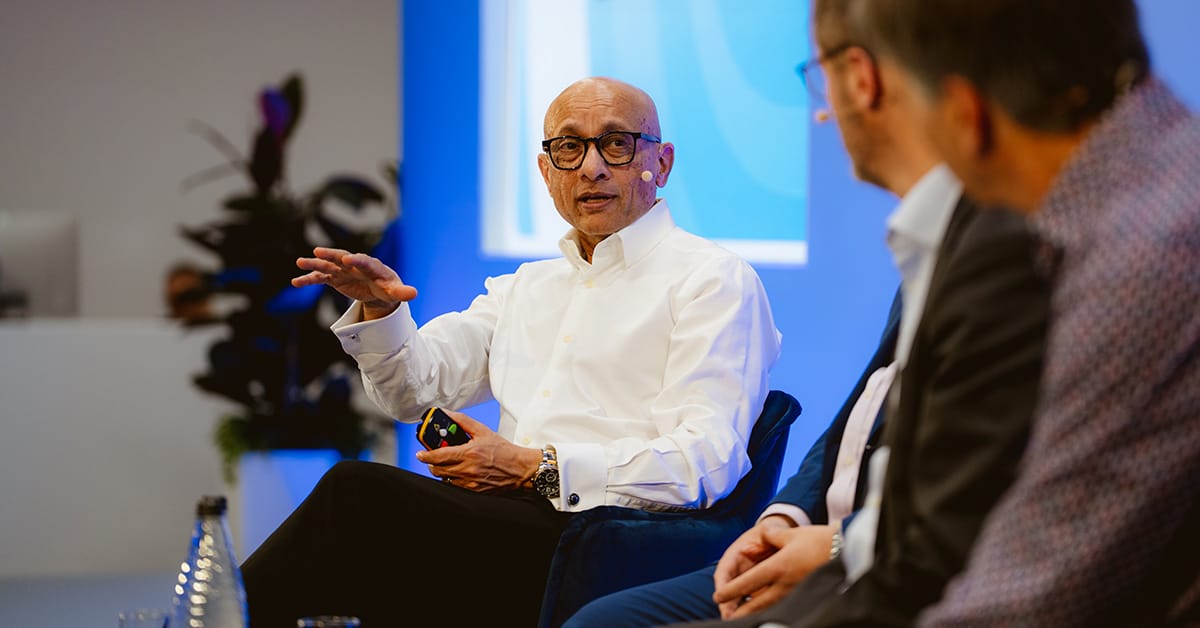
“Conversational AI has moved beyond simple interactions, and it now needs to resolve complete customer journeys. Enterprises are shifting away from fragmented tools toward a single platform that can unify AI, data, and workflows across every touchpoint. We believe this recognition from Forrester reinforces NiCE as a leader in helping organizations operationalize AI at scale and turn every interaction into a measurable outcome.”
General Manager and Chief AI Officer,
NiCE Cognigy
What this recognition means in context
NiCE is now the only vendor recognized as a Leader in both the CCaaS and Conversational AI Forrester Waves™. That dual recognition reflects something specific: the ability to operate across the full scope of enterprise customer service, not just one layer of it.
The 2026 Wave is a useful data point for organizations trying to make sense of a market that has become genuinely complex. The number of vendors claiming AI leadership has grown considerably, and the differences between them aren’t always easy to evaluate from marketing materials alone. Forrester’s framework, particularly the weight given to operational capabilities and actual customer outcomes, cuts through some of that noise.
The next phase of AI in customer service will be defined less by model capability and more by the ability to operate AI safely, measurably, and at scale across real customer journeys. That’s the problem we’ve been working on and what our customers are already demonstrating in production.
Access your copy of The Forrester Wave™ report and see the full scorecard.
Forrester does not endorse any company, product, brand, or service included in its research publications and does not advise any person to select the products or services of any company or brand based on the ratings included in such publications. Information is based on the best available resources. Opinions reflect judgment at the time and are subject to change. This report is part of a broader collection of Forrester resources, including interactive models, frameworks, tools, data, and access to analyst guidance. For more information, read about Forrester's objectivity here.