

Average handle time (AHT) or repeat contact doesn’t spike because leaders lack data. It spikes because the organization doesn’t have fast enough answers about what’s changed in customer conversations and what to do next.
Most CX teams already capture plenty of data from recordings, transcripts, QA forms, digital journey logs, customer satisfaction (CSAT), and agent notes. The issue is operational: those interactions rarely translate into decisions at the speed the contact center runs. By the time the “root cause” is revealed and socialized across CX leadership, supervisors, QA, operations, and digital teams, the damage is already visible in rising contact volume, repeat contacts, and negative customer sentiment.
The gap between what customers expect and what the business can deliver is growing. Customer experience is now a primary differentiator—80% of customers say the experience a company provides is as important as its products and services. And even with more data than ever, leaders admit they can’t consistently turn it into outcomes: Aberdeen found that 73% of business leaders are dissatisfied with their ability to use customer and operational data to meet CX goals, citing a lack of the right technologies.
The organizations closing that gap aren’t “doing more analytics.” They have a faster operating loop where interaction data analysis is rapidly transformed into actionable insights for the teams who run CX day to day.
Fifth Third Bank is a clear example: by using NiCE Interaction Analytics to capture and analyze 100% of interactions, the bank improved customer sentiment by 35% over 18 months with a shared, scalable view of what was happening on every call, not just a survey sample or a QA subset.
AI interaction analytics uses AI to analyze customer and agent conversations across voice, chat, and digital channels. It turns unstructured interaction data, such as recordings, transcripts, agent notes, and journey logs, into organized insights leaders can use to improve CX performance.
How AI interaction analytics becomes operational in practice
High-performing teams operationalize AI interaction analytics as a workflow—not a report:
- Capture every interaction across voice and digital channels (with consistent metadata).
- Structure signals from customer intents, agent actions, and interaction outcomes from unstructured conversations.
- Prioritize what changed and what matters most (volume, impact on AHT/CSAT/sentiment, trend velocity).
- Route action to the right owners:
- Supervisors: targeted coaching on specific behaviors and call types
- QA: calibration focus areas and evaluation consistency
- Operations: process fixes, policy clarifications, escalation tuning
- Digital teams: self-service containment gaps and journey friction
- Knowledge teams: article gaps, outdated guidance, “where agents get stuck”
- Measure impact and close the loop (did the action move AHT, sentiment, repeat contacts, or compliance outcomes?)
To make the AI analysis trustworthy, leaders also need visibility into what the system looked at, why it made a recommendation, and how humans control outcomes, including confidence handling, auditability, and override paths.
When AHT rises, AI interaction analytics should pinpoint why in operational terms: which intents surged, which steps expanded handle time, which behaviors correlate with longer calls, and where knowledge or process gaps are forcing workarounds. Then it should translate that into a short list of actions—agent coaching targets, knowledge updates, or process fixes—each tied to evidence in the interaction data and reviewed by the teams accountable for the outcome.

Redefining CX with AI customer interaction insights
CX teams don’t need more static dashboards. They need faster, more defensible operational decisions built directly from customer and agent conversations. Today, CX programs using AI-powered interaction analytics look very different. Organizations can understand every interaction across voice, chat, and digital channels in one connected AI platform. Instead of piecing together isolated touchpoints, they analyze the full customer journey in context.
This shift is changing how teams work and how decisions get made. It unlocks faster answers, clearer priorities, and more data-backed decisions across the business.
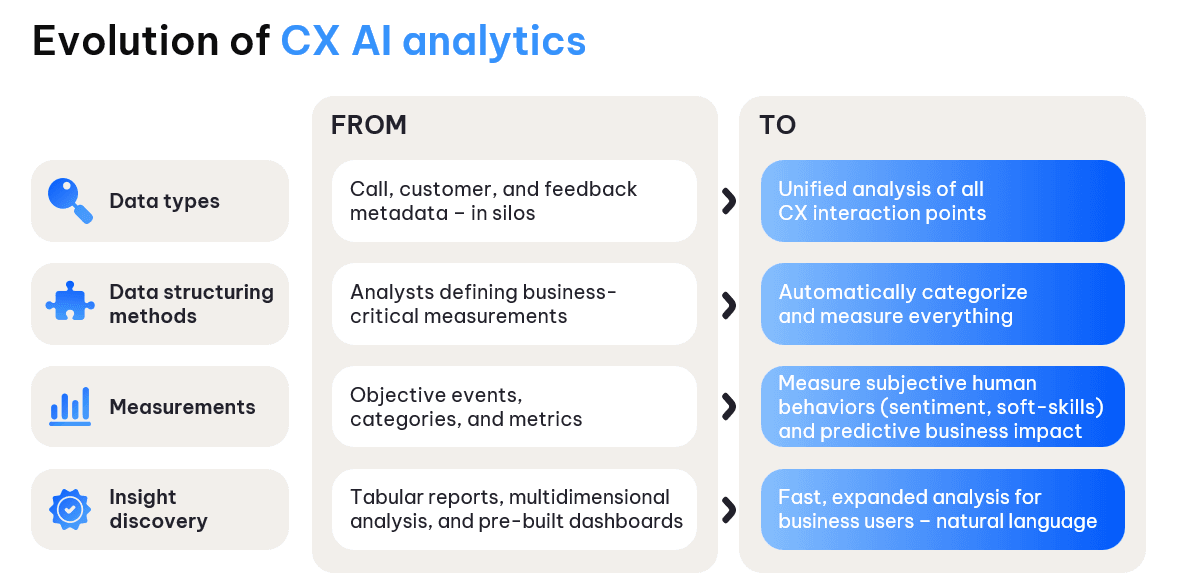
Contact centers have more data than ever. Every interaction across voice and digital channels adds to it. AI interaction analytics bring structure to unstructured interaction data automatically. It groups similar customer intents and agent activities, making patterns easy to see and act on.
Teams can also tailor these models to reflect their business, without depending on technical teams for every adjustment. The result is a more comprehensive analysis with a faster path from data to insight and from insight to action.

Measuring agent behaviors with consistency
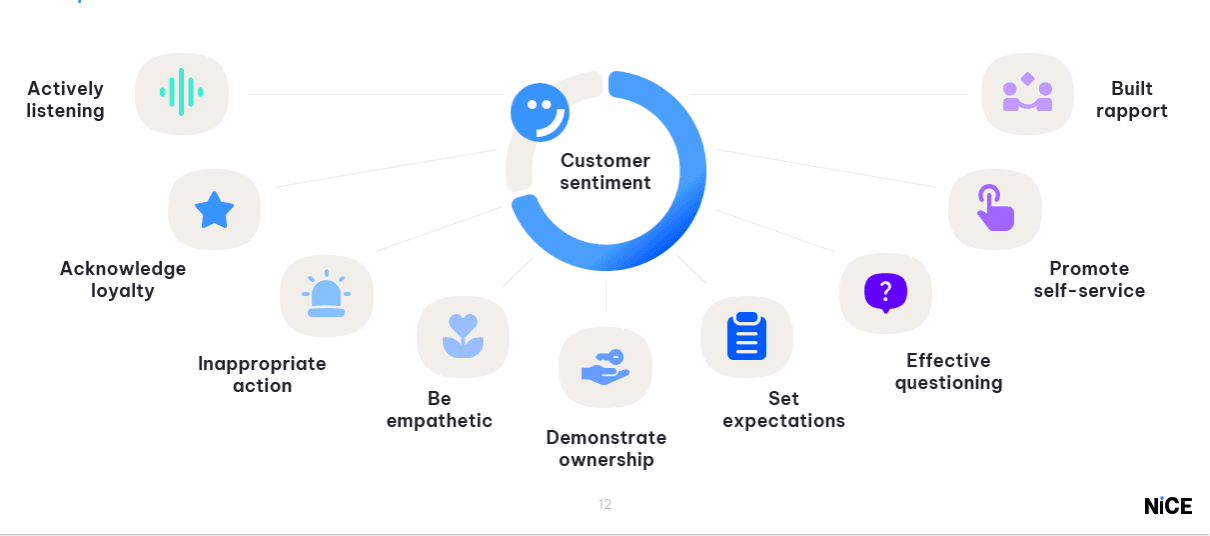
One of the clearest examples is agent performance. When interaction data is structured consistently, teams can move beyond subjective evaluations and understand which behaviors are improving customer outcomes.
But these behaviors have always been hard to measure. They are often seen as subjective, which leads to inconsistency and bias in quality evaluations. As a result, many teams struggle to assess them at scale.
Now, that is changing. Organizations can evaluate these behaviors consistently across every interaction, with a clear and objective view of performance. This influences many areas of contact center performance such as AHT, sentiment, CSAT, repeat contacts, coaching effectiveness, and root-cause resolution. For example, Open Network Exchange (ONE) measures their agents on nine soft skill behaviors and experienced a 20% reduction in escalations due to personalized coaching. They also saved over 23,000 hours annually across the organization on coaching preparation.
How to turn interaction data into action
Once interaction data is structured and analyzed, the real value comes from what you do next. An actionable AI framework delivers proactive improvement opportunities so teams can quickly identify where to improve, why it matters and what to do next with evidence behind each recommendation.
Instead of digging through reports, conversational AI lets teams ask questions and get answers instantly ask questions and get answers, insights are provided instantly.
This changes how AI-driven analytics works in practice:
- Fast — uncover trends, anomalies, and root causes in moments, not days
- Accessible — put insights into the hands of business users across the organization
- Intelligent — understand what is driving outcomes and trigger guided workflows
Predicting business impact with confidence
Improving performance starts with a clear goal. Take average handle time as an example. Leaders want to know where to focus and what will make the biggest difference to this metric.
AI interaction analytics prioritizes the issues most affecting AHT and route them into coaching or process improvement. Using structured interaction data, it also breaks down those coaching and real-time knowledge opportunities by topic and conversation. With that visibility, leaders can prioritize improvement efforts based on the recommendations expected to deliver the strongest performance gains.
Delivering measurable CX outcomes
As enterprise AI adoption accelerates, analytics is shifting from static reporting to conversational, action-oriented workflows. Leaders no longer want to search through dashboards. They want to ask better questions, get defensible answers, and move directly from insight to execution. According to McKinsey, 88% of enterprises have adopted AI with a growing majority investing in conversational AI and agentic systems to automate interactions and decisioning. That shift is also transforming how teams work with analytics. Instead of building reports and dashboards, they can ask simple questions and get clear answers:
- “What is driving the change in AHT?”
- “Where are the biggest problem areas?”
- “Is CSAT improving, and why?”
AI interaction analytics is moving from static reporting to dynamic, conversational experiences that can both inform and take action. This closes the gap between insight and execution, helping teams move faster in three key areas:
- Analyze — understand what happened and why, with full business context
- Recommend — get a clear, step-by-step plan backed by evidence for full transparency
- Act — take action and generate outputs like reports or executive summaries automatically

The future of CX AI-driven analytics is here
High customer experience expectations are compounding contact center challenges, and organizations relying on outdated approaches will see the gap between insight and action continue to grow. One major driver of change is the rapid adoption of interaction intelligence, supported by the emergence of prebuilt models that can analyze customer and agent interactions quickly and intelligently.
These capabilities along with conversational AI are making interaction analytics more accessible to business users at all levels, enabling broader influence on customer experience outcomes and stronger agent accountability. At the same time, maintaining high data quality and strong internal governance is essential to ensure AI systems provide accurate insights, avoid misleading customers, and support trusted, effective agent coaching.
AI interaction analytics also establishes a new foundation for measuring key metrics like AHT and CSAT, along with deeper insights into customer and agent behavior across 100% of interactions. This goes beyond improved visibility. It drives better performance, faster resolutions, more effective agents, and a stronger overall customer experience.
NiCE Interaction Analytics transforms every conversation into actionable intelligence with out-of-the-box omnichannel analytics for fast, accurate AI insights at scale across multiple languages.
Learn more about the value of making AI interaction analytics central to your CX strategy in the white paper, Redefining CX with AI-Powered Analytics.