

A service operation can look stable and still be falling behind. Supervisors see it first: live queues appear calm while case work, backlog, and follow-up tasks keep building underneath. That is why workforce planning has to model more than contacts. When staffing reflects how work actually forms, planners make better decisions, supervisors recover time to lead, and agents work in a steadier rhythm.
That shift matters because service demand now moves across channels, workflows, and time. When forecasts fall out of sync with real demand, the impact shows up quickly: overtime rises, backlog ages, service levels wobble, and supervisors spend more time rebalancing work than leading teams. Planners lose confidence in the plan. Agents feel the instability in a workday that becomes fragmented instead of manageable. Forecast accuracy now shapes labor cost, service consistency, and manager effectiveness.
The pattern is easy to recognize. A billing question may start in chat, create a CRM case, trigger a billing review task, reopen in email, and escalate to voice the next morning. One contact becomes a workflow. One workflow becomes staffing demand.
Intermedia research shows that 90% of customers expect seamless interactions across service channels, even as the work behind those interactions spreads across systems and teams.
Forecast used to reflect contacts. Now they have to reflect workload.
Traditional workforce management was built around contact events. That model worked when one issue was resolved in one interaction, in one channel, inside a fairly stable interval. Today, digital service expands the shape of work. Conversations now pause, resume, reopen, and move across teams. Cases create tasks. Tasks create delays. Delays create follow-up contacts.
16% of contact center conversations originate from back-office issues (Aberdeen Strategy & Research)
That changes the planning equation. A forecast can look accurate at the front door while missing the labor required to finish the work. That gap affects business performance in predictable ways: schedules fit live demand while hidden work accumulates, backlog pressure spills into tomorrow, overtime rises to cover exceptions, and customer effort grows as issues take longer to resolve.
Aberdeen Strategy & Research reported that 16% of contact center conversations originate from back-office issues. That is a useful signal for CX leaders: once service work spreads into case steps, approvals, and handoffs, contact volume captures only the front edge of the labor model. Contact center forecasting now has to account for the work created after the interaction begins.
Modern service demand unfolds through asynchronous conversations, case reopenings, ticket backlogs, multi-step workflows, and cross-team handoffs. Much of that work lives inside the CRM, which makes workforce planning far more complex than predicting channel volume alone.
Once service work spreads into case steps, approvals, and handoffs, contact volume alone no longer describes the labor model.

Digital service spreads work across queues and time
Customers move through service the same way they handle the rest of their digital lives: they choose the next step that feels fastest in the moment. A conversation may begin in chat, continue in email, and escalate to voice when urgency rises. Each movement creates new workload, new timing, and often a new queue.
This is where business value gets lost when planning stays channel-specific. A leader may see stable voice demand and still miss the growing effort tied to case updates, reopenings, and delayed responses in messaging or email. The result is familiar: service looks manageable in one view while total workload expands somewhere else.
The pressure spreads beyond forecasting. Channel-based KPIs can pull teams in different directions, even when they are all contributing to the same customer outcome. Forecasting works best when it follows the journey rather than the queue. That makes it harder to balance service levels, productivity, and employee experience across one journey.
The operating challenge is fragmentation. When the same issue generates work across multiple queues, time horizons, and teams, traditional forecasts lose their ability to represent true demand. Because the journey moves, demand moves with it. Forecasting has to account for how work shifts, how long it remains active, and when it is most likely to resurface.
Asynchronous service changes the rhythm of staffing
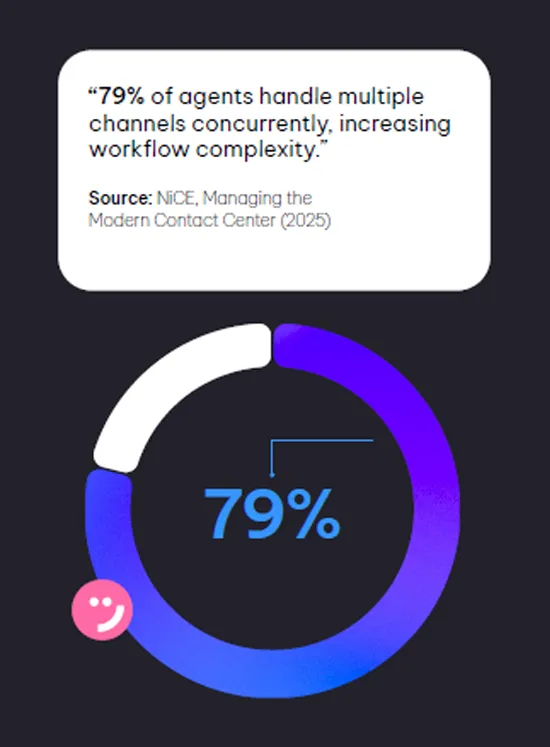
Messaging, email, and in-app threads are now core service channels. They also create a different operating cadence. Customers respond when it suits them. Conversations stretch across hours or days. Backlog builds quietly while live channels appear calm.
Agents manage multiple threads at once, which means capacity now depends on concurrency, backlog load, case complexity, and response timing. A quiet interval can still be generating tomorrow’s staffing problem. That is why modern contact center forecasting has to capture the work that remains in motion: what is still open, what is aging, what tends to reopen, and where delayed responses will spill into other queues.
Better forecasting creates business value because it gives leaders time to act earlier. Teams can rebalance skills before backlog compounds, adjust schedules before service levels slip, and protect agent focus before work becomes fragmented across too many priorities.
CRM workflows now shape service demand
The most important shift in service operations is where work gets resolved. Tickets, subtasks, approvals, escalations, account updates, exception handling, and handoffs often determine how much labor a customer issue really creates. That work decides resolution. It also shapes cost to serve.
Inside the CRM, one inquiry can become several tasks. Cases pass through multiple teams. Work resurfaces when customers reply or when new steps appear. This is why workforce planning now has to include the workflow behind the interaction alongside the interaction itself.
This is why back-office task management now sits inside the workforce planning conversation. Traditional metrics such as AHT and contacts per hour describe the interaction. The workflow behind resolution requires additional visibility into case steps, handoff effort, backlog pressure, and time-to-next-step. When leaders plan around contact metrics alone, they staff only part of the work.
When planning relies on traditional metrics like AHT and contacts per hour alone, leaders are staffing based on only part of the work. As a result, forecasts often miss:
- Time spent on case steps
- Subtask volume
- Handoff effort
- The pressure of aging backlogs
When forecasts do not include CRM workload, staffing becomes reactive. Overtime rises. Backlogs linger. Service performance becomes harder to stabilize.
One in five customer conversations is tied to back-office issues, reinforcing that a significant share of service demand originates from work that happens after the initial interaction, according to Aberdeen.
Front-office and back-office work are converging - and WFM must follow
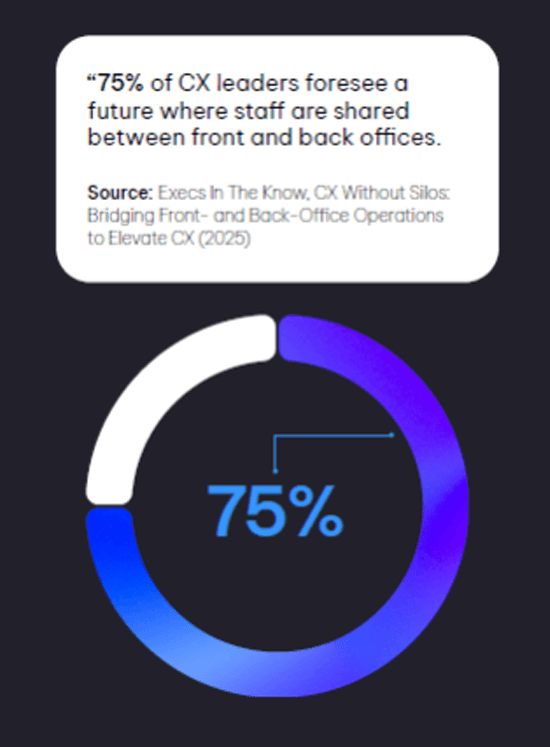
Front-office and back-office work now operate inside the same customer journey. Customers experience one path to resolution, even when the work behind it moves across service teams, operations teams, and specialists.
Tasks now resurface in live customer conversations, triggering follow-ups, case reopenings, and escalations that add volume and variability to service demand. That makes workforce planning a broader operating model issue. Leaders now have to support live customer demand, follow-up work, exception handling, billing and account updates, fulfillment issues, and escalation paths inside one planning logic.
This is where AI workforce management becomes useful. Its value starts with visibility. It should show which inputs it uses, including interaction history, case creation, reopen patterns, backlog aging, handoff frequency, and workflow velocity. It should show what it predicts, including journey-level workload, spillover risk, and staffing needs by skill and time horizon. It should also keep planners in control with confidence indicators, review steps, overrides, and auditability.
When those elements are visible, AI supports planning in a way executives can defend internally. It helps translate fragmented activity into a clearer demand picture and a more credible staffing plan.

What better forecasting changes in the business
Forecasting feels harder because the work itself behaves differently. Demand is shaped by irregular async volumes, work hidden inside the CRM, multi-step cases that resolve over days, and digital peaks that fan out across channels and teams.
Teams are responding to a real structural change in service demand. The challenge is not planning discipline. The challenge is that the old unit of measurement no longer captures the full workload.
Many organizations still plan with disconnected views - channels in one system, case work in another, and back-office effort in spreadsheets. That fragmentation slows decisions and hides the true cost of demand.
A stronger planning approach connects interactions, CRM workflows, and backlog into one operating view so forecasting, scheduling, and intraday management reflect how work actually moves. Leaders can then respond earlier, allocate skills more precisely, and manage the day with less recovery work.
That changes business performance in concrete ways: service becomes steadier, staffing decisions become more credible, supervisors spend less time firefighting, and agents work in a more manageable rhythm. The value shows up in labor efficiency, backlog control, and a more consistent path to resolution for customers.
For example, organizations using AI-driven workforce management have reduced monthly overtime by up to 38%, demonstrating the financial impact of more accurate, workload-aware forecasting.
What modern workforce planning requires: AI forecasting + CRM-native visibility
In many organizations, planning still mirrors the org chart rather than the customer journey. Voice, chat, email, and back-office work are modeled separately, even though customers experience one continuous path.
A modern planning approach brings those views together so leaders can plan against one workload picture instead of a set of disconnected queues. That means one connected dataset, visibility across channels and workflows, and forecasts that account for both real-time demand and backlog in motion.
AI becomes valuable when it turns fragmented activity into a usable planning signal. By connecting interaction history, case creation, reopen patterns, backlog aging, handoff frequency, workflow velocity, case complexity, and channel switching, it helps planners see the full workload a journey creates.
That value should be visible in the model itself: leaders should be able to see which inputs it uses, what it predicts, where confidence is high or low, and how planners can review, override, and audit decisions.
When AI is applied this way, the output is practical: journey-level workload forecasts, spillover risk, and staffing needs by skill, queue, and time horizon. The operational payoff is clearer planning, smarter schedule mix across real-time and async work, better skill allocation, and faster intraday decisions as demand shifts.

Forecasting can catch up when it follows the work
Customers will keep moving between channels. Conversations will stretch across time, and work will flow through tickets, tasks, and workflows. That is now the operating environment for modern CX leaders.
The organizations that succeed will be the ones whose workforce planning reflects how work actually moves across the full customer journey. They will see the workload earlier, allocate labor more precisely, and manage service with more confidence.
When planning reflects the full workload, service becomes steadier, decisions become clearer, and teams spend less time reacting to avoidable surprises. Agents get a more manageable day. Supervisors get more room to lead. Customers get more consistent progress toward resolution.
Digital service changed where work happens and how demand builds behind the scenes. The next step for workforce planning is to catch up to that reality.
Want to go deeper? Download the whitepaper Where Digital Work Finds Its Rhythm to see how teams plan for CRM work and asynchronous demand, and how NiCE unifies forecasting, scheduling, and intraday management in one workflow.