

A field technician in front of a complex energy system doesn’t need another channel or a generic answer. They need the right guidance, in the right language, precise enough to resolve the issue safely. A homeowner waiting for power to be restored doesn’t care whether the answer comes from a bot, an agent, or a knowledge article. They care about the outcome.
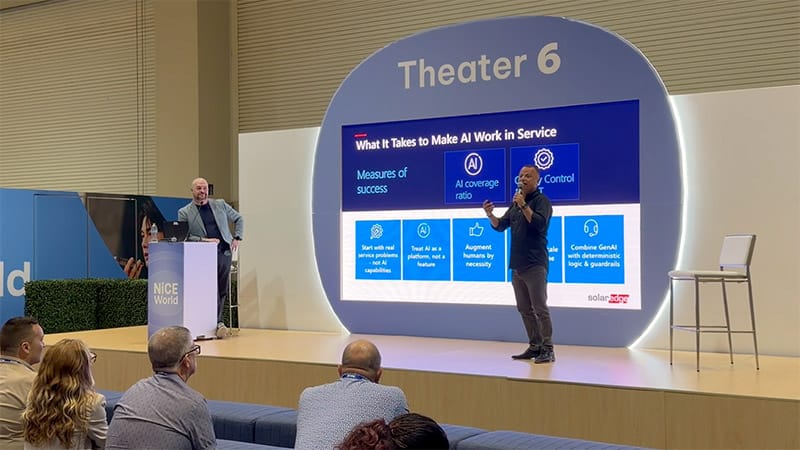
For SolarEdge, a global leader in smart energy production, storage, and management, service excellence is a business-critical capability. At NiCE World 2026 in Orlando, SolarEdge VP of Global Service Yaniv Avni presented the company’s approach to AI-first CX.
SolarEdge is doing more than experimenting with AI at the edge of the business. It’s applying AI where service pressure, technical complexity, and customer expectations converge. That distinction matters. Many organizations still treat AI as a set of discrete capabilities: a chatbot here, an agent-assist tool there, an analytics layer somewhere else. SolarEdge’s strategy points to a more mature model. The session’s core message: AI must be treated as a platform, not a feature. This is why Avni and his team chose NiCE CXone.
Service excellence starts with real operational pressure
SolarEdge’s service environment spans residential, commercial, utility, manufacturing, and service operations across a global energy ecosystem. Its customers include professional installers, distributors, and home or site owners, each with different levels of technical expertise and urgency.
SolarEdge’s business is complex and scale is top of mind:
- 91,000+ installer partners
- 5M+ monitored systems
- 600+ support experts
- 17 global call centers
- 11 supported chat and phone languages
- 145 countries
- 5M+ service contacts a year
They also highlighted an average response time of under three minutes and a global CSAT score of 4.5.
That complexity creates a difficult service equation. The service model has to recognize the customer, understand the exact issue, route the work, surface the most accurate knowledge, and escalate safely when in-person human expertise is required.
SolarEdge’s strategy is to shift from reactive support to autonomous, controlled service. The goal isn’t to remove humans, it’s to redesign the operating model so AI handles scale, speed, and repeatability, while humans focus on complexity, judgment, and edge cases.
In high-stakes service environments, autonomy without control creates risk; control without autonomy limits scale. SolarEdge’s framework brings both together through this controlled AI foundation: generative AI for flexibility and natural interaction, deterministic AI for structured decisions, and guardrails for consistency, trust, and safety.
As Avni said, AI must be humanized enough for adoption, deterministic enough for trust, and governed enough for enterprise scale.
AI as the operating layer
One of the strongest messages from the session was that SolarEdge did not begin with AI capabilities. It started with service problems: massive volumes of specialized inquiries, the need for surgical troubleshooting knowledge, and consistency across global regions.
This is where the platform approach becomes strategic. SolarEdge and NiCE share the same view: AI value compounds when data, knowledge, workflows, agents, and analytics learn from the same operating system. It fails when each point solution optimizes only a narrow slice of the journey.
That gap is showing up industry-wide. McKinsey's 2025 State of AI research found only 23% of organizations have moved an agentic AI system from pilot to full production scale in even one business function. SolarEdge's model shows what closing that gap looks like when AI runs as infrastructure rather than a collection of separate tools.
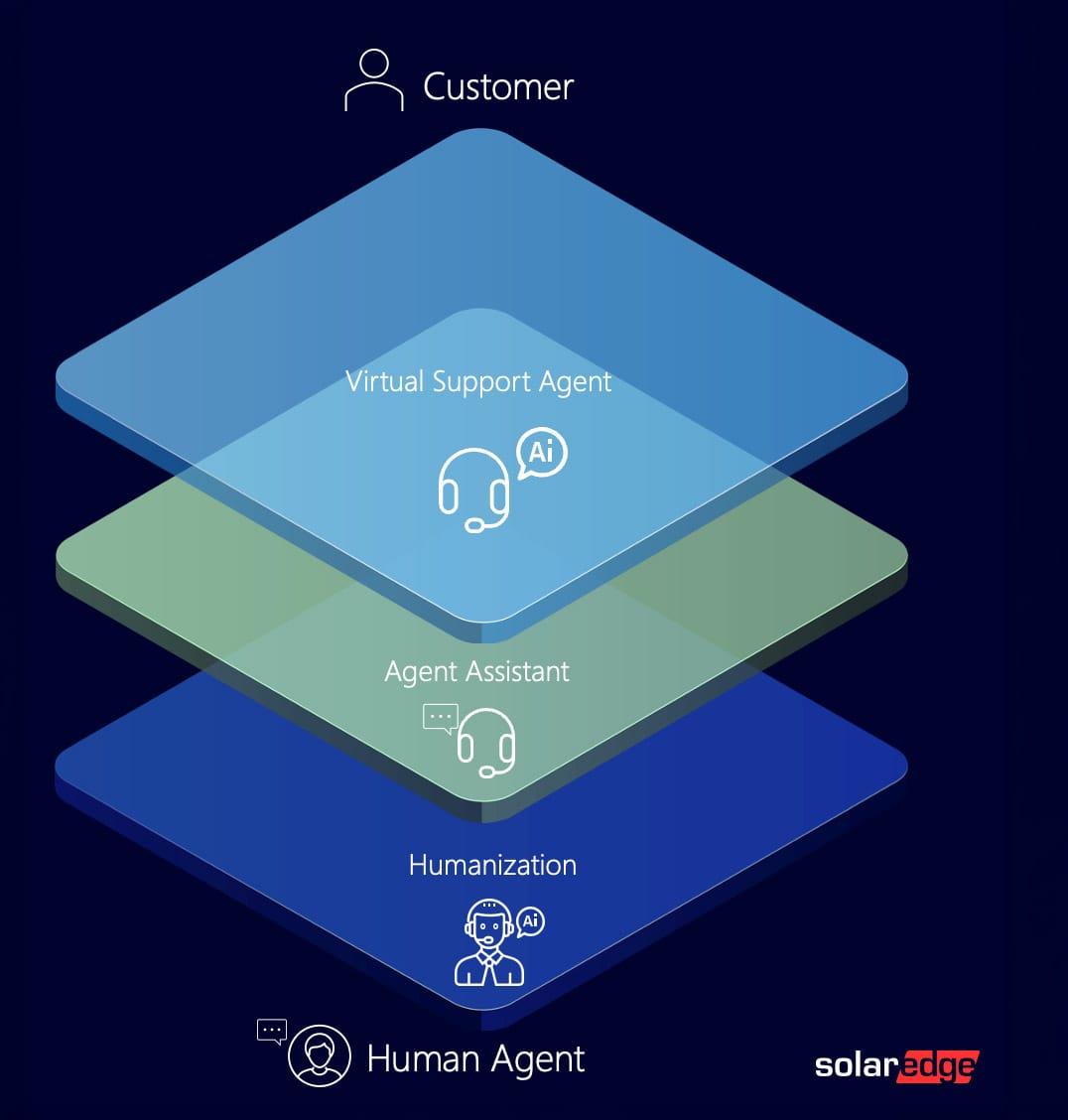
A chatbot can answer questions. A platform connects intent, knowledge, routing, agent guidance, analytics, quality, workforce management, and workflow automation into one shared service intelligence layer. For Avni, that means AI is not only greeting the customer but also seeing context, understanding intent, determining whether an inquiry can be resolved autonomously, assisting the agent when needed, and feeding insights back into the operation.
The answer is a multi-layer AI design, with a digital front door using NiCE AI Agents for Self Service to handle initial inquiries, agent empowerment through Copilot for Agent Assist and Interaction Analytics Advanced, and connected intelligence through Topic AI to spot global interaction trends before they become operational issues.
Making AI visible: What it sees, why it acts, how it adapts
Leveraging CXone AI capabilities, the SolarEdge model sees customer type, language, support need, intent, topic, context, and likely resolution path. In agent-assisted scenarios, it also helps preserve conversation context and reduce the handoffs and context-switching that slow down agents.
NiCE Copilot for Agents reflects the same principle by proactively delivering knowledge and next-best steps, bringing data and tools together, and adapting to workflows with configurable support. In practice, that transforms AI from a passive suggestion engine into an active layer of service guidance.
AI acts when speed, repeatability, and confidence are required: triaging incoming needs, supporting real-time troubleshooting, recommending knowledge, summarizing conversations, and keeping agents focused on the customer instead of searching across systems.
The NiCE AI platform adapts through connected intelligence. Topic AI, for example, classifies and quantifies interaction intents, events, and outcomes, then monitors topic frequency and correlates insights with KPIs. That’s how service organizations move from reporting what happened to detecting what’s changing. A rise in a specific troubleshooting topic, product issue, language-region pattern, or repeated handoff can become visible before it turns into a larger service event. AI is not only resolving interactions; it is sensing the health of the operation.
The takeaway for service leaders
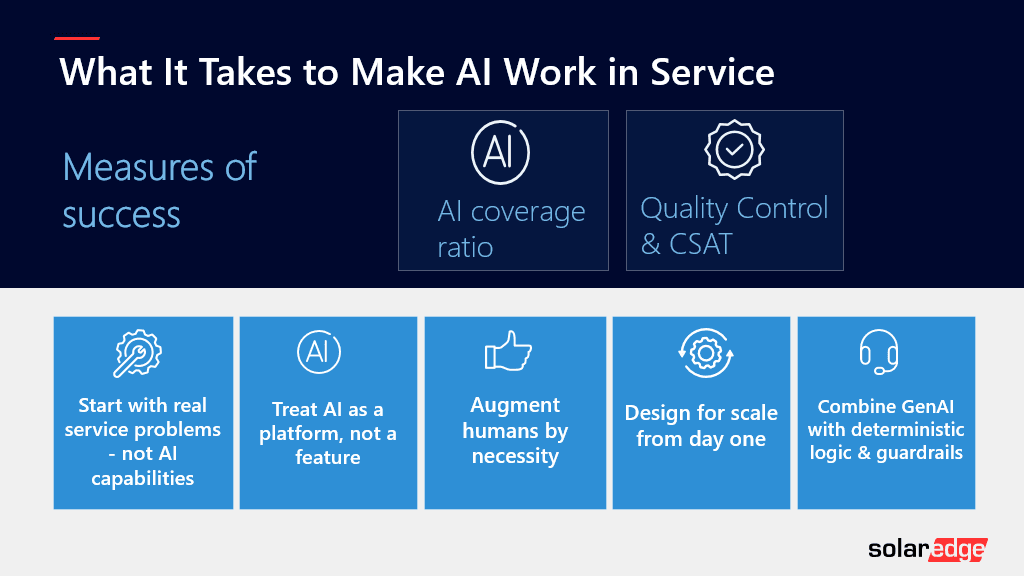
The lesson for enterprise leaders is straightforward: start with the service problem, not the AI capability.
- Build for global consistency, not isolated automation
- Make AI visible in what it sees, why it acts, and how it adapts
- Keep humans where judgment matters most
- Run AI through a unified CX platform
This is how AI becomes a growth engine: improving experience, reducing effort, increasing consistency, and giving the enterprise the operational clarity to keep improving.
SolarEdge’s presentation shows what happens when AI is treated with this level of discipline. The future of service excellence will not be won by the company with the most AI features. It will be won by the company that orchestrates AI, people, workflows, and intelligence.