

AI Voice Agent Use Cases: Where Voice Automation Pays Off
- The Use-Case Map: What Voice Agents Do Today
- Industry Applications
- Prioritizing Your Use Cases: Value vs. Feasibility
- Use Cases That Deserve Extra Care
- From Use Case to Business Case: Sizing the Opportunity
- Sequencing a Multi-Year Use-Case Roadmap
- Anti-Patterns: Use Cases That Look Good and Aren't
- Voice as Part of an Omnichannel Use-Case Strategy
- Find Your Highest-Value Use Cases
- Continue Exploring AI Voice Agents
AI voice agent use cases are the specific call types and calling programs enterprises automate with AI voice agents — and choosing them well matters more than any other program decision. The same platform that shines on order status can disappoint on complex disputes; the difference is fit. This guide catalogs the proven use cases across functions and industries, then gives you a prioritization framework for building your own roadmap.
The Use-Case Map: What Voice Agents Do Today
Six families of applications across the customer lifecycle.
Answering and intelligent routing
The universal starting point: an open-ended front door that answers instantly, identifies and verifies the caller, captures intent in natural language, and either resolves or routes with context. Even before end-to-end automation, this use case eliminates menu friction and misroutes — the migration logic is detailed in AI voice agents vs. IVR.
Account, billing, andpayments
Balance inquiries, bill explanations ("why is my bill higher this month?"), payment processing through secure flows, payment arrangements, plan and subscription changes, and dispute intake. These intents are high-volume and system-executable — ideal automation targets when billing integrations are in place.
Orders, logistics, and returns
Order status, delivery scheduling and rescheduling, address changes, returns initiation, and stock or store inquiries. Retail and e-commerce contact volumes concentrate heavily here, with sharp seasonal peaks that voice agents absorb without hiring cycles.
Scheduling and appointments
Booking, rescheduling, cancellations, confirmations, and waitlist management for healthcare visits, field service, installations, and professional services. Paired with outbound reminders, this use case attacks no-show rates from both directions.
Support and troubleshooting
Guided diagnostics for common issues, outage and service-status information, how-to help grounded in approved knowledge, and warranty or coverage checks. Success depends on knowledge quality and honest escalation when hands-on help is needed.
Proactive outbound programs
Appointment and payment reminders, delivery confirmations, service notifications, surveys, renewals, and lead follow-up — run at scale with consent and compliance guardrails. Outbound is distinct enough in design and regulation to merit its own guide: AI voice agents for outbound calls.
Industry Applications
Every industry maps these families onto its own vocabulary and regulatory context. A sampling of where adoption concentrates:
Financial services
Balance inquiries, card controls, fraud alerts, and secure verification.
Healthcare
Appointment management, prescription refills, and pre-visit intake.
Retail & e-commerce
Order status, returns, store information, and loyalty support.
Utilities & telecom
Outage updates, meter readings, plan changes, and technical triage.
Travel & hospitality
Bookings, changes, disruptions, and itinerary support at peak scale.
Insurance
First notice of loss intake, claim status, and policy servicing.
Industry applications. Where voice agents deliver outsized impact by sector.
A concrete production example: energy provider Essent uses a NiCE Cognigy voice AI agent to automatically collect customer meter readings by phone four times a year — a perfectly bounded, high-volume, system-executable intent — alongside intelligent routing across seventeen mission-based teams.
Prioritizing Your Use Cases: Value vs. Feasibility
Score every candidate intent on two axes. Business value combines call volume, handling cost, revenue or retention impact, and experience pain (queues, abandonment, repeat calls). Automation feasibility combines how well-defined the intent is, whether the resolving systems are integrable, policy and risk constraints, and conversational complexity. Plotting candidates yields a natural roadmap.
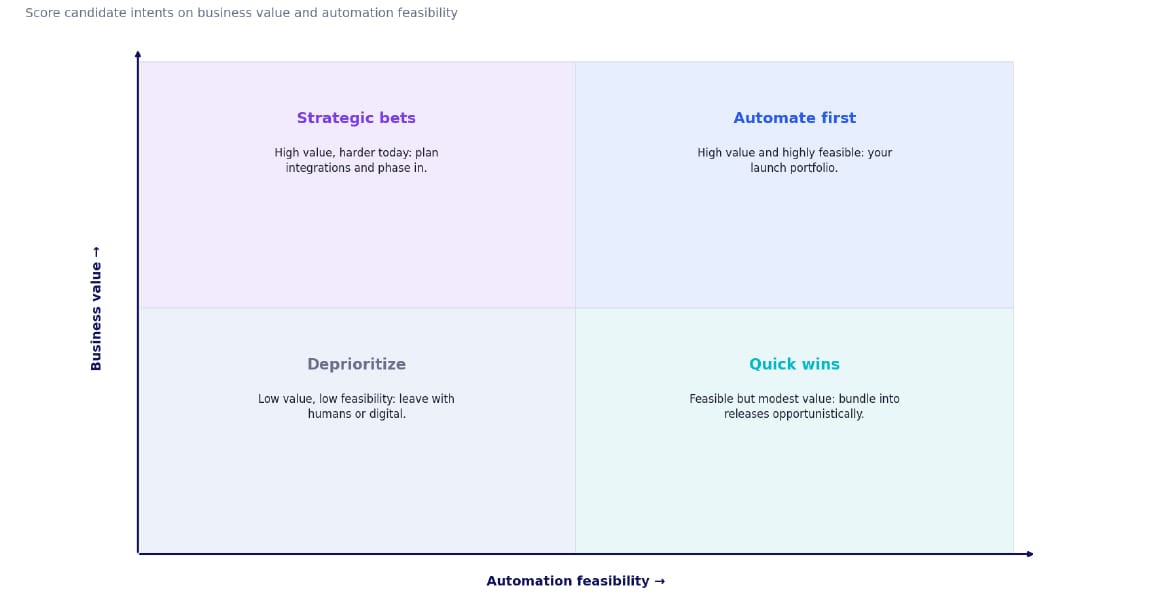
Figure 3. Prioritizing voice automation use cases. A value-versus-feasibility matrix: automate the top-right first, plan integrations for strategic bets, and bundle quick wins opportunistically.
- Automate first (high value, high feasibility): your launch portfolio — typically order status, scheduling, billing explanations, and routing.
- Strategic bets (high value, lower feasibility): intents blocked by missing integrations or policy questions; put the enablers on the roadmap.
- Quick wins (lower value, high feasibility): bundle into releases when marginal cost is low; don't let them crowd out the launch portfolio.
- Deprioritize (low value, low feasibility): leave with human agents or digital channels — automation is not the goal; outcomes are.
Ground the scoring in data, not opinion: mine call recordings, dispositions, and IVR paths to quantify true intent volumes. NiCE's data-driven approach surfaces high-impact, high-ROI intents directly from customer interaction analytics — the same discipline described in AI voice agent services for businesses. Then instrument each launched use case with the KPI framework in AI voice agent for customer service, and let analytics reveal the next wave.
Use Cases That Deserve Extra Care
Some applications work only with deliberate design: collections and payment reminders (regulatory constraints and tone), healthcare communications (privacy and disclosure), vulnerable-customer interactions (detection and escalation duty), and any conversation where empathy is the product. These are not reasons to avoid automation — they are reasons to pair it with explicit policy, compliance review, and generous human escalation, as covered for the outbound cases in AI voice agents for outbound calls and for multilingual populations in the language guide.
From Use Case to Business Case: Sizing the Opportunity
Each candidate intent should carry its own mini business case, built from your data. For a given intent, multiply monthly call volume by the fully loaded assisted cost per contact to get the addressable spend; apply a conservative containment assumption grounded in the intent's feasibility score; subtract the automation cost attributable to that intent (platform usage plus a share of build and optimization); and note the non-cost effects — speed to answer, after-hours coverage, surge absorption — that accrue to experience and retention. Summing across the launch portfolio yields a program case that survives finance review precisely because it is assembled from inspectable parts. Just as important, per-intent cases create per-intent accountability after launch: when measured containment diverges from the model, you know exactly where to look, using the KPI framework in AI voice agent for customer service.
Sequencing a Multi-Year Use-Case Roadmap
The prioritization matrix answers "what first"; a roadmap answers "in what order after that." Three sequencing principles hold across industries. Follow the integrations: intents sharing a system dependency (billing, scheduling) are cheaper in clusters — once the integration exists, adjacent intents ride it. Alternate depth and breadth: deepen automation on launched intents (more edge cases, more languages) in the same rhythm as adding new intents, or quality stalls while coverage sprawls. Let analytics vote: interaction analytics on live traffic — what callers actually ask that the agent cannot yet do — is the most reliable roadmap input you will ever have, and it compounds as volume grows. Revisit the matrix quarterly; feasibility scores change every time an integration lands, a model improves, or a policy question is settled.
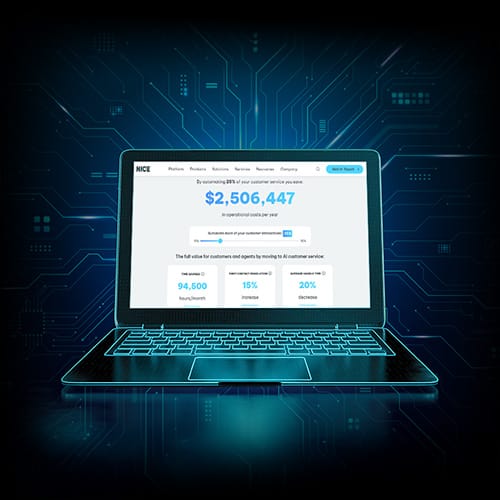
Discover the full value of AI in CX
Understand the benefits and cost savings you can achieve by embracing AI, from automation to augmentation.
Anti-Patterns: Use Cases That Look Good and Aren't
- The rare-but-painful call. Low-volume intents rarely repay design and testing effort no matter how annoying they are; leave them with humans.
- The policy-ambiguous request. If your own teams debate the correct handling, the agent will automate the debate; settle policy first.
- The empathy-critical moment. Bereavement, hardship, and serious complaints belong with people even when technically automatable.
- The read-only 'resolution.' Automating the status check while the underlying fix still requires a human call just splits one contact into two.
- The unmeasurable win. If you cannot instrument an intent's resolution, you cannot manage it; build measurement before automation.
Voice as Part of an Omnichannel Use-Case Strategy
Voice use cases should be chosen with the whole channel mix in view. Some intents are naturally voice-first — urgent issues, situations where customers are away from screens, populations that prefer or need the phone, and conversations where speaking is simply faster than typing. Others are better served digitally, with voice as the fallback. The strongest programs design intents once and deploy them across channels: the same order-status logic, knowledge grounding, and integrations serve the voice agent, the web chat, and the messaging channels, with channel-appropriate presentation. This is a platform property as much as a design choice — NiCE AI agents operate across voice and digital channels with shared context, so a customer who starts on chat and calls in later resumes rather than restarts. Cross-channel continuity also changes prioritization arithmetic: an intent that looks marginal for voice alone may be clearly worthwhile when its design, integrations, and knowledge investment amortize across every channel at once.
Find Your Highest-Value Use Cases
NiCE helps enterprises identify high-impact, high-ROI intents from their own interaction data — then automate them with AI agents on one platform. Start with NiCE AI Agents for Self-Service, or hear NiCE Cognigy Voice AI Agents handle real use cases in natural conversation.
Continue Exploring AI Voice Agents
Return to the hub or continue with the guides that turn a use-case roadmap into a running program.
- AI voice agents: the complete guide — The pillar hub for the complete resource center.
- AI voice agent for customer service — Journey design, escalation policy, and KPIs for the inbound use cases above.
- AI voice agents for outbound calls — The design and compliance guide for proactive calling programs.
- Multilingual AI voice agents — Extending your use cases to every caller language.
- AI voice agent services for businesses — How discovery engagements quantify and prioritize your intents.
Frequently Asked Questions About AI Voice Agent Use Cases

Ready to experience the power of one platform?
Let us show you how NiCE can unify, automate and elevate your entire customer experience - with AI at the core and outcomes at the forefront.