

AI Voice Agents vs. IVR: What Changes When Menus Become Conversations

On this page
- IVR and AI voice agents
- The core differences
- Where IVR still fits
- Migrating from IVR to AI voice agents
- Making the business case
- How cost structures differ
- Risk management during migration
- IVR vs. AI decision guide
- Your existing IVR investment
- Modernize your voice front door
- Continue exploring AI voice agents
- FAQs
- IVR and AI Voice Agents, Defined
- The Core Differences, Side by Side
- Where IVR Still Fits
- Migrating From IVR to AI Voice Agents Without a Big Bang
- Making the Case: What to Compare in the Business Case
- Economics: How the Cost Structures Differ
- Risk Management During Migration
- Decision Guide: Questions That Settle the IVR-vs-AI Choice
- What Happens to Your Existing IVR Investment
- Modernize Your Voice Front Door
- Continue Exploring AI Voice Agents
AI voice agents and interactive voice response (IVR) systems both answer business phone calls automatically — and that is roughly where the similarity ends. IVR presents structure: menus, options, and prompts the caller must navigate. An AI voice agent presents a conversation: the caller states their need naturally, and the agent understands, acts, and resolves. For contact center leaders, the comparison is less "which technology is better" than "what does each generation make possible, and how do we get from one to the other safely."
This guide compares the two across experience, capability, operations, and economics, then lays out a phased migration path that avoids a big-bang cutover.
IVR and AI Voice Agents, Defined
Interactive voice response (IVR) is telephony software that plays recorded or synthesized prompts and collects caller input via keypad tones (DTMF) or constrained speech to route calls and complete simple self-service tasks. Modern cloud IVR — such as NiCE Interactive Voice Response — remains a legitimate, widely used technology for routing and structured self-service, natively integrated with contact center routing.
AI voice agents are autonomous, conversational agents built on speech recognition, large language model (LLM) reasoning, and neural text-to-speech. They understand free-form speech, hold multi-turn dialogue, execute tasks across integrated systems, and escalate with context — the full definition is at What is an AI voice agent?.
The Core Differences, Side by Side
Two generations of voice automation compared:
Traditional IVR
- Rigid menu trees: "Press 1 for billing..."
- Callers adapt to the system's structure and vocabulary.
- Primarily routes calls; limited transactional self-service.
- Changes require IT projects; long update cycles.
- High zero-out rates when menus don't match caller needs.
AI voice agent
- Open conversation: "How can I help you today?"
- The system adapts to the caller's natural language.
- Resolves requests end to end across integrated systems.
- Flows, knowledge, and policies update quickly without re-recording menus.
- Escalates the right calls with full conversational context.
Traditional IVR vs. AI voice agents. The interaction model inverts: with IVR, callers adapt to the system; with AI voice agents, the system adapts to callers.
The experience gap is easiest to feel from the caller's seat. The same billing question that takes an IVR journey through nested menus, an authentication maze, and a queue becomes, with a voice agent, one natural exchange.
The Caller's Path: Menu Tree vs. Open Intent
An illustrative comparison of the same billing question through an IVR and through an AI voice agent.
IVR journey (illustrative)
- Listen to a full greeting and 6-option menu.
- Press 3 for billing, then hear a 5-option submenu.
- Press 2, authenticate by typing an account number.
- Realize no option fits; press 0 and wait in queue.
- Repeat everything to the human agent.
AI voice agent journey
- "Hi! How can I help you today?"
- Caller: "My bill looks higher than usual this month."
- Agent verifies identity conversationally and reviews the bill.
- Agent explains the change and offers to adjust the plan.
- Resolved in one natural conversation - or transferred with full context.
Where IVR Still Fits
An honest comparison notes that IVR is not obsolete. Deterministic menus remain reasonable for very simple estates (two or three destinations), for regulated flows where exact scripted wording is mandatory, as a resilient fallback layer, and where budgets confine automation to routing. Many enterprises also run hybrid estates during migration — a conversational front door backed by IVR-era flows that are retired incrementally. The practical question is not IVR versus AI in the abstract, but which calls deserve conversation and resolution today.
Migrating From IVR to AI Voice Agents Without a Big Bang
Rip-and-replace is rarely necessary and rarely wise. A phased path lets you bank experience gains early, learn from live traffic, and retire legacy menus only as containment and quality targets are met.
Five-phase timeline: baseline the IVR with analytics, deploy a conversational front door, automate the top intents end to end, retire legacy menus, and expand to new languages and journeys.
- Baseline. Mine IVR path analytics and call recordings to quantify zero-out rates, misroutes, repeat calls, and the true top intents — this becomes your business case and your measurement baseline.
- Front-door AI. Replace the opening menu with open-ended natural language intake ("How can I help you today?") and intelligent routing. Routing accuracy improves even before any end-to-end automation.
- Automate top intents. Move the highest-volume, lowest-risk intents to full AI resolution, using the prioritization framework in AI voice agent use cases.
- Retire menus. Decommission legacy trees intent by intent as targets are met, keeping fallback paths during the transition.
- Add languages, outbound journeys, and proactive service on the same platform.
Platform choice determines how smooth this is: running IVR, routing, and AI agents on one platform — as with NiCE CXone — keeps context, reporting, and administration unified throughout the transition. The capabilities to verify are listed in AI voice agent platform.
Making the Case: What to Compare in the Business Case
Build the comparison on your own baseline, not vendor benchmarks: current IVR containment (measured honestly — completed tasks, not menu dwell time), zero-out and misroute costs, queue and abandonment costs, agent minutes spent on intents a voice agent could resolve, and the experience cost of menu friction visible in CSAT and repeat calls. Then model the voice agent scenario with conservative containment assumptions by intent. If the phased path above is followed, the front-door phase typically pays for the learning that de-risks everything after it.
Economics: How the Cost Structures Differ
IVR and AI voice agents concentrate cost in different places, and the business case should model both honestly. IVR's costs are mostly fixed and front-loaded — platform, call flows, and periodic change projects — with very low marginal cost per call but a hard capability ceiling: everything the IVR cannot do becomes an agent-handled call at full assisted cost, plus the experience tax of the failed detour. AI voice agents carry higher variable costs (model and platform usage per conversation) and real design and integration investment, but each successfully automated intent removes assisted-handling cost at scale, and the ceiling keeps rising as intents, languages, and integrations are added. The crossover math therefore hinges on two of your numbers: what your IVR's honest task-completion rate is today, and how much assisted-agent time is spent on intents a voice agent could resolve. Baselining those two figures — step one of the migration path above — usually settles the debate more decisively than any vendor comparison.
Risk Management During Migration
The migration path's phasing exists to manage specific risks, and naming them keeps the program honest. Experience risk — a conversational front door that misroutes worse than the menu did — is contained by launching on a traffic slice with the legacy IVR as instant fallback and by defining rollback criteria before go-live. Operational risk — surges hitting an unproven system — is contained by capacity testing and by keeping human queues staffed through early phases. Compliance risk — scripted disclosures lost in the move to generated conversation — is contained by encoding mandatory wording as guardrails and validating it per release. Measurement risk — declaring victory on flattering metrics — is contained by fixing definitions (task completion, not menu dwell) during the baseline phase, before anyone has an incentive to bend them. Platforms with simulation testing, staged rollout, and per-call tracing make each control practical rather than aspirational; those capabilities are itemized in AI voice agent platform.
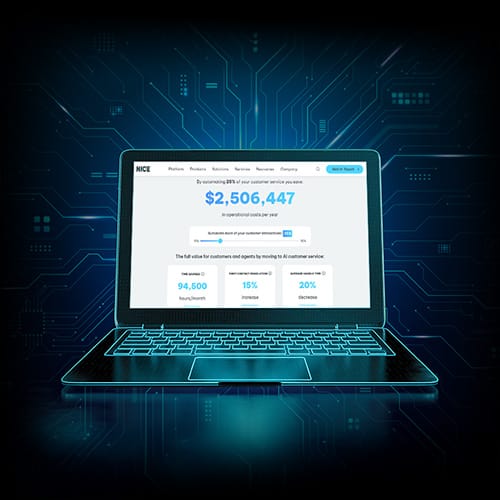
Discover the full value of AI in CX
Understand the benefits and cost savings you can achieve by embracing AI, from automation to augmentation.
Decision Guide: Questions That Settle the IVR-vs-AI Choice
- What share of callers zero out or misroute today? High escape rates are the clearest evidence that menus no longer fit your call mix.
- How many of your top ten intents could be resolved, not just routed, with system integration? That count sizes the AI opportunity; if it is near zero, fix integrations first.
- How often do menu changes queue behind IT projects? Change velocity is a hidden IVR cost that platform-based agents largely eliminate.
- Do you need languages your IVR will never speak well? Multilingual reach is often the tiebreaker — see Multilingual AI voice agents.
- Can you measure honestly? If task-completion instrumentation doesn't exist yet, build it during the baseline phase — it serves whichever path you choose.
What Happens to Your Existing IVR Investment
A frequent and fair question from teams that recently modernized their IVR: is that investment stranded? Usually not. Modern cloud IVR assets — clean call-flow logic, integrations into billing and scheduling systems, routing rules, and the analytics that describe caller behavior — transfer value directly into the AI program. Integrations built for IVR self-service become the action layer the voice agent calls; documented call flows become the first draft of conversation designs; IVR path analytics provide the baseline that sizes the business case. What retires is the interaction surface (menus and prompts), not the plumbing beneath it. Enterprises running NiCE Interactive Voice Response on the same platform as their AI agents get the gentlest version of this transition: routing, recording, integrations, and reporting stay put while the front of the call becomes conversational. Frame the migration internally as re-fronting proven infrastructure, not replacing it — it is both more accurate and more fundable.
Modernize Your Voice Front Door
Whether you are optimizing an existing IVR or moving to conversational AI, NiCE covers the full path on one platform. Explore NiCE Interactive Voice Response for modern cloud IVR, or see NiCE AI Agents for Self-Service for end-to-end conversational resolution.
Continue Exploring AI Voice Agents
Return to the hub or continue with the guides that support a migration decision.
- AI voice agents: the complete guide — The pillar hub for the complete resource center.
- What is an AI voice agent? — The definitional foundation for the comparison on this page.
- How AI voice agents work: ASR, LLM, and TTS — The technology that makes conversation-first automation possible.
- AI voice agent use cases — Choose which intents to automate first as you retire menus.
- AI voice agent platform — Platform capabilities that keep IVR, routing, and AI unified during migration.
Frequently Asked Questions About AI Voice Agents vs. IVR

Ready to experience the power of one platform?
Let us show you how NiCE can unify, automate and elevate your entire customer experience - with AI at the core and outcomes at the forefront.