

AI Voice Agents for Outbound Calls: Proactive Service at Scale
On this page
- Outbound use cases that deliver value
- Anatomy of an outbound campaign
- Regulatory and trust guardrails
- Measuring outbound programs
- Getting started
- Outbound conversation design
- Orchestrating outbound journeys
- Common outbound program mistakes
- Outbound voice orchestration
- Make outbound a valued service
- Continue exploring AI voice agents
- FAQs
- Outbound Use Cases That Earn Their Keep
- Anatomy of a Compliant Outbound Campaign
- Regulatory and Trust Guardrails
- Measuring Outbound Programs Honestly
- Getting Started
- Conversation Design for Calls Nobody Asked For
- Orchestrating Outbound Within the Customer Journey
- Common Outbound Program Mistakes
- Orchestrating Outbound Voice Within the Customer Journey
- Make Outbound a Service Customers Appreciate
- Continue Exploring AI Voice Agents
AI voice agents for outbound calls flip the usual direction of voice automation: instead of answering, the AI voice agent initiates the call — reminding, notifying, confirming, collecting, surveying, or following up — and then holds a genuine two-way conversation about it. That last part is what separates modern outbound voice AI from the robocalls that earned the category its reputation: the recipient can ask questions, reschedule, pay, dispute, or opt out, all in natural speech.
This guide covers the outbound use cases that work, the campaign anatomy that keeps programs compliant and welcome, the regulatory guardrails to design in, and the metrics that distinguish value from volume.
Compliance note
Outbound calling is regulated differently across jurisdictions and use cases — for example, the Telephone Consumer Protection Act (TCPA) and Telemarketing Sales Rule in the United States, and analogous consent, disclosure, and do-not-call regimes elsewhere. This page provides general educational guidance, not legal advice. Every outbound program should be reviewed with qualified legal counsel before launch.
Outbound Use Cases That Earn Their Keep
Outbound AI voice agent use cases. Six proactive calling programs enterprises automate — each conversational, not broadcast.
Reminders & confirmations
Appointments, deliveries, and service reminders with simple confirmation flows.
Payment & collections
Early-stage, respectful payment reminders with secure options and escalation.
Notifications
Outage, disruption, recall, and service status calls at massive scale.
Surveys & feedback
Post-interaction CSAT and NPS conversations with open-ended follow-up.
Lead follow-up
Initial callbacks on inbound leads to qualify and route for sales handoff.
Retention & winback
Renewal outreach and save offers, escalating warm leads to an agent.
Six cards: reminders and confirmations, payment and collections, notifications, surveys and feedback, lead follow-up, and retention and winback.
- Reminders and confirmations. Appointments, deliveries, installations, and renewals — with in-call rescheduling that turns a reminder into a resolution. Paired with inbound scheduling automation, this attacks no-shows from both directions.
- Payment reminders and early-stage collections. Respectful notices with secure in-call payment or arrangement options; tone, timing, and regulation make this a design-intensive use case.
- Service notifications. Outage updates, disruption alerts, recalls, and status changes delivered at a scale no phone bank can match — with the ability to answer follow-up questions on the spot.
- Surveys and feedback. Post-interaction CSAT and NPS conversations in which an agent can probe open-ended answers, not just collect keypad scores.
- Lead follow-up and qualification. Instant callback on inbound leads, qualification questions, and warm handoff to human sales — where minutes of response time change outcomes.
- Retention and winback. Renewal outreach and save conversations, escalating engaged customers to specialists.
Anatomy of a Compliant Outbound Campaign
Successful programs treat compliance and experience as the same design problem: a call that is legal, expected, clearly identified, and easy to act on is also a call customers tolerate — often appreciate. The workflow below builds governance into each step.
Five steps from list to outcome, with consent, disclosure, and audit built in. Regulatory obligations vary by jurisdiction — review with counsel.
- Define & consent
Establish purpose, audience, and verified consent/opt-in status per contact. - Schedule within rules
Respect calling windows, frequency caps, and suppression and DNC lists. - Identify & disclose
The agent states who is calling and, where required, that it is an automated/AI call. - Converse & resolve
Handle the task, objections, opt-outs, and requests naturally; escalate as needed. - Log & measure
Record outcomes, honor opt-outs immediately, and feed analytics and audit trails.
Regulatory and Trust Guardrails
Design these guardrails into the platform configuration — not into training documents that agents may or may not follow. The advantage of automated outbound done right is that compliance becomes systematic: an AI agent never forgets the disclosure, never calls outside the window, and never fails to log the opt-out.
Outbound Compliance and Trust Guardrails
Design requirements for automated outbound calling (validate with legal counsel)
Consent management
Call only contacts with the appropriate consent for the purpose and channel.
Identification & AI disclosure
Clear caller identification and AI disclosure where regulations or policy require.
Time & frequency limits
Enforce permissible calling hours and attempt caps by jurisdiction.
Instant opt-out
Honor 'stop calling' immediately, in-conversation, with durable suppression.
DNC & suppression lists
Screen against do-not-call registries and internal suppression lists.
Recording & audit
Retain disclosures, consents, and outcomes to evidence compliance.
Six guardrail families to implement as platform controls. Validate specific obligations with legal counsel per jurisdiction and use case.
Transparency deserves special mention. Several jurisdictions require — and customer trust everywhere rewards — clear disclosure when a call is automated or AI-driven. Design disclosure as a natural part of the greeting, give recipients an immediate path to a human or to opt out, and make the conversation genuinely useful thereafter. Trust, once spent on a deceptive or useless call, is not refunded.
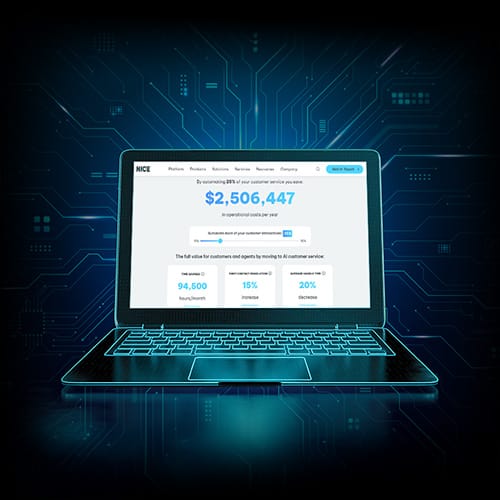
Discover the full value of AI in CX
Understand the benefits and cost savings you can achieve by embracing AI, from automation to augmentation.
Measuring Outbound Programs Honestly
Volume metrics flatter outbound programs; outcome metrics discipline them. Measure reach (connected conversations, not dials), resolution (appointments confirmed or moved, payments arranged, questions answered in-call), downstream impact (no-show rates, days-sales-outstanding, repeat inbound volume), experience (in-call sentiment, complaint and opt-out rates), and compliance health (disclosure completion, window adherence, opt-out latency). Rising opt-out or complaint rates are early warnings that targeting, frequency, or usefulness is off — treat them as design feedback, not noise. The instrumentation approach mirrors the inbound framework in AI voice agent for customer service.
Getting Started
Begin with a use case that is unambiguously service, not sales — appointment reminders and service notifications are ideal: consent is clear, value to the recipient is obvious, and regulatory complexity is lowest. Prove conversation quality (the same conversational competencies apply outbound, plus answering-machine detection and voicemail etiquette), validate the compliance workflow end to end, and instrument outcomes before expanding into higher-stakes programs like collections. Outbound also compounds with your other capabilities: multilingual support extends reach, and shared platform context means an outbound reminder can reference — and update — the same records as your inbound service, as on NiCE CXone.
Conversation Design for Calls Nobody Asked For
Outbound conversation design inverts inbound assumptions: the recipient did not initiate, may be busy or suspicious, and grants you seconds of attention. Design accordingly. Open with immediate identification and purpose — organization, reason, and (where required or chosen) AI disclosure — before anything else; a recipient who knows within five seconds who is calling and why is a recipient who might stay. Lead with the value ("your delivery is scheduled for tomorrow — I can confirm it or find a better time"), keep the happy path under a minute, and handle the realities of outbound: answering-machine detection with a useful, compliant voicemail; the wrong person answering (verify before disclosing anything sensitive); call-backs at better times; and instant, graceful opt-out that thanks rather than argues. Every objection path — "how did you get this number," "take me off your list," "is this a scam" — deserves designed, tested handling, because outbound trust is won or lost in exactly those moments.
Orchestrating Outbound Within the Customer Journey
Outbound calls should behave as one instrument in an orchestrated journey, not a parallel channel with its own memory. Sequence channels deliberately — a text reminder first, a call only if unconfirmed — and suppress intelligently: never call about an issue the customer resolved online an hour ago, or one currently open with a human agent. That requires the outbound agent to share context with inbound service and digital channels, reading and writing the same customer records — the platform-unification argument covered in AI voice agent platform and native to CXone. Frequency governance must also be customer-level, not campaign-level: three well-meaning campaigns calling the same person in one week is a complaint generator no single campaign owner will see coming. Finally, capture outcomes as structured data (confirmed, rescheduled, disputed, opted out) so downstream journeys — and your analytics — react correctly.
Common Outbound Program Mistakes
- Porting inbound scripts outbound. The trust context is entirely different; design for the unasked-for call explicitly.
- Campaign-level frequency caps. Govern contact frequency per customer across all campaigns, or overlapping programs will burn your list.
- Slow opt-out plumbing. An opt-out honored in days instead of seconds is a compliance exposure and a trust failure; test the propagation path end to end.
- Measuring dials. Connected conversations and resolved outcomes are the metrics; dial counts reward the wrong behavior.
- Skipping the voicemail experience. A large share of outbound attempts reach voicemail; a compliant, useful message is part of the design, not an afterthought.
Orchestrating Outbound Voice Within the Customer Journey
Outbound calls land differently depending on what surrounds them, so mature programs orchestrate voice as one movement in a multichannel sequence rather than a standalone blast. A common pattern: notify by low-friction channels first (push, SMS, email), and reserve the outbound call for what voice does uniquely well — reaching customers who did not respond, handling matters that need dialogue (rescheduling, payment arrangements), and moments where a conversation prevents a costlier failure such as a missed appointment or a service disruption. Sequencing also protects goodwill: a customer who already confirmed by SMS should be suppressed from the call list within minutes, which requires real-time state shared across channels rather than nightly batch updates. Frequency governance must likewise span channels — a per-channel cap that permits three touches each across SMS, email, and voice is a twelve-touch week from the customer's perspective. Finally, let inbound context shape outbound behavior: if the customer called yesterday about the same bill, tonight's payment-reminder call should acknowledge that or be suppressed. Shared platform context, as on NiCE CXone, is what makes this orchestration practical rather than aspirational.
Make Outbound a Service Customers Appreciate
NiCE Cognigy Voice AI Agents handle high-volume inbound and outbound phone interactions with natural, humanlike conversation. Explore NiCE Cognigy Voice AI Agents for proactive engagement, or see the full portfolio at NiCE AI Agents for Self-Service.
Continue Exploring AI Voice Agents
Return to the hub or continue with the guides that pair with outbound programs.
- AI voice agents: the complete guide — The pillar hub for the complete resource center.
- AI voice agent use cases — The full use-case catalog, including how outbound fits the prioritization matrix.
- Conversational AI voice agents — The conversational quality bar outbound calls must also meet.
- Multilingual AI voice agents — Extend outbound reach across every customer language.
- AI voice agent for customer service — The inbound counterpart — shared context makes both programs stronger.
Frequently Asked Questions About AI Voice Agents for Outbound Calls

Ready to experience the power of one platform?
Let us show you how NiCE can unify, automate and elevate your entire customer experience - with AI at the core and outcomes at the forefront.