

AI Voice Agent Services for Businesses: From Strategy to Scale
On this page
- What's included in AI voice services
- Choosing a delivery model
- Voice agent program roles
- Choosing a services provider
- Discovery deliverables
- Contracts, SLAs, and outcomes
- Capability transfer planning
- Common services mistakes
- Questions before signing
- Get expert implementation help
- Explore more AI voice agents
- FAQs
- What AI Voice Agent Services Include
- Delivery Models: In-House, Vendor Services, or Hybrid
- The Roles a Voice Agent Program Needs
- Choosing a Services Provider: What to Verify
- What Discovery Actually Produces: Artifacts to Expect
- Contracting for Outcomes: SLAs, Acceptance, and Optimization Terms
- Capability Transfer: Ending Up Smarter Than You Started
- Common Services Engagement Mistakes
- Questions to Ask Before Signing a Services Engagement
- Bring Expert Help to Your Voice Automation Program
- Continue Exploring AI Voice Agents
AI voice agent services for businesses are the human expertise wrapped around voice automation technology: analyzing which calls to automate, designing the conversations, integrating the systems, testing rigorously, launching safely, and improving continuously after go-live. Enterprises ask about services for a practical reason — AI voice agents succeed or fail on design and operational discipline at least as much as on the underlying platform, and few organizations begin with those skills in-house.
This guide explains what voice agent services include, the delivery models available, the roles a program needs, and how to choose a sourcing approach that fits your team and timeline.
What AI Voice Agent Services Include
A complete services engagement spans five stages. Vendors and partners package them differently — fixed-scope launches, time-and-materials builds, or fully managed operations — but the underlying work is consistent.
The Voice Agent Services Lifecycle
Five stages of a full-service engagement, from discovery through continuous operation.
- Discovery
Call-driver analysis, ROI modeling, and use-case prioritization. - Design
Conversation design, persona, guardrails, and escalation strategy. - Build
Configuration, integrations, knowledge grounding, and security setup. - Validate
Simulation, user testing, compliance review, and tuning. - Operate
Monitoring, analytics reviews, and continuous optimization.
1. Discovery and business case
Services teams mine your interaction data — call recordings, IVR paths, transcripts, and CRM dispositions — to quantify call drivers, identify the intents with the highest automation value, and model the ROI. Data-driven intent selection is where experienced teams add immediate value: NiCE's approach uses customer interaction analytics to surface high-impact, high-ROI intents for automation rather than guessing. The output is a prioritized roadmap, success metrics, and a baseline to measure against.
2. Conversation and experience design
Designers craft how the agent greets, asks, confirms, recovers from misunderstanding, and hands off — plus its persona, tone, and pacing. Good voice design is a specialized craft distinct from chatbot design: spoken interactions have no visible menus or buttons, so structure must be carried in language. The principles are covered in Conversational AI voice agents; services teams bring pattern libraries and lessons from prior deployments so you do not relearn them on live customers.
3. Build and integration
Engineers configure the agent on the platform, connect telephony and CCaaS routing, integrate CRM, order, billing, and scheduling systems so the agent can act, ground the agent in approved knowledge, and implement security controls such as sensitive-data redaction. Integration depth determines whether the agent resolves calls or merely answers questions — the architecture requirements are detailed in AI voice agent platform.
4. Validation and launch
Before real traffic, the agent is exercised through simulated calls, accent and noise testing, adversarial probing, compliance review, and user acceptance testing. Launch is staged: a controlled slice of traffic first, with human fallback ready, expanding as containment and quality targets are met.
5. Managed optimization
After go-live, the work shifts to analytics reviews, tuning misrecognized intents, expanding coverage, adding languages, and retesting after every change. Managed-service arrangements assign this to the vendor or partner with agreed review cadences and improvement targets; the KPIs to manage against are defined in AI voice agent for customer service.
Delivery Models: In-House, Vendor Services, or Hybrid
The core sourcing decision is who performs the lifecycle above. In practice most enterprises land on a hybrid: vendor or partner services lead the first deployments and transfer capability, while an internal team grows into ownership of design and optimization.
AI Voice Agent Delivery Models
In-house builds maximize control; vendor and partner services maximize speed and proven practice. Most enterprises combine them.
How businesses source design, build, and operations
In-house / self-service build
- Internal CX, IT, and conversation-design teams build on the vendor platform.
- Maximum control over roadmap, data, and iteration speed.
- Requires sustained skills in voice UX, prompt and flow design, and integration.
- Best when voice automation is a durable core competency.
Vendor & partner services
- Vendor professional services or certified partners design, build, and launch the agents.
- Faster time to value using proven playbooks and prebuilt industry components.
- Managed optimization keeps containment and quality improving after go-live.
- Best for first deployments, aggressive timelines, or lean internal teams.
One useful signal when evaluating providers: pre-trained, use-case-specific delivery. NiCE Cognigy, for example, delivers AI agents trained to your use cases, specifications, and business outcomes so organizations can onboard them quickly and go live within weeks — a materially different starting point than a blank canvas.
The Roles a Voice Agent Program Needs
Whether staffed internally or sourced through services, successful programs cover six roles. Sourcing conversations go better when you map which of these you have, which you will hire, and which the provider must supply.
Roles in a Successful Voice Agent Program
Six roles to staff internally or source through services.
- Conversation designer — owns dialogue quality, persona, and error recovery; the single biggest influence on how the agent feels to callers.
- Solution architect — designs telephony, integration, and data flows; accountable for warm transfers and system actions working reliably.
- AI/automation engineer — builds flows, prompts, actions, and the testing pipeline that protects quality through change.
- CX analyst — turns interaction analytics into an optimization backlog: what to fix, expand, or retire next.
- Security and compliance lead — owns data handling, consent, redaction, and audit requirements, especially for regulated industries and outbound calling.
- Business owner — prioritizes intents, owns the outcome targets, and keeps the program tied to ROI.
Choosing a Services Provider: What to Verify
Beyond platform capability, evaluate the provider's delivery evidence. Ask for referenced deployments at your scale and in your industry; the methodology and artifacts they will use (design standards, test suites, launch checklists); how they measure and report containment, resolution, and experience quality; how capability transfer to your team works; and how optimization is contracted after launch. Providers confident in their outcomes will talk in terms of resolved contacts and customer experience, not just deployed bots.
What Discovery Actually Produces: Artifacts to Expect
A rigorous discovery engagement should hand you five artifacts, and their quality is a preview of the provider's delivery quality. An intent inventory quantifying call drivers from your real interaction data, not workshop guesses. A prioritized automation roadmap scored on value and feasibility (the same framework detailed in AI voice agent use cases). A baseline measurement pack — containment, handle time, cost per contact, CSAT by intent — that future results will be judged against. An integration and data readiness assessment identifying what must be connected, localized, or cleaned before the agent can act. And a business case with conservative, per-intent containment assumptions and explicit dependencies. If a provider proposes to skip straight to building, that is a signal, not a shortcut.
Contracting for Outcomes: SLAs, Acceptance, and Optimization Terms
The services contract shapes program behavior long after signatures. Define acceptance criteria in observable terms: recognition accuracy thresholds on your test set, conversational-quality test passage (barge-in, repair, multi-intent), escalation context completeness, and containment on the launch portfolio measured over a defined window — not "agent delivered." For managed optimization, contract a cadence (weekly analytics reviews in early quarters), response expectations for quality regressions, and improvement mechanics — how the backlog is prioritized and who approves changes touching policy or compliance wording. Clarify intellectual property and portability up front: who owns the conversation designs, prompts, and test suites, and what transfers if you change providers. Finally, tie a portion of fees to outcome measures where both sides can influence them; pure time-and-materials optimization tends to optimize hours.
Capability Transfer: Ending Up Smarter Than You Started
The best services engagements leave your team able to run the program. Build transfer into the plan explicitly: paired design sessions rather than black-box delivery, documentation of design standards and escalation policy in your repositories, shadow-then-lead rotations for your analysts on the optimization cadence, and a defined graduation point where your team owns routine changes and the provider handles step-changes (new languages, new lines of business, major platform shifts). Providers confident in their value welcome this structure; reluctance to transfer capability is a dependency strategy, not a partnership.
Common Services Engagement Mistakes
- Buying build without operate. The value curve of voice automation slopes upward after launch; an engagement that ends at go-live strands it.
- Letting the provider pick the metrics. Baselines and definitions set before build, by you, keep success honest.
- Under-scoping conversation design. Integration effort is easy to estimate and design effort easy to shortchange; callers experience the design.
- Skipping compliance early. Disclosure wording, recording consent, and data handling reviewed at the end force expensive rework — involve your compliance lead from discovery, as the role map above recommends.
- No capability transfer plan. Decide on day one whether you are renting an outcome or building a competency, and contract accordingly.
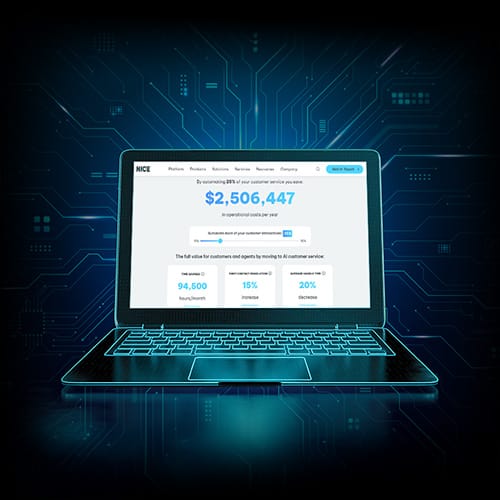
Discover the full value of AI in CX
Understand the benefits and cost savings you can achieve by embracing AI, from automation to augmentation.
Questions to Ask Before Signing a Services Engagement
A short diligence conversation separates services partners who industrialize outcomes from those who bill hours. Ask five questions. Who owns the intellectual property and the agent itself? Conversation designs, integrations, and analytics configurations should belong to you, portable within the platform, so a partner change never means a rebuild. How is success defined and measured? Insist on a shared scorecard — containment, resolution, CSAT, escalation quality — with baselines captured before launch, not reconstructed after. What does the knowledge-transfer plan look like? Every engagement phase should name the skills your team absorbs, with a declining dependence curve you can inspect quarterly. How are changes governed? Look for versioned releases, regression testing before exposure, and rollback paths — the operational disciplines described in AI voice agent platform. What happens at renewal? The right partner prices ongoing optimization against measurable improvement, not against your inability to leave. Partners who answer these crisply tend to run their delivery the same way; partners who hedge on ownership and measurement are telling you how the engagement will feel in year two.
Bring Expert Help to Your Voice Automation Program
NiCE pairs enterprise voice AI technology with the expertise to deploy it well. Explore NiCE AI Agents for Self-Service to see how leading brands launch and scale voice automation, or learn how NiCE Cognigy Voice AI Agents are delivered pre-trained to your use cases so you can go live in weeks.
Continue Exploring AI Voice Agents
Return to the hub or continue with the guides most relevant to planning a deployment.
- AI voice agents: the complete guide — The pillar hub — start-to-finish orientation for enterprise voice automation.
- AI voice agent platform — The technology capabilities your services team will design and build on.
- AI voice agent use cases — The prioritization framework discovery engagements use to choose what to automate first.
- Conversational AI voice agents — The design discipline behind conversations customers actually enjoy.
- AI voice agent for customer service — The KPIs and escalation design your program will be managed against.
Frequently Asked Questions About AI Voice Agent Services

Ready to experience the power of one platform?
Let us show you how NiCE can unify, automate and elevate your entire customer experience - with AI at the core and outcomes at the forefront.