

Agentic AI Use Cases: A Prioritized Guide for Enterprise Deployment

Agentic AI use cases are the specific, recurring pieces of work where autonomous AI systems can own outcomes — not a technology wish list, but a map of deployable workloads with measurable value. This guide catalogs the enterprise use cases that are working in production today, organizes them across the customer journey, and provides the prioritization matrix and phased roadmap CX and operations leaders need to sequence adoption. If you're looking for narrative illustrations of what these systems do, start with agentic AI examples; this page is about choosing where to deploy and in what order.
Use Cases vs. Examples: A Working Definition
A use case names a workload and its business intent — "automate first notice of loss intake," "reduce after-call work," "contain billing-adjustment contacts." An example shows one instance of that workload being performed. The distinction matters because use cases carry the attributes a deployment decision needs: volume, policy clarity, data dependencies, risk class, and target KPIs. Every use case below is defined at that level. The conceptual foundations — what agentic AI is and how it differs from adjacent technologies — live on the Agentic AI hub and in the agentic AI vs. AI agents comparison.
Agentic AI Use Cases Across the Customer Journey
From proactive outreach through post-interaction operations on one governed platform
Before contact
- Proactive engagement
- Outage & delay alerts
- Renewal / payment reminders
- Onboarding journeys
During self-service
- Autonomous resolution
- Billing adjustments
- Plan & account changes
- Claims first notice of loss
During agent contact
- Human augmentation
- Real-time coaching
- Knowledge retrieval
- Guided next-best action
After contact
- Operations & insight
- Auto summaries & QA
- Root-cause analytics
- Continuous optimization
Shared foundation: identity, context, memory, guardrails, and AI-to-human handoff travel with the customer across every stage.
Before contact: proactive engagement use cases
Proactive use cases prevent inbound demand rather than absorbing it. Production-proven workloads include service-disruption notification with automatic credit or rebooking, payment and renewal reminders that complete the transaction in-conversation, onboarding and activation journeys, and appointment confirmation with same-conversation rescheduling. These use cases pair naturally with AI Agents for Proactive Engagement and typically measure success by prevented inbound contacts and completion rate of the proactive task.
During self-service: autonomous resolution use cases
The core of the agentic opportunity: intents resolved end to end without human handling. High-volume candidates include billing adjustments and disputes, plan and subscription changes, order status with modification, returns and exchanges, address and account updates, scheduling, and password or access recovery. Executed across many intents under shared governance, these use cases become full autonomous customer service. Success depends as much on escalation design as on automation — every autonomous use case needs a defined AI-to-human handoff path.
During agent contact: human augmentation use cases
Agentic systems also work for employees. Use cases include real-time agent coaching for compliance and sales guidance, live knowledge retrieval grounded in governed knowledge management, guided next-best action, and in-conversation workflow execution where the AI performs system tasks while the human manages the relationship. The copilot vs. autopilot decision framework explains when augmentation is the right mode versus full autonomy.
After contact: operations and insight use cases
Post-interaction use cases are often the fastest to deploy: automated summaries, dispositions, and follow-up tasks; 100%-coverage quality evaluation; root-cause and intent analytics that identify the next automation candidates; and continuous optimization loops that tune prompts, flows, and guardrails from real outcomes. These use cases also supply the evidence base that governs expansion of the customer-facing ones.
Use-Case Catalog With Target KPIs
How to Prioritize: Impact vs. Complexity
With dozens of viable use cases, sequencing determines success. Plot each candidate on two axes — business impact (volume × cost per contact × experience effect) and implementation complexity (policy clarity, data readiness, integration effort, risk class) — and deploy in quadrant order.
Agentic AI Use-Case Prioritization Matrix
Sequence deployments by business impact and implementation complexity
Axes
- Business impact ↑
- Implementation complexity →
START HERE — Quick wins
- After-call work automation
- Order status & tracking
- Password / account resets
- Appointment scheduling
SCALE NEXT — Strategic bets
- End-to-end billing disputes
- Proactive retention journeys
- Multi-agent orchestration
- Regulated self-service
AUTOMATE OPPORTUNISTICALLY
- FAQ and knowledge answers
- Simple form completion
- Survey and feedback capture
DEFER OR REDESIGN
- Complex negotiations
- High-emotion escalations
- Novel policy exceptions
Three questions sharpen the plot. Is the outcome verifiable — can you check, automatically, that the task completed correctly? Is the action reversible if the AI errs? Is the required data reachable in real time through governed integrations? Use cases failing any of these belong later in the sequence or in an assist-only mode, a filter developed further in where autonomous service should not be used.
A Phased Adoption Roadmap
A Phased Roadmap for Agentic AI Use-Case Adoption
Expand autonomy as evidence, guardrails, and confidence mature
Phase 1 — Assist
- Copilots, summaries, knowledge answers
- Human decides; AI recommends
- Gate: accuracy & CSAT baselines
Phase 2 — Automate
- After-call work, simple transactions
- AI acts on narrow, reversible tasks
- Gate: containment & QA evidence
Phase 3 — Resolve
- End-to-end intents with clear policy
- AI owns outcomes within guardrails
- Gate: risk review & audit trail
Phase 4 — Orchestrate
- Multi-agent journeys across the enterprise
- Supervised autonomy at scale
- Ongoing: continuous evaluation
Each phase gate is an evidence requirement, not a calendar date. Advance a use case from Automate to Resolve only when accuracy, containment quality, and QA evidence support it; advance to Orchestrate only after single-intent autonomy is stable and audited. The measurement machinery for these gates — autonomous resolution rate, escalation quality, task completion accuracy, guardrail intervention rate — is defined in KPIs for agentic AI CX, and the financial translation in cost reduction with autonomous AI agents and ROI of agentic AI.
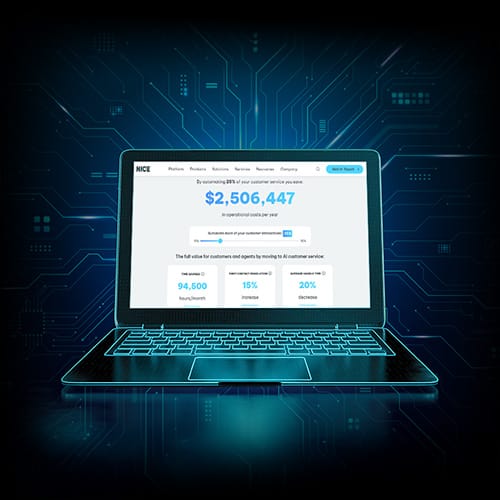
Discover the full value of AI in CX
Understand the benefits and cost savings you can achieve by embracing AI, from automation to augmentation.
What Every Use Case Needs to Operationalize
- Intent and policy definition. A written statement of what the agent may decide, what it may execute, and what it must escalate.
- Governed integrations. Authenticated, least-privilege access to the systems the use case touches — identity, CRM, billing, scheduling, fulfillment.
- Guardrails and escalation. Confidence thresholds, prohibited actions, value limits, and designed handoff paths with full context transfer.
- Evaluation and observability. Pre-release simulation and testing, plus production monitoring of accuracy, drift, and intervention rates.
- Ownership and governance. A named business owner per use case and alignment with the organization's AI risk management program.
Enterprises that treat these five requirements as part of the use case — not as separate compliance overhead — consistently reach production faster and expand autonomy with fewer reversals.
Conclusion
The winning agentic AI programs of 2026 are not the ones with the most ambitious use cases — they are the ones with the best-sequenced ones. Start verifiable, reversible, and data-ready; measure with a balanced scorecard; expand autonomy through evidence gates. NiCE can help you quantify the opportunity in your own interaction data and build the roadmap.
Continue Exploring Agentic AI
- Agentic AI hub — Concepts, capabilities, and implications of agentic AI.
- Agentic AI examples — Concrete illustrations of each use case in action.
- Autonomous customer service — Running resolution use cases as a governed operating model.
- KPIs for agentic AI CX — The measurement framework behind every phase gate.
- Cost reduction with autonomous AI agents — The economic mechanics of the highest-value use cases.
Frequently Asked Questions About Agentic AI Use Cases

Ready to experience the power of one platform?
Let us show you how NiCE can unify, automate and elevate your entire customer experience - with AI at the core and outcomes at the forefront.