



What Are Customer Insights?
Last Updated September 22, 2026
Customer insights are actionable understandings of customer behavior, needs, preferences and experiences derived from data. They help organizations move beyond reporting what happened to understanding why it happened, which customers are affected and what action is most likely to improve the outcome.
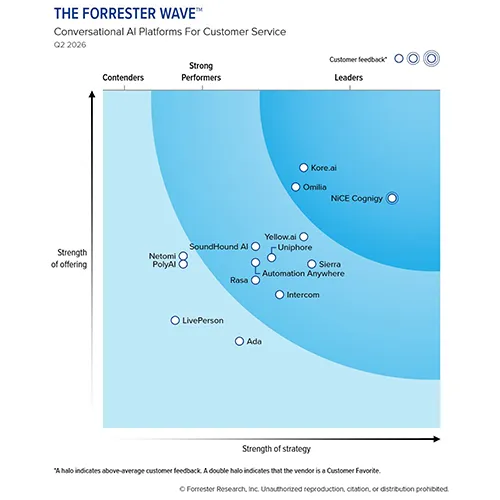
Named a Leader in The Forrester Wave™ 2026
Conversational AI Platforms
Ranked highest in the Strategy category. Above-average customer feedback among evaluated vendors.
Data is not the same as insight
A dashboard showing that repeat contacts increased is data. An analysis showing that repeat contacts increased because customers cannot complete a specific billing task in self-service is an insight. The insight points to a cause and creates a clear next step.
Useful customer insights usually combine multiple signals rather than relying on one source.
Where customer insights come from
Customer-service organizations can draw insight from:
- Voice and digital interaction transcripts.
- Customer surveys and feedback.
- CRM and account data.
- Purchase, billing and service history.
- Digital journeys and self-service behavior.
- Quality and agent-performance data.
- Routing, wait-time and resolution data.
- Churn, retention and revenue outcomes.
Unifying these sources helps teams distinguish an isolated complaint from a systemic customer-experience issue.
Types of customer insights
Behavioral insights
These describe what customers do: which channels they use, where they abandon, which features they adopt and how frequently they contact support.
Sentiment and perception insights
These reveal how customers feel about an interaction, product or journey. Sources may include surveys, conversation sentiment, complaints and open-text feedback.
Intent insights
Intent analysis identifies what customers are trying to accomplish. Tracking intent volume and resolution can show which needs are growing and which journeys are difficult.
Predictive insights
Predictive models estimate what may happen next, such as churn risk, repeat contact, escalation or likelihood to accept an offer.
Operational insights
These connect customer outcomes with operational conditions such as staffing, routing, handle time, transfers or knowledge gaps.
What customer insights software does
Customer insights software collects or connects customer data, analyzes it and presents findings to business users. In customer service, this may include interaction analytics, journey analytics, sentiment, topic discovery, dashboards and AI-generated summaries.
The most useful systems do more than visualize data. They help teams move from a pattern to an action, such as creating a new knowledge article, changing a routing rule, fixing a broken digital journey or prioritizing a coaching program.
A practical customer-insight workflow
- Start with a business or customer question.
- Identify the data needed to answer it.
- Segment customers, interactions or journeys where appropriate.
- Analyze patterns and outliers.
- Validate the likely cause using multiple signals.
- Prioritize the action based on impact and effort.
- Measure whether the change improves the outcome.
This closed-loop approach prevents insight programs from becoming reporting exercises.
Customer insights and AI
AI expands the amount of customer data organizations can analyze, especially unstructured data such as calls, chats and emails. Generative AI can summarize themes and help analysts explore large datasets using natural language. Predictive AI can identify risk and next-best actions.
AI-generated insights should still be traceable to underlying evidence. Users need to be able to inspect the interactions or data behind a recommendation, particularly for high-impact decisions.
Choosing customer insights software
Evaluate whether the software can work with the data sources that matter to your organization and whether it supports the decisions teams actually need to make. Important capabilities can include interaction analytics, journey context, segmentation, real-time alerts, dashboards, predictive models, natural-language exploration, governance and integration with operational workflows.
How NiCE supports CX insights
NiCE CXone combines customer interaction data with analytics, AI, quality, workforce and orchestration capabilities. That helps organizations connect what customers say with what happened operationally and then use those insights to improve routing, service, knowledge, coaching and automation.
Also related
How NiCE is Redefining Customer Experience
NiCE offers the industry’s only unified AI platform for customer service automation. CXone revolutionizes how organizations automate customer service from start to finish—with channels, data, end-to-end workflows, and enterprise knowledge converging to improve customer experience at scale. With domain specific AI trained on the industry’s largest CX dataset, an open framework with endless integration possibilities, and a complete suite of advanced AI applications, CXone is one platform built for organizations of all sizes to deliver seamless customer service experiences, boost operational efficiency, and drive better outcomes.
Agentic Experience Automation
AI Agents for Sales and Marketing
AI Agents for Proactive Engagement
Engagement Orchestration
Workforce Empowerment
Contact us
If you would like to know more about our platform or just have additional questions about our products or services, please submit the contact form. For general questions or customer support please visit our Contact us page.