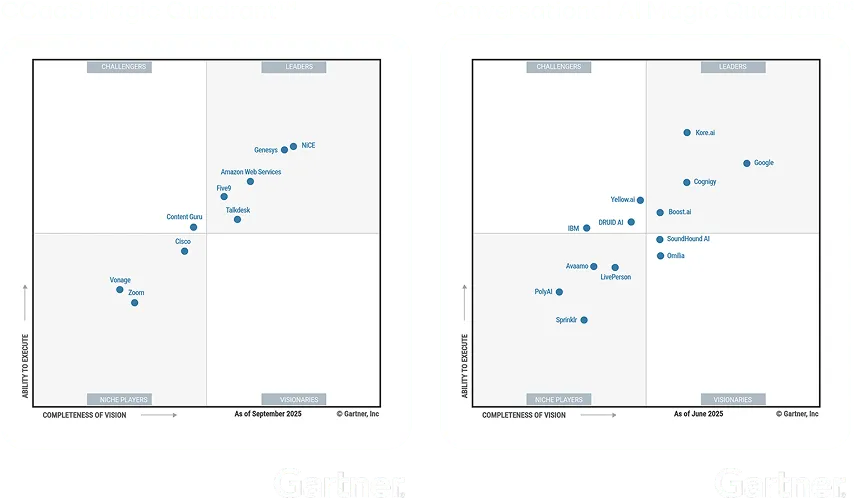
Intelligent workflow automation is the application of AI, machine learning, and process orchestration to business workflows — enabling systems to perceive inputs, apply contextual judgment, and adapt their behavior in real time rather than following static rule sets. It is the evolution from 'automated execution' to 'automated reasoning.'
Where Intelligence Enters the Workflow
Intelligence enters the workflow at four critical moments: when inputs arrive and require interpretation (NLP, document AI), when decisions must be made under uncertainty (ML classification and prediction), when exceptions fall outside predefined rules (adaptive exception handling), and when the system learns from outcomes to improve future performance (model retraining).
Two Leaders. One platform.
At NiCE, we’re setting the standard for AI-first customer experience.
The Three-Layer Architecture of Intelligent Automation
According to NiCE, intelligent workflow automation that delivers enterprise-grade reliability is built on three layers: Perception (reading emails, documents, voice, and structured data), Cognition (applying AI models to classify, predict, and decide), and Action (executing the next step, triggering integrations, or escalating to a human when confidence thresholds are not met).
Intelligent Automation vs. Rules-Based Automation: Key Differences
Rules-based automation breaks when inputs deviate from expected patterns — a fundamental limitation that intelligent workflow automation overcomes. Where a rules engine requires a human to define every edge case, an intelligent system identifies patterns across thousands of historical cases and handles novel inputs with a measurable accuracy rate, not a binary pass/fail.
Discover the full value of AI in CX
Understand the benefits and cost savings you can achieve by embracing AI, from automation to augmentation.Calculate your savings
Where Intelligent Workflow Automation Delivers the Most Value
Organizations deploying intelligent workflow automation see the greatest impact in high-volume, high-variation environments: contact center routing, billing dispute resolution, insurance claims processing, compliance review, and cross-functional approval workflows — all processes where variability is high and the cost of errors is significant.
Intelligent workflow automation incorporates AI and machine learning to interpret inputs, make context-aware decisions, handle exceptions, and improve over time — going well beyond the fixed rules of traditional automation. The defining feature is adaptability: the system adjusts based on what it perceives, not a pre-written script.
Yes. NLP and document AI components allow intelligent automation to process emails, PDFs, voice transcripts, chat messages, and other unstructured sources — extracting structured meaning and acting on it automatically, without human data entry.
Ready to experience the power of one platform?
Let us show you how NiCE can unify, automate and elevate your entire customer experience - with AI at the core and outcomes at the forefront.Watch the demoContact Sales