

Virtual Agent Testing and Optimization: Software-Grade Discipline for Conversations

Every operation has lived some version of the story: a well-meaning prompt tweak on Friday afternoon, no regression run because “it's just wording,” and a weekend of the virtual agent confidently mishandling a flow nobody thought was related. The root cause is never the tweak — it's the category error of treating conversational systems as content when they are software: versioned, tested, released, and monitored like anything else customers depend on. The hub defines the platform's job as the full lifecycle — design, deployment, monitoring, and continuous optimization — and this page is the engineering discipline that makes the last two real: what to test and in what volume, how changes ship safely, and how the post-launch loop compounds quality week over week. One delineation up front: the estate-wide *analytics practice* — discovering what to fix from live conversations — has its owner in conversational AI analytics; this page is the engineering counterpart that turns those findings into tested, shipped, verified improvements without breaking anything else on the way.
The Conversation Test Pyramid
What to test, in what volume — before customers do the testing for you
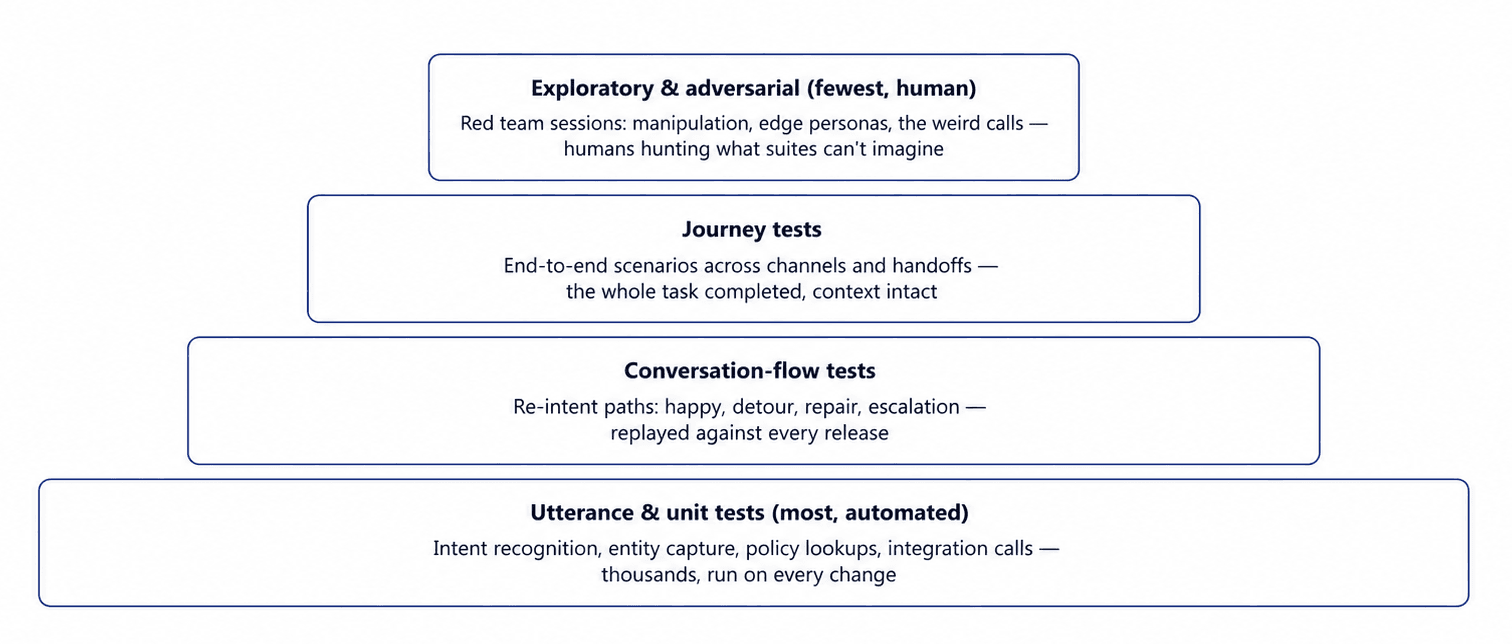
The regression rule: every bug that reaches production becomes a permanent test — the suite is the operation's memory of its own mistakes
Figure 1. What to test, in what volume. NiCE testing framework.
Utterance and unit tests form the wide, automated base: does each intent recognize its hundred phrasings (and refuse its near-misses), does entity capture pull the right order number from messy speech, does each policy lookup and integration call return what the flow assumes — thousands of assertions, cheap to run, executed on every change. Conversation-flow tests script each intent's paths — happy, detour, repair, escalation — and replay them against every release, catching the cross-flow breakage that “just wording” changes cause; this layer is where the conversation design contract becomes executable. Journey tests run the whole task end to end: across channels, across specialist handoffs, against real (staged) systems — the booking actually created, the context actually intact, the seams actually holding. And at the top, human adversarial sessions: red-teaming manipulation and injection (feeding the security program), edge personas, emotional extremes, the gloriously weird calls no suite imagines — because generative systems fail creatively, and only humans hunt creatively. Two rules bind the pyramid. *Non-determinism is managed, not ignored:* where responses vary, tests assert on outcomes and constraints — the task completed, the disclosure present, the boundary held — rather than exact strings. And *the regression rule:* every bug that reaches production becomes a permanent test, making the suite the operation's accumulated memory of its own mistakes.
The Release Pipeline: Everything Ships the Same Way
The Release Pipeline for Virtual Agent Changes
Prompts, flows, knowledge, and models all change — every change rides the same gated pipeline
- Build & version
Every change — flow, prompt, knowledge, model — versioned and attributable, no invisible edits to a production agent. - Test in staging
Full regression suite plus targeted tests for the change, failures block, not warn. - Canary release
A traffic slice gets the change, live metrics compared against control before full rollout. - Watch & roll back
Post-release monitoring on the release dashboard — with one-click rollback the moment the numbers argue.
The discipline that ends the Friday-afternoon prompt tweak that broke the weekend — conversational systems earn software-grade release engineering.
The gated release pipeline. NiCE release framework.
The pipeline's premise is that a production virtual agent has more change vectors than most software — flows, prompts, knowledge articles, model versions, integration contracts — and every one of them can break customer conversations, so every one of them rides the same gates. Build and version: each change versioned and attributable; no invisible edits to production, which for prompts and knowledge means treating them as code — reviewed, diffed, owned — and closing the side doors well-meaning editors use. Test in staging: the full regression pyramid plus tests targeted to the change, with failures *blocking* rather than warning, because a warning culture is a Friday-tweak culture with extra steps. Canary: a traffic slice receives the change while live metrics — recognition, completion, escalation, sentiment — run against control; conversational changes are precisely the kind whose real effects only live traffic reveals, which makes canarying more valuable here than in most software, not less. Watch and roll back: a release dashboard for the first hours and days, with one-click reversion the moment the numbers argue — rollback as routine hygiene, not emergency heroics. Model and prompt updates deserve one added note: they can shift behavior *globally*, so they earn the widest regression runs and the slowest canaries — the exact inverse of the casualness they usually receive.
The Optimization Loop: Launch Is the Starting Line
The Post-Launch Optimization Loop
Launch is the starting line — the weekly loop that compounds virtual agent quality
- Mine the misses
Failed recognitions, abandonments, escalations, and repair loops clustered weekly — the improvement backlog writes itself. - Fix at the root
Each miss sorted to its cause — knowledge, policy, flow design, or model — and fixed there, not patched at the symptom. - Test the fix in
Every fix lands with its regression test and rides the release pipeline — improvement without whack-a-mole. - Verify the movement
The targeted metric re-read after release — recognition, completion, containment-with-resolution — movement claimed only when measured.
Staffing note: the loop is a funded weekly rhythm with named owners — the operate muscle every abandoned bot story skipped.
The weekly post-launch loop. NiCE optimization framework.
The loop is the operational heartbeat the hub's continuous optimization promise depends on. Mine the misses: the week's failed recognitions, mid-conversation abandonments, escalations, and repair loops, clustered by pattern — the analytics practice's discovery output, arriving here as an engineering backlog. Fix at the root: each cluster sorted to its actual cause — a knowledge gap, an ambiguous policy, a flow design flaw, a model weakness — and fixed *there*, because patching symptoms (the extra prompt bolted over a broken flow) is how virtual agents accrete the scar tissue that eventually makes them unmaintainable. Test the fix in: every fix lands with its regression test and rides the pipeline — the discipline that separates improvement from whack-a-mole. Verify the movement: the targeted metric re-read after release — recognition on that intent, completion on that flow, honest containment where that's the claim — because a fix whose effect was never measured is a hypothesis wearing a checkmark. The staffing truth belongs in every business case: this loop is the *operate* muscle whose absence explains most abandoned-bot stories — a funded weekly rhythm with named owners, budgeted from day one alongside the build, exactly as the readiness discipline prescribes.
Testing the Estate, Not Just the Agent
As estates mature, the unit under test grows. Specialist teams need *seam tests* — the re-ask rate, handoff payload integrity, and loop detection the orchestration architecture defines — run as journeys, because individually perfect agents can still compose a broken conversation. Multi-channel estates need *consistency tests*: the same intent asked by voice and chat should meet the same policy and reach the same outcome, which is a test class, not an assumption. Authentication needs *step-up tests* woven through journeys — verification demanded exactly where the ladder says, never lost at a handoff. Escalation paths need *scheduled live fire* — synthetic escalations through to real queues, the same discipline the always-on model applies to overnight paths. And the suite itself needs maintenance review: tests that no longer reflect current policy are false confidence with a green badge. The through-line is the program's oldest rule in engineering clothes: trust is built by verification, and the estate that verifies most systematically is the one that can safely move fastest — expanding scope, shipping weekly, and retiring caution earned by evidence rather than hope.
Standing Up the Discipline
- Version everything on day one. Flows, prompts, knowledge, models — attributable, diffable, reviewable. Retrofit is miserable; start clean.
- Build the pyramid from the base. Utterance tests first (cheap, huge coverage), flows next, journeys once integrations stabilize, red-teaming on a calendar.
- Gate before you're big. The pipeline installed at one agent is habit; installed at ten agents is a migration project.
- Fund the weekly loop as headcount, not intention. Named owners, protected hours, a visible backlog — the operate muscle, budgeted.
- Keep score on the discipline itself. Regression escape rate, rollback frequency, fix-to-verified time — the meta-metrics that prove the machine is working.
The Velocity Dividend
The objection this discipline always meets is speed — gates, suites, and canaries sound like bureaucracy to a team that used to ship a prompt edit in an afternoon. The lived experience runs the other way, for the same reason it did in software: the afternoon-edit shop is fast until the first production incident, after which every change moves at the speed of fear — review meetings multiply, releases batch up waiting for safe windows, and the estate ossifies exactly when the optimization loop is generating its richest backlog. The gated estate inverts the curve: because every change is regression-protected and rollback is one click, small changes ship continuously with low ceremony — the weekly loop lands a dozen root-cause fixes where the fearful shop debates one — and the big changes (a model version, a new specialist joining the team) become graduated experiments instead of bet-the-quarter events. The meta-metrics make the dividend visible to leadership: fix-to-verified time falling, release frequency rising, regression escapes flat at near-zero — the three-line chart proving that discipline bought speed. That is the mature answer to the velocity objection: testing isn't the tax on iteration; it's the infrastructure that makes iteration cheap enough to do weekly, forever — which is what continuous optimization actually requires.

Discover the full value of AI in CX
Understand the benefits and cost savings you can achieve by embracing AI, from automation to augmentation.
Conclusion
Version everything, test in pyramids, ship through gates, and run the weekly loop like the heartbeat it is — conversations are software, and the estates that engineer them like software are the ones still improving in year three while the Friday-tweak shops rebuild. NiCE's platform carries the lifecycle; this page's discipline is how your team carries its half.
Explore the NiCE CX AI Platform
Continue Exploring the AI Virtual Agent Platform
- AI Virtual Agent Platform hub — The complete guide to the virtual agent platform.
- Virtual assistant platform for customer service — The platform foundations this discipline runs on.
- Multi-agent orchestration — The seams the estate-level tests exist to guard.
- Virtual agent containment rate — The honest metric the optimization loop moves.
- Conversational AI analytics — The discovery practice this engineering discipline ships.
Frequently Asked Questions About Virtual Agent Testing and Optimization

Ready to experience the power of one platform?
Let us show you how NiCE can unify, automate and elevate your entire customer experience - with AI at the core and outcomes at the forefront.