

The AI Contact Center Adoption Roadmap: Sequencing Capabilities in Four Waves
On this page
- Wave One: See — Intelligence on Existing Operations
- Wave Two: Assist — Value on Every Interaction, Risk on None
- Wave Three: Automate — Resolution at Scale
- Wave Four: Orchestrate — The Compounding Operation
- The Gates Between Waves
- Why This Order — and When to Bend It
- Common Sequencing Mistakes
- Who Owns Each Wave — and How the Funding Works
- Conclusion
- Continue Exploring the AI Contact Center Platform
- FAQs
- Wave One: See — Intelligence on Existing Operations
- Wave Two: Assist — Value on Every Interaction, Risk on None
- Wave Three: Automate — Resolution at Scale
- Wave Four: Orchestrate — The Compounding Operation
- The Gates Between Waves
- Why This Order — and When to Bend It
- Common Sequencing Mistakes
- Who Owns Each Wave — and How the Funding Works
- Conclusion
- Continue Exploring the AI Contact Center Platform
“Where do we start?” is the most consequential question in contact center AI, and the most common answers — start with a chatbot, start with whatever the incumbent vendor shipped this quarter, start everywhere — produce the stalled programs everyone has seen. This roadmap answers it structurally: four waves, sequenced so that each wave delivers standalone value, builds assets the next wave inherits, and generates the evidence that makes the next wave's decisions data-driven. It assumes the platform question is settled — the selection method lives in how to choose an AI contact center platform — and it deliberately does not cover platform or cloud migration itself, which has its own NiCE guides in the cloud migration glossary and the move-to-the-cloud solution. This page is about sequencing intelligence on the platform you run.
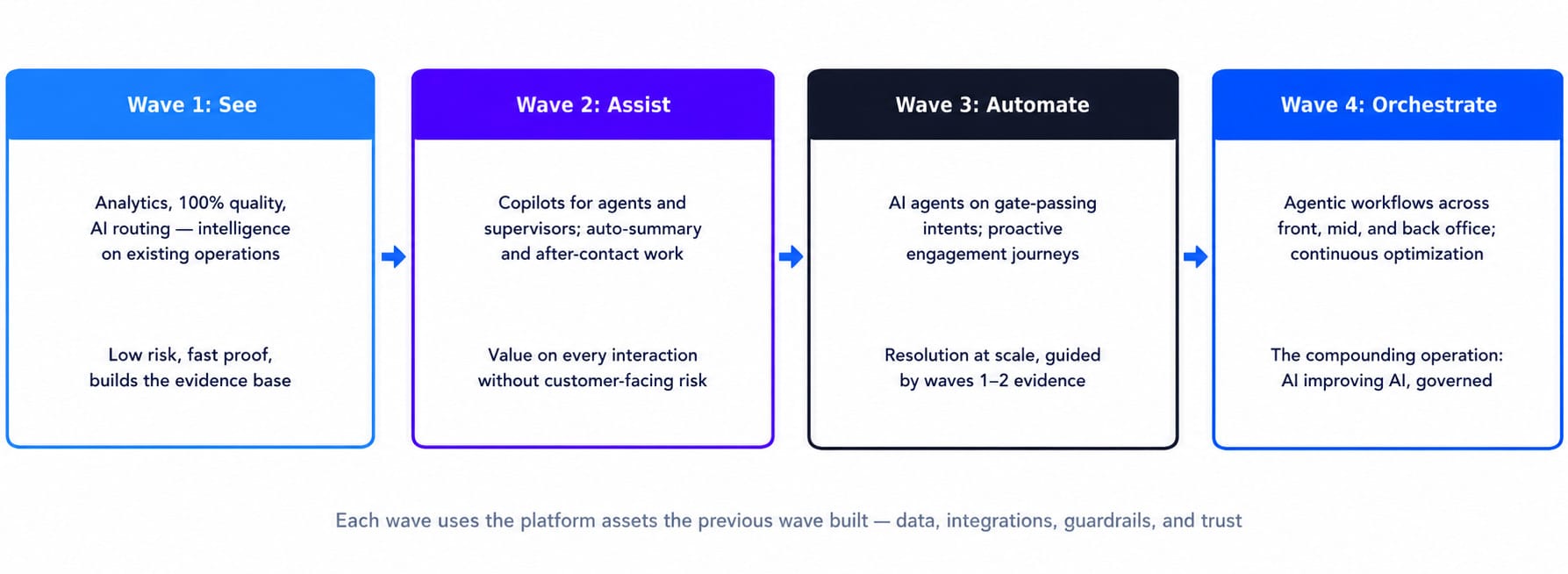
A Value-First AI Adoption Roadmap on One Platform
Four waves — each funds and de-risks the next; order adapts to where your pain is sharpest
Wave One: See — Intelligence on Existing Operations
Start where AI carries no customer-facing risk and pays immediately: full-coverage quality and analytics (Quality Management, Interaction Analytics) that replace the 2% sample with a census of every interaction; and intent-based routing (Omnichannel Routing) that improves outcomes for every contact without changing what agents or customers do. Wave one's deliverable is not just its own metrics — better matching, found root causes — but the program's evidence base: which intents dominate, what top-performing handling looks like, where knowledge gaps live, which contacts customers repeat. Every later wave will spend this evidence; the operations detail lives in AI in contact center operations.
Wave Two: Assist — Value on Every Interaction, Risk on None
With the operation visible, put AI beside every employee: Copilot for Agents for real-time guidance, knowledge, and automated after-contact work; Copilot for Supervisors for fleet focus and coaching queues; and AI forecasting and scheduling (Workforce Management) now feeding on wave one's data. Assist-wave AI is the trust-builder: agents experience AI as help rather than replacement, wrap-up minutes return to the schedule, and the organization learns to operate AI — monitoring, feedback, tuning — on workloads where a bad day is an inconvenience, not an incident. It is also the workforce-transition on-ramp: the role changes that full automation brings, covered in the enterprise implementation guide, begin here gently.
Wave Three: Automate — Resolution at Scale
Now the customer-facing move, made with evidence instead of hope: AI agents on the intents wave one proved suitable — high volume, clear policy, live data, verifiable outcomes, the four-gate funnel defined in AI agent use cases in customer service — deployed through AI Agents for Self-Service, with escalation designed per the handoff discipline and quality measured by the same full-coverage machinery that watches humans. Add proactive engagement (AI Agents for Proactive Engagement) to prevent inbound volume, and extend winning intents to voice under the channel's own rules, per voice AI agents. Wave three is where deflection-versus-resolution discipline decides everything: count automated only what verifiably resolved, and let repeat-contact rate referee.
Wave Four: Orchestrate — The Compounding Operation
The final wave connects automation into journeys: agentic workflows that span front, mid, and back office — the claim that processes its own refund, the disruption that rebooks and notifies and credits — through AI Agents for Process Automation and Orchestration, governed by the fleet-level controls in enterprise AI agent governance and security. Optimization becomes continuous: interaction data surfaces new automation candidates with projected impact, top human resolutions tune deployed agents, and the platform's improvement loop — the flywheel from platform capabilities — runs as the operating system of the center. Wave four never ends; it is what a mature AI contact center does on an ordinary Tuesday.
The Gates Between Waves
The Gate Between Waves: Four Questions Before You Advance
Advance on evidence, not on calendar — the gates keep ambition and safety in balance
1. Did the wave hit its numbers?
- Pre-committed metrics met on the balanced scorecard — resolution, experience, safety, economics
2. Is the operating muscle in place?
- Monitoring watched, escalations staffed, tuning loop running — not just deployed, but operated
3. Are the assets reusable?
- Integrations, knowledge, guardrails, and evaluation suites ready to be inherited by the next wave
4. Is the organization ready?
- Roles adjusted, teams trained, stakeholders bought in on what the next wave changes
Advance on evidence, not calendar. Before each wave: did the last one hit its pre-committed numbers on the balanced scorecard (KPIs for agentic AI CX)? Is the operating muscle real — monitoring watched, escalations staffed, tuning running, per the training lifecycle? Are the assets the next wave inherits — integrations, knowledge, guardrails, evaluation suites — actually reusable? And is the organization ready for what changes next? A failed gate is not failure; it is the roadmap telling you precisely what to fix before scaling what works.
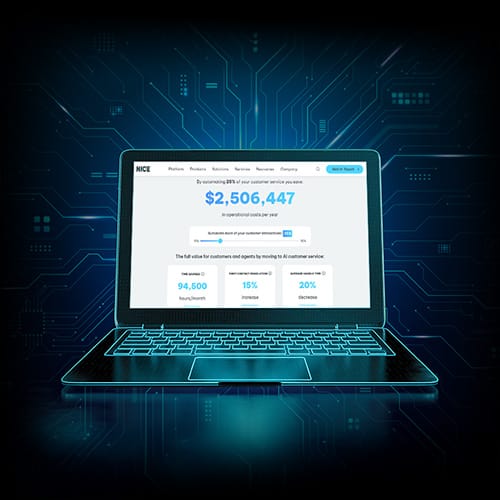
Discover the full value of AI in CX
Understand the benefits and cost savings you can achieve by embracing AI, from automation to augmentation.
Why This Order — and When to Bend It
Why Platform Programs Compound and Project Programs Stall
Value per quarter, qualitatively: shared assets bend the curve upward
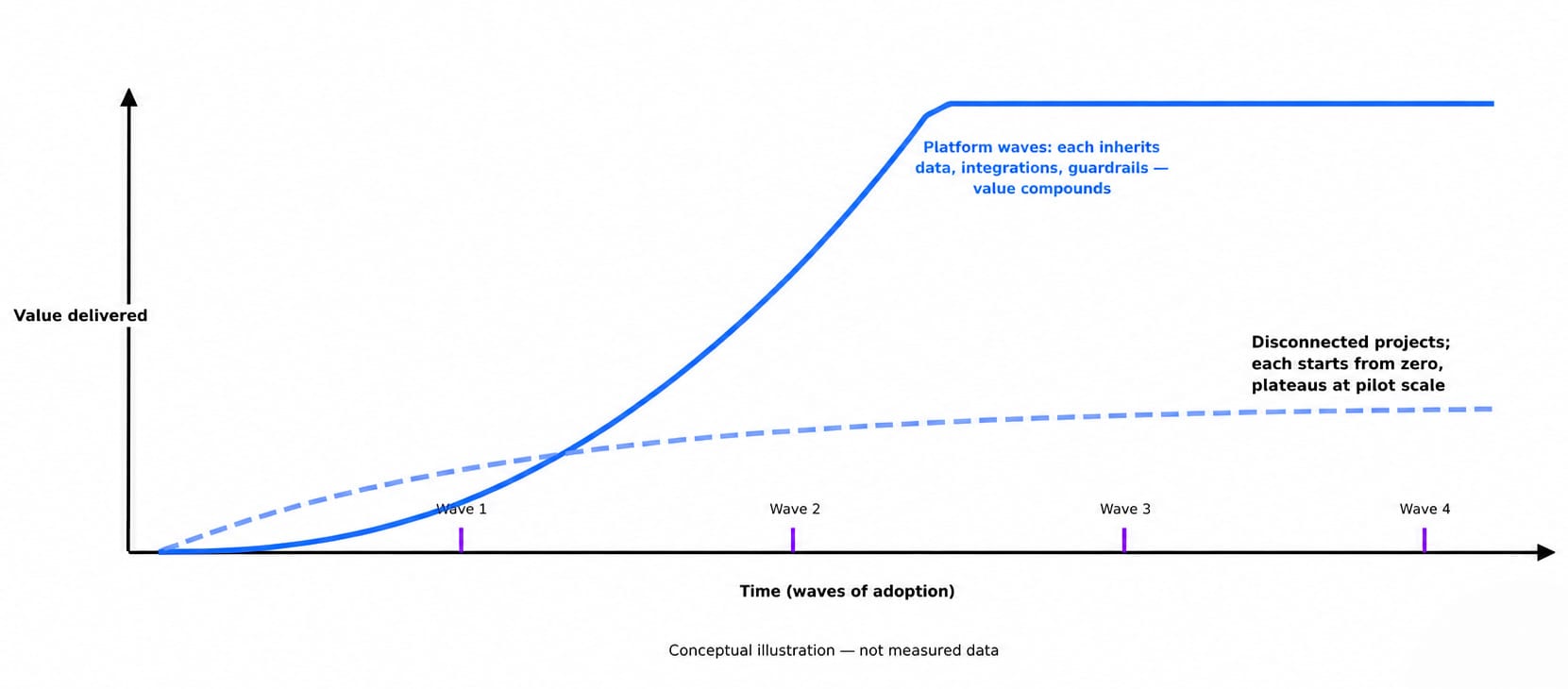
The order encodes three principles: evidence before automation (wave one makes wave three's choices data-driven), trust before autonomy (waves two's assist builds the human confidence wave three spends), and assets before ambition (each wave's integrations and guardrails are the next wave's head start). Bend it where your reality demands: an IVR replacement mandate may justify a narrow wave-three voice deployment early — run it as a contained exception with wave-one instrumentation around it, not as a new order of march. A center drowning in attrition might pull wave two forward for the copilot relief. What should never bend: the gates, the resolution-not-deflection standard, and the rule that every wave's success is measured against a baseline captured before it began.
Common Sequencing Mistakes
- Starting at wave three. Customer-facing automation without wave one's evidence or wave two's operating muscle — the classic stalled-pilot pattern, and the reason “start with a chatbot” has such a poor record.
- Treating waves as projects. Each wave is an operating capability to run permanently, not a milestone to pass; wave one's quality census must still be running when wave four orchestrates.
- Skipping the baseline. Value claims without a before-picture are unfalsifiable — capture baselines in wave zero, per the selection process in how to choose a platform.
- Sequencing by vendor roadmap. Adopt in the order your pain and evidence dictate, not the order features ship.
- Forgetting the humans. Every wave changes roles; staff the transition work — training, role redesign, supervisor enablement — as part of the wave, not after it.
Sequenced this way, the roadmap answers its own opening question. Where do you start? With sight. What do you buy with it? Trust. What do you spend the trust on? Resolution. And what does resolution compound into? An operation that improves itself — on one platform, one gate at a time.
Who Owns Each Wave — and How the Funding Works
Ownership shifts as the waves progress, and naming it early prevents the hand-off fumbles that stall programs between waves. Wave one belongs to operations: quality, analytics, and routing are operational tooling, and the operations leader who owns service levels should own their AI. Wave two is co-owned by operations and the frontline organization: copilot adoption lives or dies with team leaders and agent champions, so enablement is the deliverable, not deployment. Wave three adds CX and product ownership: customer-facing agents need journey owners, conversation design, and the training lifecycle staffed as a permanent function. Wave four is an enterprise program: cross-office orchestration pulls in IT, finance, and compliance as standing members, under the governance regime the enterprise pillar defines. The funding model mirrors the ownership: wave one is typically funded as operational improvement from the existing budget; wave two's returned wrap-up minutes and wave one's routing gains fund wave three's build; and by wave four the program should be self-funding on measured resolution economics — validated against your own volumes with the AI value calculator, never against industry averages. A roadmap whose waves each pay for the next is a roadmap no budget cycle can kill.
How long does the whole journey take? Honest answer: wave one produces value in weeks, and wave four never finishes — so the useful question is pace between gates, and the useful commitment is cadence: gates reviewed quarterly, evidence current, waves advanced or repaired on what the numbers say. Enterprises with strong data foundations and clear executive ownership move through the first three waves markedly faster than those rebuilding basics as they go — which is itself a wave-zero finding worth acting on. The roadmap is not a race; it is a compounding schedule, and the organizations that win are the ones that never stop paying into it.
Conclusion
See, assist, automate, orchestrate — four waves, four gates, one platform carrying the assets forward. Sequence by evidence and the program funds itself; sequence by enthusiasm and it stalls at the pilot. NiCE CXone was built for the whole roadmap, which is why customers can start with sight and end with an operation that improves itself.
Continue Exploring the AI Contact Center Platform
- AI Contact Center Platform hub — The complete guide to the AI contact center platform.
- AI in contact center operations — Wave one and two capabilities in operational depth.
- AI contact center platform capabilities — The full map the waves progressively switch on.
Frequently Asked Questions About AI Contact Center Adoption Roadmap

Ready to experience the power of one platform?
Let us show you how NiCE can unify, automate and elevate your entire customer experience - with AI at the core and outcomes at the forefront.