


What Are Workforce Management Tools?
Last Updated September 22, 2026
Workforce management tools are software applications that help organizations plan, schedule and manage employees against expected workload. In contact centers, WFM tools turn forecasted interaction demand into staffing requirements and schedules, then help supervisors and planners respond when actual volume or staffing differs from the plan.
Core capabilities in a contact center WFM tool
Forecasting and staffing
A WFM solution should forecast by the level of detail the operation actually manages, such as queue, skill, channel and interval. It should also account for handle time, shrinkage, seasonality and known business events where possible.
Accurate forecasting matters, but staffing decisions still need business context. Product launches, outages, policy changes and new channels may require planner judgment that historical data alone cannot provide.
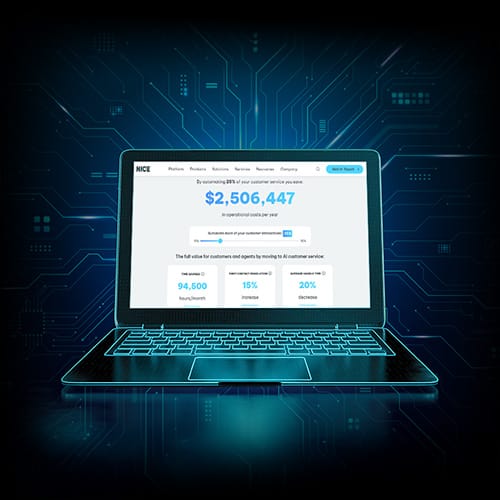
Discover the full value of AI in customer service
Understand the benefits and cost savings you can achieve by embracing AI, from automation to augmentation.
Scheduling and employee flexibility
Scheduling turns required staffing into individual work plans while respecting skills, availability, labor rules, contracts and business constraints. Modern tools can evaluate many schedule combinations and incorporate employee preferences without losing sight of service coverage.
Employee self-service features such as shift swaps and time-off requests can reduce administrative work and improve schedule flexibility when rules prevent changes that would create unacceptable coverage gaps.
AI in workforce management tools
- Detect changing demand patterns faster.
- Compare forecast models and identify likely error drivers.
- Optimize schedules across more constraints.
- Recommend intraday moves based on service impact.
- Surface recurring adherence or staffing patterns.
- Summarize workforce trends for planners and supervisors.
What to evaluate when comparing WFM tools
- Multi-channel and multi-skill forecasting.
- Forecast transparency and scenario planning.
- Schedule optimization and complex rule support.
- Real-time adherence and intraday reforecasting.
- Employee mobile and self-service experience.
- Integrations with routing, HR and time systems.
- Reporting that explains causes, not only outcomes.
- Security, permissions and data governance.
- Ease of configuration for planners and supervisors.
WFM tool vs. broader workforce optimization
WFM focuses primarily on forecasting, staffing, scheduling and adherence. Workforce optimization or workforce engagement suites may add quality management, performance management, coaching, analytics and employee engagement capabilities.
Organizations should decide whether they need a focused WFM tool or a broader platform based on how tightly those workflows need to work together.
How NiCE is Redefining Customer Experience
NiCE offers the industry’s only unified AI platform for customer service automation. CXone revolutionizes how organizations automate customer service from start to finish—with channels, data, end-to-end workflows, and enterprise knowledge converging to improve customer experience at scale. With domain specific AI trained on the industry’s largest CX dataset, an open framework with endless integration possibilities, and a complete suite of advanced AI applications, CXone is one platform built for organizations of all sizes to deliver seamless customer service experiences, boost operational efficiency, and drive better outcomes.
Agentic Experience Automation
AI Agents for Sales and Marketing
AI Agents for Proactive Engagement
Engagement Orchestration
Workforce Empowerment
Contact us
If you would like to know more about our platform or just have additional questions about our products or services, please submit the contact form. For general questions or customer support please visit our Contact us page.