

Too many customer experiences fall short of our expectations - they’re reactive, and we are forced to repeat ourselves because brands don’t seem to know who we are, and we end up doing the heavy lifting to get our issues resolved.
Last winter, a flight cancellation turned into Groundhog Day. My itinerary changed three times. Each change reset the experience: wait on hold, re-enter the reservation, explain what happened again, repeat the same preference - “aisle seat, please.” The disruption was manageable. The effort was the failure.
Now flip the script. Lufthansa has deployed AI agents that proactively engage customers during disruptions—automatically rebooking travelers and sharing seat selections directly in the conversation. At peak, those AI agents handle up to 375,000 conversations per day and roughly 16 million conversations per year. The point isn’t just the number. It’s also the operating model: intent detected, action executed, resolution delivered—at scale.
That is now the competitive line in CX. Executive teams are leaning into agentic AI to reduce customer effort, lower cost-to-serve, and scale decision-making across millions of interactions. The five priorities below are what separate promising pilots from enterprise outcomes.
In a recent NiCE webinar, Michele Carlson, Director, Product Marketing, CX, and I explored what determines whether agentic AI in customer service scales in the enterprise. Agentic AI in customer service detects customer intent, decides the next best action using policy and context, and executes the workflow needed to resolve the issue without waiting for a human to initiate each step.
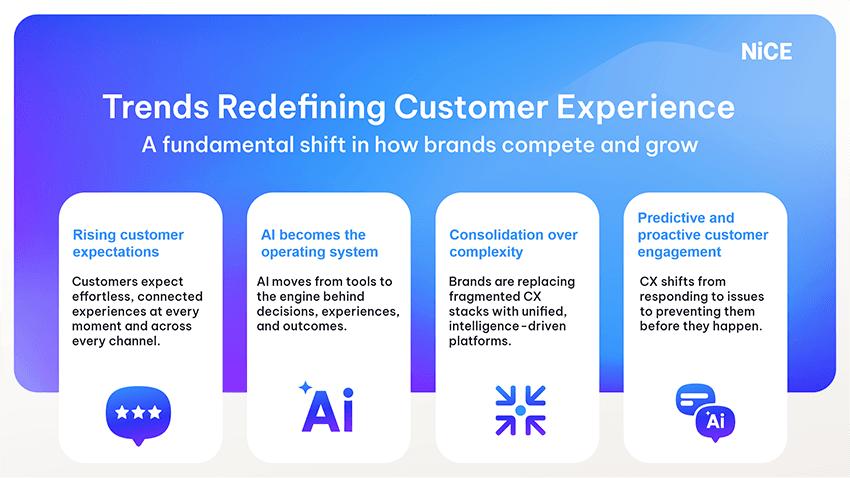
Trends redefining customer experience
What ‘agentic’ really means (in plain English)
Generative AI can be brilliant at answering questions. Agentic AI goes further: it completes work.
Think of it this way. If “normal AI” is the kid who tells you where your running shoes are, agentic AI is the kid who brings the shoes, ties them, and opens the door so you can start your run.
In CX terms, agentic systems don’t just respond - they detect intent, decide the next best action, and orchestrate the workflows required to fulfill it (refunds, rebookings, claims, payouts, policy updates) with the right level of oversight.
Scaling that capability is not a “deploy a model” project. It’s an enterprise operating shift. Here are five executive priorities that help organizations scale agentic AI without creating new complexity.
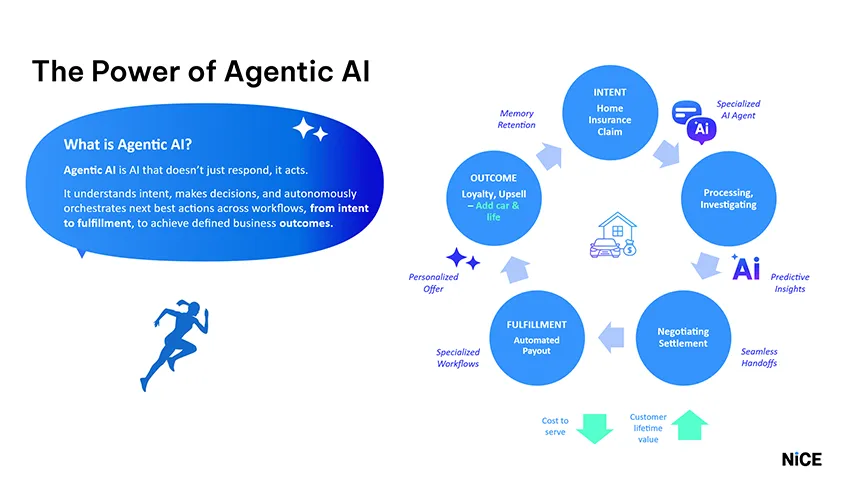
The power of agentic AI: An insurance use case
Priority 1: Redesign CX around outcomes, not interactions
Most organizations still run CX as an intake function: the customer contacts you, routing happens, the agent responds, and the case gets handled. That model optimizes for throughput.
Agentic AI changes the goal. It optimizes for resolution.
Executives should start by aligning stakeholders on the outcomes that matter:
- Lower customer effort (fewer steps, fewer repeats, fewer handoffs)
- Faster time to resolution (including back-office steps)
- Higher first-contact resolution
- Resilience during disruption (storms, surges, outages)
- Revenue protection and growth (retention, cross-sell/upsell when appropriate)
Then leaders can work backward from those outcomes:
- Identify a high-friction journey (rebooking, refunds, claims, billing disputes)
- Define “done” (one conversation, one workflow, one confirmation)
- Map the end-to-end work across front, middle, and back office
- Decide what can be fully automated, what needs human oversight, and where to blend the two
In other words: stop counting contacts. Start designing for completions.
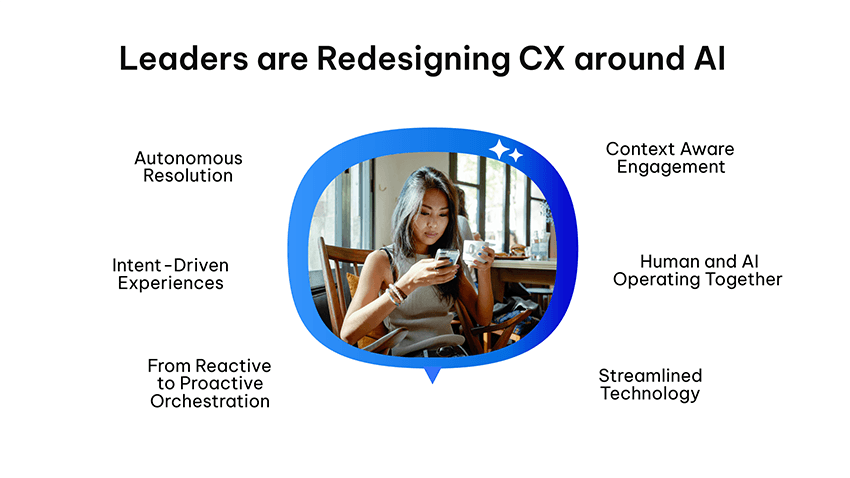
Leaders are redesigning CX around AI
Priority 2: Treat consolidation as a growth strategy (not just a cost play)
If agentic AI in customer service is the operating model, “tool sprawl” is what prevents it from scaling.
Fragmented CX stacks make agentic systems brittle: customer context is scattered across vendors and data stores, workflow automation sits in pockets, analytics can’t see end-to-end performance, and governance is inconsistent across teams.
That’s why more AI does not necessarily equal more intelligence. You can deploy multiple AI tools and still fail to deliver a connected, coherent experience.
Leading enterprises are simplifying to move faster:
- Marriott eliminated 11 vendor solutions by consolidating on CXone—reducing integration points and accelerating change. Six weeks into full platform integration, the team was already working through a backlog of 80+ improvements.
- MoneyGram unified 13 international contact centers on a single cloud solution—reducing average handling time for a digital queue by 30%, cutting transfers by 5%, and simplifying IVR applications from 30+ down to three.
Consolidation isn’t only about “doing the same for less.” It’s how you create the operating conditions for agentic AI: shared data, shared workflows, shared governance, and fewer seams where experiences break.
Priority 3: Build connected intelligence, or agentic AI will plateau
Agentic systems are only as effective as the intelligence they can access in real time.
That’s the real obstacle behind why customers still have to repeat themselves. It’s not a model problem. It’s a data and workflow problem.
Recent research underscores the challenge:
- DATAVERSITY found 68% of respondents cited data silos as their top concern.
- Omdia’s State of Digital CX research reports 49% cite slower customer service because data is hard to access quickly.
Connected intelligence is the antidote. It’s the ability to unify:
- Signals (intent, sentiment, context, behavior)
- Knowledge (policies, product rules, compliance requirements)
- Workflow (orchestration across systems of record)
- Measurement (observability from interaction → resolution)
The payoff is tangible. For example, Blue Cross of Idaho reduced average handle time by ~17% overall, with targeted processes reducing AHT by up to 87%, contributing to estimated annual savings of more than $250,000.
The strategic point: disconnected systems can’t learn at enterprise scale. Connected intelligence compounds value.
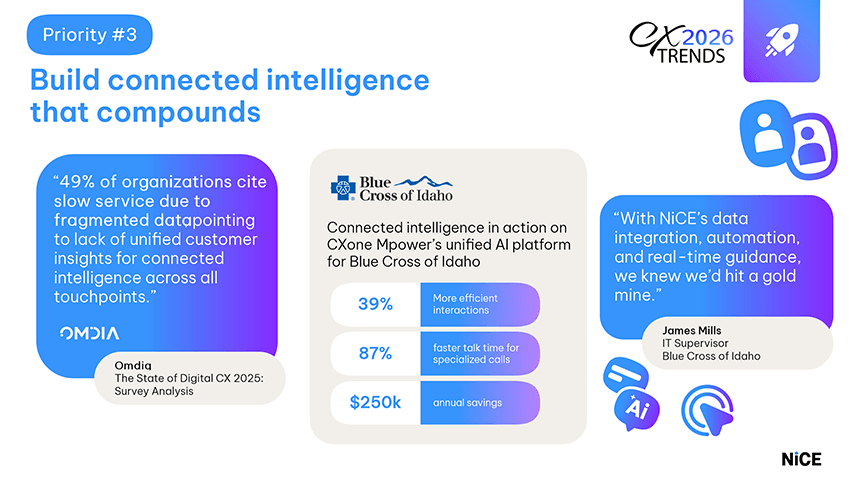
The power of connected intelligence
Priority 4: Design a hybrid workforce—humans and AI agents together
Agentic AI doesn’t replace work. It changes how work gets done.
Harvard Business Review has noted that agentic AI’s ability to reason and execute can transform human‑machine collaboration, creating major productivity upside, alongside new governance requirements.
The winning model is a hybrid workforce:
- AI agents handle repeatable, high-volume work end-to-end (or prepare it end-to-end and escalate for approval).
- Human agents focus on exceptions, empathy-heavy moments, complex negotiations, and high‑value retention.
- Leaders gain real-time visibility and can continuously tune journeys based on performance.
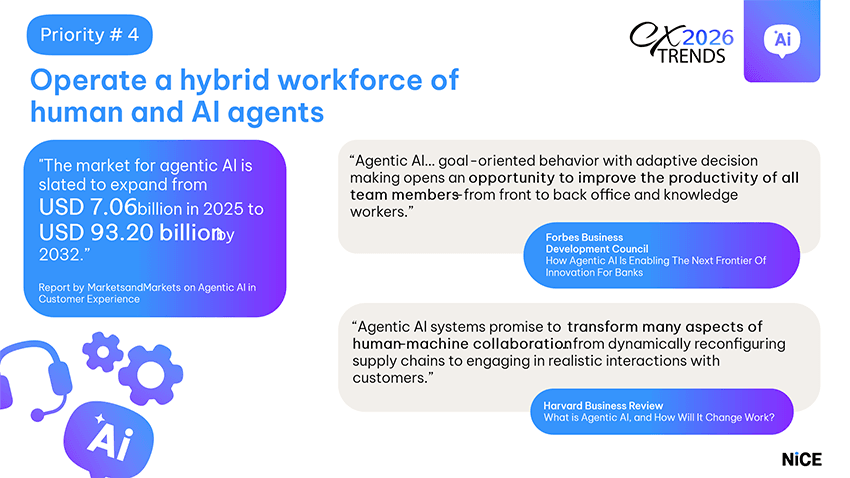
The power of people and AI
Two design principles matter most:
- Seamless handoffs. If a human takes over, they inherit full context—what the customer asked, what the AI did, what’s pending, and why.
- Learning loops. AI insights and human decisions become workflow improvements—every exception is a signal to tighten automation, knowledge, or policy.
And don’t ignore agent adoption. The fastest path to team buy‑in is showing what’s in it for them: fewer swivels, fewer repeated explanations, and more successful resolutions. Less stress and more personal satisfaction.
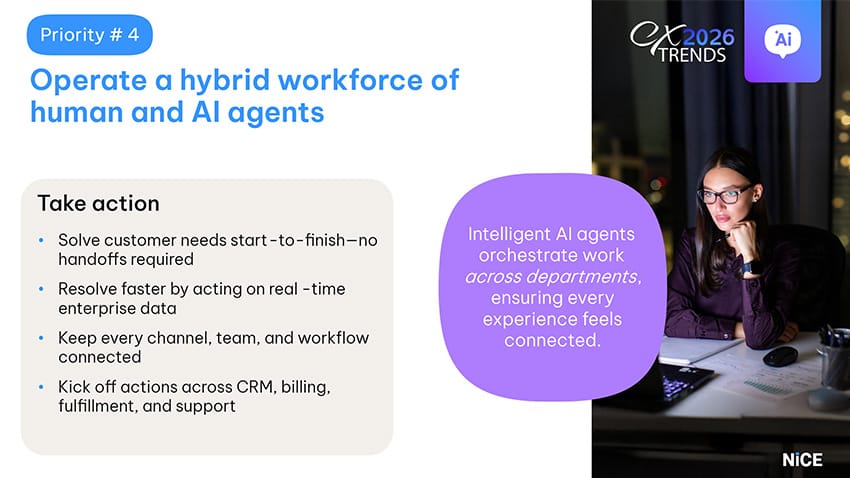
Human + agentic AI collaboration
Priority 5: Scale with guardrails - agentic + deterministic by design
The enterprise question isn’t “Can AI do it?”, it’s “Can AI do it safely, consistently, and in compliance - at scale?”
Observability and governance must be built into the system, not bolted on later. Executives should require:
- Brand and policy guardrails (what the AI can and cannot say/do)
- Deterministic workflows where needed (step-by-step processes for regulated use cases)
- Real-time observability (see what the AI decided, why, and what happened next)
- Continuous tuning (feedback loops, testing, and performance management)
This is how you prevent “AI that runs amok”—and how you earn the right to expand automation into higher-stakes journeys.
The proof point executives can’t ignore: Happiness is rising, but friction remains
NiCE’s Global Happiness Index 2025 found that 41% of consumers now “smile” at service interactions, and 72% report experiencing the benefits of AI and automation in the contact center. At the same time, 37% are still stuck repeating themselves with chatbots - a clear signal that automation without connected intelligence doesn’t deliver effortless CX.
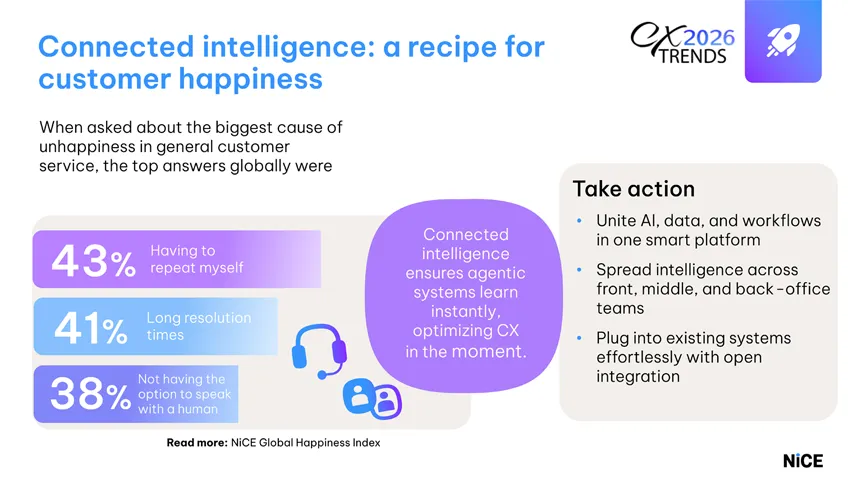
Connected intelligence as a recipe for customer happiness
That’s the executive mandate: remove the remaining friction, scale the gains.
Why platform architecture determines whether agentic AI scales
At enterprise scale, agentic AI succeeds through connection. The system needs access to customer context, policy rules, workflow steps, and workforce visibility in the same operating environment. When those elements sit in separate tools, the AI can answer faster while the actual work still stalls across handoffs.
That is where a unified CX AI platform earns attention. NiCE CXone is built as a unified CX AI platform that works as an operating layer that connects conversation, workflow, and oversight. Executives should be able to see what signals informed an action, what workflow was triggered across systems of record, what policy or compliance rule governed the decision, where human approval was required, and what outcome and audit trail were captured for continuous improvement.
- Agentic Experience Automation should move work from intent to fulfillment (not just deflection)
- Engagement Orchestration to route, coordinate, and optimize journeys across channels and systems
- Workforce Empowerment to enable the hybrid workforce with quality, performance, and continuous improvement
CXone’s open, extensible foundation helps enterprises connect systems of record and orchestrate workflows end-to-end, so automation scales without creating new seams.
When AI, workflow, and workforce share one intelligence layer, improvements compound: fewer repeats for customers, fewer swivels for employees, and clearer performance visibility for leaders. That is the platform story an executive can defend internally.
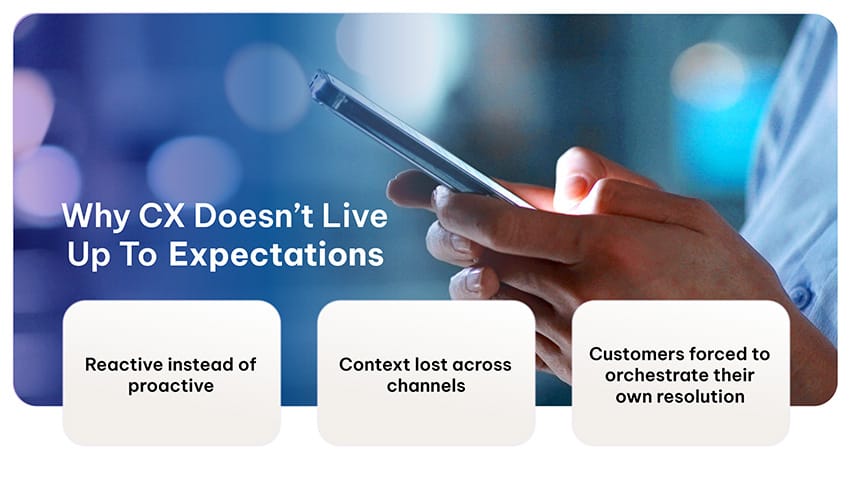
Why many customer experiences don’t live up to expectations
Connected intelligence on one platform removes friction
If you want agentic AI in CX to drive measurable business outcomes, treat it like a platform-led transformation, not a feature rollout.
Start with a high-friction journey. Define the outcome. Connect the intelligence. Orchestrate the workflow. Empower the workforce. Govern it in real time. Then scale - confidently.
Because customers don’t want more channels. They want less effort.
Get more insights on how AI in CX only works with connected intelligence.
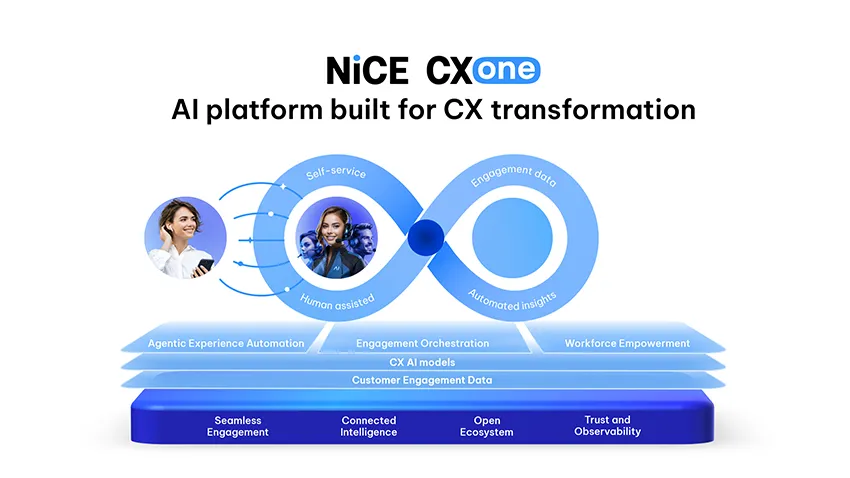
NiCE’s connected platform with market-leading AI agents creates learning loops where every engagement, human and automated, makes AI smarter and the customer experience better.