

On this page
- What are low-code AI agents?
- How a low-code AI agent works
- Capabilities to look for in a low-code AI agent platform
- Why low-code matters for enterprise CX
- Where low-code AI agents still need engineering
- Governance requirements for low-code AI agents
- How to evaluate a low-code AI agent platform
- Related topics
Last Updated November, 2026
Low-code AI agents give business and technical teams a faster way to design autonomous workflows without hand-coding every conversation, integration, policy, and action. The goal is not to eliminate engineering. It is to reduce the amount of custom development required for common agent workflows while preserving enterprise controls.
What are low-code AI agents?
Low-code AI agents are AI-driven applications that can understand a goal, use approved tools, follow workflow logic, and take actions while being configured largely through visual builders, templates, reusable components, and connectors. Developers can still extend the system with code, but common business workflows do not have to start from a blank application.
This approach matters in customer experience because contact centers often need dozens or hundreds of automation flows. If every new intent requires a custom engineering project, automation scales slowly. Low-code design can let CX, operations, IT, and development teams collaborate on reusable patterns for authentication, routing, knowledge retrieval, transaction execution, handoff, and monitoring.
Low-code vs no-code vs custom AI agents
No-code
- Best fit
- Simple, standardized workflows managed by business users
- Tradeoff
- Fastest setup but less flexibility for complex integrations and logic
Low-code
- Best fit
- Enterprise workflows that need speed plus extensibility
- Tradeoff
- Requires platform governance and some technical expertise for advanced use cases
Custom code
- Best fit
- Highly specialized workflows, proprietary logic, or unusual architecture
- Tradeoff
- Maximum control but higher development and maintenance effort
How a low-code AI agent works
- The agent receives a customer request, event, or business objective.
- AI interprets intent and relevant context using approved data and knowledge sources.
- Workflow logic determines which policies, tools, and actions are available.
- The agent calls connectors or APIs to retrieve data or execute approved actions.
- The system validates the result and either continues, completes the workflow, or escalates an exception.
- Observability captures the interaction, actions, outcomes, and handoff context for monitoring and improvement.
Capabilities to look for in a low-code AI agent platform
- Visual workflow and conversation design with reusable components.
- Prebuilt connectors for CRM, ticketing, knowledge, payments, scheduling, and enterprise systems.
- API and code extensibility when visual configuration is not enough.
- Role-based access and granular tool permissions.
- Human-in-the-loop approvals and exception routing.
- Testing, versioning, deployment controls, and rollback.
- Observability into model responses, tool calls, latency, cost, completion, and errors.
- Knowledge grounding and retrieval controls for trusted answers.
- Central governance across multiple agents, teams, and use cases.
Why low-code matters for enterprise CX
Customer service automation is rarely one workflow. Enterprises have many products, regions, policies, channels, and customer intents. Low-code patterns make it easier to reuse integrations and governance rather than rebuild the same infrastructure for every agent. Teams can standardize how agents authenticate customers, access data, call tools, record actions, and transfer exceptions.
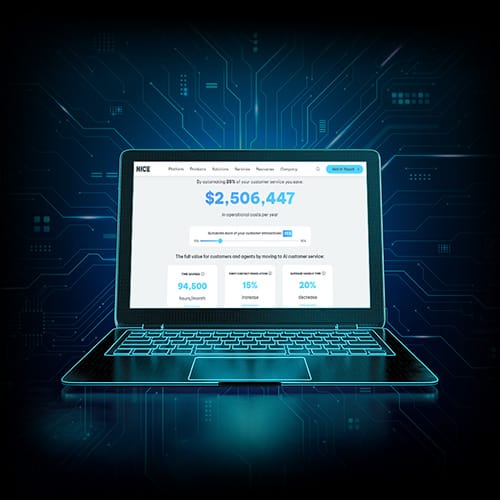
Discover the full value of AI in CX
Understand the benefits and cost savings you can achieve by embracing AI, from automation to augmentation.
Common low-code AI agent use cases in customer service
Order and delivery support
- What the agent can do
- Check status, explain delays, update preferences, and trigger approved next steps
Appointment management
- What the agent can do
- Find availability, reschedule, cancel, and confirm changes
Account servicing
- What the agent can do
- Retrieve account context, update approved fields, and complete routine requests
Billing support
- What the agent can do
- Explain balances, retrieve transactions, and initiate approved payment or dispute workflows
Returns and exchanges
- What the agent can do
- Check eligibility, create a return, generate instructions, and update systems
Proactive service
- What the agent can do
- React to events and start an approved workflow before the customer contacts support
Where low-code AI agents still need engineering
Low-code platforms accelerate common work, but they do not remove the need for architecture and engineering. Complex security models, proprietary systems, custom data contracts, high-volume integration, unique business rules, and specialized user experiences may still require development. The advantage is that engineering can focus on the difficult or differentiating work rather than rebuilding common agent infrastructure.
Governance requirements for low-code AI agents
- Use approved models and data sources for each workflow.
- Restrict tool access to the minimum permissions required.
- Define which actions can run autonomously and which require approval.
- Test normal flows, edge cases, prompt injection attempts, unavailable systems, and ambiguous requests.
- Maintain version history and controlled promotion from test to production.
- Monitor completion, policy adherence, customer impact, errors, cost, and escalation rates.
How to evaluate a low-code AI agent platform
The best evaluation starts with operating requirements rather than a visual builder demo. Ask whether the platform can connect to the systems that matter, enforce enterprise policies, support reusable components, let developers extend the platform, and provide centralized observability across every deployed agent.
Explore the broader agentic AI model, then compare agentic AI software and the architecture required to operate agents across CX.
Related topics
Frequently asked questions

Next step
Explore how NiCE approaches agentic AI for customer experience and how enterprises can operationalize governed AI agents across customer journeys, systems, and teams.