

On this page
- What is an AI assistant?
- What is an AI agent?
- The 6 biggest differences between AI agents and AI assistants
- When should you use an AI assistant?
- When should you use an AI agent?
- How AI agents and AI assistants work together in CX
- How to evaluate AI agents and AI assistants
- How NiCE supports human and AI work in one CX operating model
- Learn more about
Last Updated November, 2026
AI assistants and AI agents can both use natural language and generative AI, but they are designed for different levels of responsibility. An AI assistant primarily helps a person complete work, while an AI agent can interpret a goal, decide what actions to take, use tools, and execute multi-step work with a defined degree of autonomy.
AI agents vs AI assistants at a glance
Primary role
- AI assistant
- Helps a human user
- AI agent
- Works toward a defined goal
Autonomy
- AI assistant
- Low to moderate
- AI agent
- Moderate to high within guardrails
Typical output
- AI assistant
- Answer, recommendation, summary, draft
- AI agent
- Completed task, workflow, transaction, or resolution
Tool use
- AI assistant
- Often retrieves information or suggests an action
- AI agent
- Can call tools and systems to execute actions
Workflow depth
- AI assistant
- Usually one step or human-led sequence
- AI agent
- Can plan and execute multiple connected steps
Human involvement
- AI assistant
- Human remains the primary decision-maker
- AI agent
- Human can supervise, approve exceptions, or receive handoffs
Governance need
- AI assistant
- Access controls and response quality
- AI agent
- Access controls plus action limits, auditability, exception handling, and monitoring
What is an AI assistant?
An AI assistant is software designed to help a person work more efficiently. It can answer questions, summarize customer history, surface knowledge, draft responses, recommend next-best actions, or guide an employee through a process. The user generally remains in control of what happens next.
In a contact center, an AI assistant may listen to an interaction, retrieve relevant information, summarize the conversation, and suggest a response. The human agent evaluates that guidance and decides how to use it. This makes assistants especially useful when empathy, judgment, negotiation, or accountability should remain with a person.
What is an AI agent?
An AI agent is software that can pursue an objective and take actions across one or more systems. Instead of only generating an answer, an agent can determine the next step, call an API, update a record, trigger a workflow, verify whether the action succeeded, and continue until the task is complete or an exception requires human involvement.
For CX teams, that can mean resolving a routine service request, changing an appointment, processing a status inquiry, updating account information, initiating a return, or coordinating several systems during a customer interaction. The level of autonomy should always be bounded by business rules, permissions, risk controls, and escalation policies.
The 6 biggest differences between AI agents and AI assistants
1. Autonomy
Assistants are usually reactive: a person asks for help and the assistant responds. Agents can be proactive or event-driven, continuing work after the initial request as long as the next action remains within their approved scope.
2. Action versus advice
An assistant may tell an employee what to do next. An agent can be authorized to do it. That difference changes the technical requirements because action-taking systems need secure tool access, transaction controls, logging, and recovery paths.
3. Workflow depth
Assistants commonly support a single interaction or step. Agents can coordinate multi-step processes such as identifying intent, checking eligibility, updating a system, confirming the result, and communicating the outcome.
4. Decision boundaries
Assistants typically leave consequential decisions to the user. Agents can make bounded decisions when policies are explicit—for example, selecting an approved workflow or choosing among permitted actions based on customer context.
5. Governance and observability
Both require governance, but agents require additional controls because they can act. Enterprises should define permissions, approval thresholds, exception handling, audit logs, testing standards, and human escalation for every autonomous workflow.
6. Success measurement
Assistant performance is often measured through adoption, time saved, response quality, agent productivity, or reduced handle time. Agent performance also needs outcome measures such as completion rate, containment, resolution quality, exception rate, policy adherence, and cost per successful resolution.
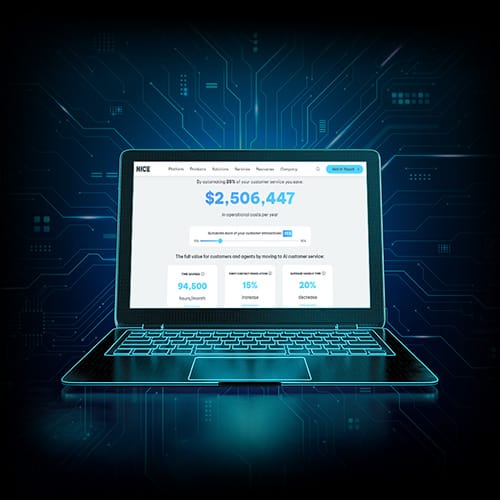
Discover the full value of AI in CX
Understand the benefits and cost savings you can achieve by embracing AI, from automation to augmentation.
When should you use an AI assistant?
- Use an assistant when a human should remain accountable for the final decision.
- Use an assistant when context is complex, emotionally sensitive, or highly variable.
- Use an assistant to summarize interactions, retrieve knowledge, draft responses, and surface next-best actions.
- Use an assistant when the workflow requires frequent judgment calls that are difficult to encode as bounded policies.
When should you use an AI agent?
- Use an AI agent for repeatable processes with clear goals and approved actions.
- Use an agent when customers benefit from immediate execution instead of receiving instructions.
- Use an agent when the workflow spans multiple systems but can be governed through permissions and business rules.
- Use an agent when success can be objectively verified, such as whether an appointment was changed or a payment arrangement was created.
How AI agents and AI assistants work together in CX
The most useful distinction is not “assistant or agent.” It is deciding where assistance should stop and autonomous execution should begin. A customer-facing AI agent can resolve routine requests, hand an exception to a human, and then an AI assistant can give that employee context, recommendations, and workflow guidance. The same platform can also use insights from human-assisted interactions to identify future automation opportunities.
For a broader view of the operating model, explore agentic AI and how autonomous AI agents in contact centers fit into enterprise CX.
How to evaluate AI agents and AI assistants
- Define the business outcome first, not the model or interface.
- Map which steps require human judgment and which can be safely automated.
- Confirm what enterprise systems the AI must read from or write to.
- Define action permissions, approval thresholds, and escalation rules.
- Require full observability into prompts, actions, tool calls, outcomes, and exceptions.
- Measure successful resolution and customer impact—not just model response quality.
How NiCE supports human and AI work in one CX operating model
NiCE CXone is designed to bring AI agents and human agents together on a connected CX platform. That makes it possible to combine automated resolution, human expertise, shared data, quality management, coaching, orchestration, and governance instead of operating each AI capability as an isolated point solution.
Learn more about
Frequently asked questions

Next step
Ready to move from isolated AI assistance to governed AI execution? Explore NiCE agentic AI capabilities and see how human and AI agents can work together across the customer journey.