

AI Workforce Management
for Contact Centers

- Introduction to AI-Powered Workforce Management
- Challenges in Traditional Workforce Management Systems
- The Role of Artificial Intelligence in Workforce Management
- Core Capabilities of AI-Powered Workforce Management Tools
- Demand Forecasting and Optimal Scheduling
- Key Benefits
- Common Use Cases
- Call to Action
- Frequently Asked Questions
Last Updated September 22, 2026
AI workforce management applies machine learning, optimization and automation to the contact center planning cycle. It helps workforce teams forecast demand, calculate staffing needs, build schedules and respond to intraday changes with less manual analysis and faster decision-making.
Where AI improves the WFM cycle
AI forecasting
Traditional forecasting often depends on historical averages and planner-selected models. AI can evaluate more patterns and variables, including shifts in contact mix, channel usage, seasonality and recent demand. The goal is not a perfect forecast; it is a forecast that responds quickly when the underlying pattern changes.
Planners should still review unusual events, product launches, outages, campaigns and policy changes that historical data cannot anticipate reliably.
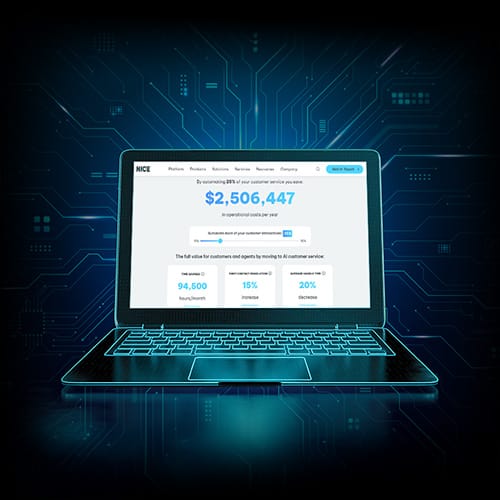
Discover the full value of AI in CX
Understand the benefits and cost savings you can achieve by embracing AI, from automation to augmentation.
Smarter scheduling without losing flexibility
Scheduling is a constrained optimization problem: the organization needs coverage, employees need workable schedules and labor rules must be respected. AI can evaluate more combinations than a planner can manually, but the schedule is only useful if it reflects real skills, preferences, contracts and operating requirements.
Modern WFM can also support self-service actions such as shift swaps, time-off requests and schedule preferences within defined rules.
Intraday automation
- Alert teams when actual volume or handle time departs from forecast.
- Identify intervals at risk of under- or overstaffing.
- Recommend overtime, voluntary time off or schedule moves where permitted.
- Reforecast the remaining day using current demand.
- Prioritize changes by customer and employee impact.
What to evaluate in AI workforce management software
- Forecast accuracy and transparency.
- Multi-skill and omnichannel planning.
- Schedule optimization and rule handling.
- Intraday reforecasting and scenario planning.
- Employee self-service and preference support.
- Integration with routing and workforce data.
- Explainable recommendations and auditability.
- Security, access controls and governance.
Measure outcomes, not just forecast accuracy
Forecast accuracy matters, but it is not the final business outcome. Track service level, wait time, occupancy, overtime, schedule stability, adherence and employee experience alongside forecast error. An AI model that improves forecast accuracy but produces impractical schedules has not solved the workforce problem.
Contact us
If you would like to know more about our platform or just have additional questions about our products or services, please submit the contact form. For general questions or customer support please visit our Contact us page.