

Customer Analytics Software for Actionable Customer Insights

On this page
Last Updated November, 2026
Customer analytics software helps organizations analyze customer data to identify trends, segments, behaviors, performance patterns, and experience signals. It gives teams a structured way to move from raw customer data to measurable findings that can guide service, experience, and business decisions.
What is customer analytics software?
Customer analytics software is designed to analyze data about customers and their interactions with an organization. It can help teams measure behavior, compare segments, identify trends, understand outcomes, and find relationships between customer actions and business performance.
Unlike a static report, analytics software typically allows users to filter, segment, compare, and explore data. More advanced tools may use AI or machine learning to detect patterns, surface anomalies, identify drivers, and help users explore questions without manually building every analysis.
Customer analytics is especially valuable when data from service, digital, journey, feedback, and business systems can be analyzed together instead of in separate silos.
What customer analytics software can measure
The specific metrics depend on available data, but common areas include customer behavior, service demand, channel usage, journey progression, satisfaction signals, retention indicators, product or feature adoption, contact reasons, outcomes, and segment differences.
For CX teams, the most useful analysis often connects operational metrics with customer context. A change in contact volume, for example, becomes more actionable when teams can identify which customers were affected, what issue they encountered, where it happened, and what outcome followed.
Core capabilities to evaluate
Look for flexible segmentation, trend analysis, dashboards, drill-down exploration, anomaly detection, data blending, filtering, and the ability to connect analytical findings to the underlying customer events or interactions.
AI-assisted analysis can help users discover patterns faster, but teams should still evaluate transparency and evidence. Users need to understand why a conclusion was surfaced and be able to inspect the supporting data.
Integration is equally important. Customer analytics becomes more valuable when it can work with the systems that already contain service, CRM, digital, feedback, and operational data.
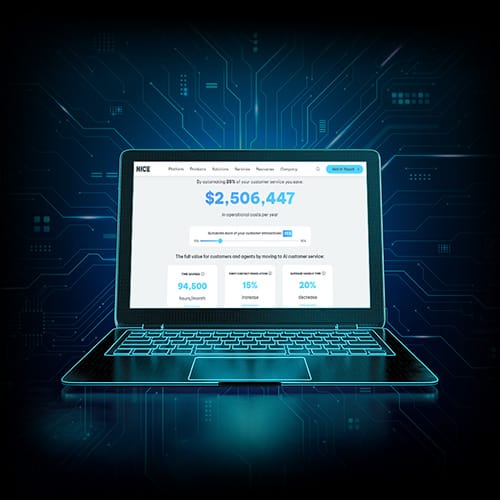
Discover the full value of AI in CX
Understand the benefits and cost savings you can achieve by embracing AI, from automation to augmentation.
Customer analytics software vs. business intelligence
General business intelligence tools can analyze many kinds of enterprise data. Customer analytics software is focused specifically on customer behavior, experience, interactions, and outcomes. That focus can make customer-specific segmentation, journey analysis, and CX use cases easier to operationalize.
Many organizations use both. General BI may support enterprise reporting, while customer analytics tools provide deeper customer-specific exploration and context.
How customer analytics supports customer experience
Customer analytics can help CX leaders identify which experiences are improving, where customers encounter friction, which segments behave differently, and where operational changes may have the greatest impact.
Service leaders can analyze contact drivers, repeat interactions, escalation patterns, channel behavior, and outcomes. Digital teams can compare customer behavior across journeys, while analysts can connect experience metrics to operational or business results.
The goal is to make analytics actionable: teams should be able to translate findings into a clear decision, test, workflow change, or experience improvement.
How to choose customer analytics software
Define the questions the business needs to answer before comparing tools. Then validate data connectivity, segmentation, exploration, AI capabilities, governance, scalability, role-based access, and ease of use for both analysts and business users.
Also evaluate activation. If an insight requires multiple exports and manual handoffs before anyone can act, the value will be limited. Tools that fit into customer-service and experience workflows can shorten the path from analysis to improvement.
Explore Customer Intelligence Platform Topics
Frequently asked questions

Next step
Explore how a broader customer intelligence strategy can connect analytics to the customer context and workflows that make insights actionable.