

Email Analytics Software for Customer Service Conversations
Last updated: November 19, 2026
Email analytics software for customer service analyzes inbound and outbound support emails to identify customer intent, recurring topics, sentiment, response patterns, resolution issues, and emerging trends. Unlike marketing email analytics, which focuses on opens, clicks, and campaign engagement, customer service email analytics focuses on the content and outcome of the conversation itself.
What is email analytics software for customer service?
Customer service email analytics software analyzes the language and operational data contained in support email conversations. It can identify why customers are writing, which products or processes they mention, how sentiment changes during the thread, how long resolution takes, and which issues are repeatedly escalated or reopened.
The analysis may include individual messages or the full email thread. Thread-level analysis is especially important because meaning can change as an issue moves from first contact to resolution.
Customer service email analytics vs. marketing email analytics
Marketing email analytics is typically centered on campaign delivery and engagement metrics such as opens, clicks, conversions, and unsubscribe rates. Customer service email analytics is centered on the support interaction: intent, topic, sentiment, response quality, resolution, escalation, and customer effort.
The data sources and business questions are different, so organizations should be clear which type of email analytics a tool is designed to support.
What AI can identify in support emails
AI can classify contact reasons, detect recurring topics, extract order numbers or other entities, identify urgency, summarize long threads, estimate sentiment, flag risk language, and group similar cases. It can also help teams discover new categories when customer language changes faster than manually maintained taxonomies.
Because email often contains detailed explanations, it can be a rich source of product and process feedback that is less visible in short-form channels.
Email analytics use cases
Support leaders can use email analytics to identify common reasons for delayed resolution, measure repeat or reopened issues, find knowledge gaps, locate emails that require quality review, and compare performance by team or issue type. Product teams can use recurring email themes to identify defects or confusing experiences.
Analytics can also reveal where customers are using email because another channel failed, making it useful for broader journey and self-service improvement.
How to analyze email conversations responsibly
Email may contain sensitive personal or account information, so access controls, retention, redaction, and data governance are essential. Organizations should also define which AI-generated labels are used for operational decisions and ensure users can review the original thread when context matters.
Accuracy should be evaluated across the language, products, customer populations, and issue types the organization actually handles rather than relying on generic benchmark claims.
How email analytics fits conversation intelligence
Email is one component of the broader customer conversation. When email analytics is connected with voice, chat, and messaging analysis, teams can compare intents and friction across channels instead of optimizing each channel independently.
That broader conversation intelligence view can reveal whether an issue starts in self-service, escalates to chat, and later ends in email—or whether the same problem is generating demand across every channel.
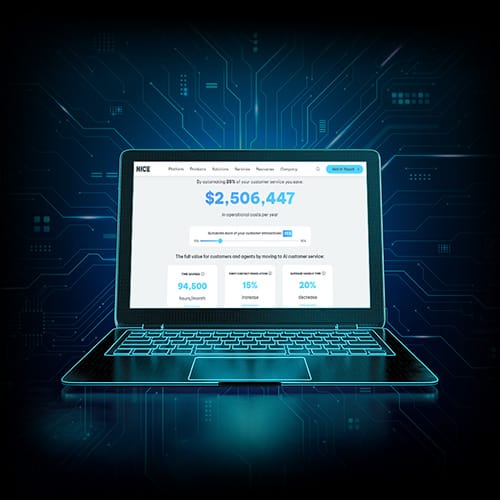
Discover the full value of AI in CX
Understand the benefits and cost savings you can achieve by embracing AI, from automation to augmentation.
Next step
Use NiCE to understand customer email conversations as part of a complete interaction intelligence strategy.
Frequently asked questions

Ready to experience the power of one platform?
Let us show you how NiCE can unify, automate and elevate your entire customer experience - with AI at the core and outcomes at the forefront.