Customer service has become the defining factor in customer loyalty, and the stakes have never been higher. Research shows that 65% of customers cite poor service as the top reason they leave a brand.[1] And CX leaders grow revenue at more than double the rate of companies that underinvest in experience, a gap McKinsey observed consistently across a five-year period, yet most organizations are losing that advantage in the broken handoffs that follow the interaction.The difference between loyalty and churn isn’t the interaction itself. It’s how quickly, and how seamlessly, an issue gets resolved.Yet most organizations are still operating in a fragmented reality. Customers move across channels but experiences don’t follow them. Agents are forced to navigate multiple systems just to understand a single issue. At the same time, Gartner research shows 91% of customer service leaders now report direct executive pressure to fix it with AI, with operational efficiency and self-service cited as the top priorities for 2026.AI has been introduced into this environment, but often only at the surface. It can respond, assist, and summarize, but too often it stops short of actually resolving the problem.That’s the gap organizations are facing today. And closing it requires more than incremental improvements. It requires a fundamentally different approach—one where AI, data, and workflows are fully connected to deliver outcomes.Closing this gap requires a shift to automated service fulfillment where AI and workflows are orchestrated end-to-end. The following three strategies show how NiCE and ServiceNow make that possible with a turnkey, AI-powered approach.
1. Start with a CX AI platform built for action
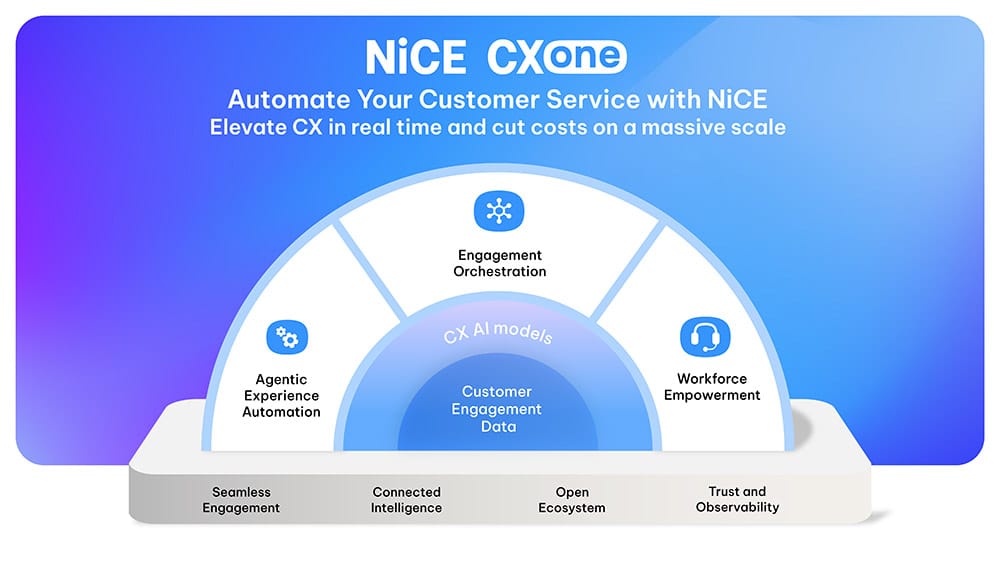
Most AI strategies fall short because they’re built on disconnected systems and generic models. They can respond, but they can’t resolve.NiCE CXone changes that. As the world’s leading CX AI platform, CXone is purpose-built for customer experience, powered by billions of real interactions capturing intent, behavior, and outcomes. Its AI models are trained specifically on CX language and workflows, enabling true agentic AI that understands, decides, and acts.This foundation drives three critical transformations:
Agentic Experience Automation – AI that completes tasks and delivers outcomes
Workforce Empowerment – Real-time intelligence that elevates every employee
Engagement Orchestration – Humans and AI working seamlessly from intent to resolution
What sets CXone apart is how it brings everything together - automation, orchestration, and workforce empowerment - in a single platform to transform customer service.
2. Connect the front, middle, and back office to eliminate service gaps
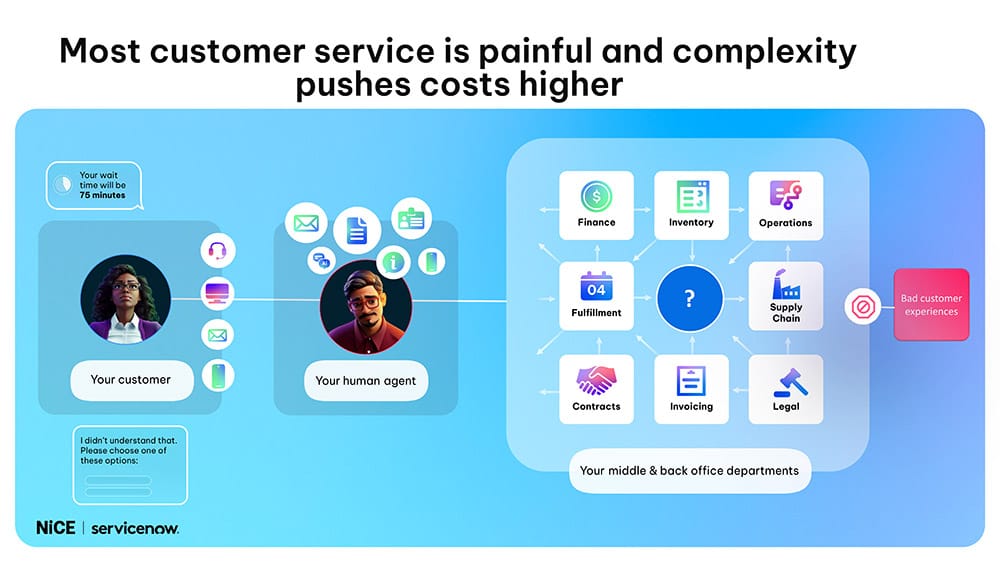
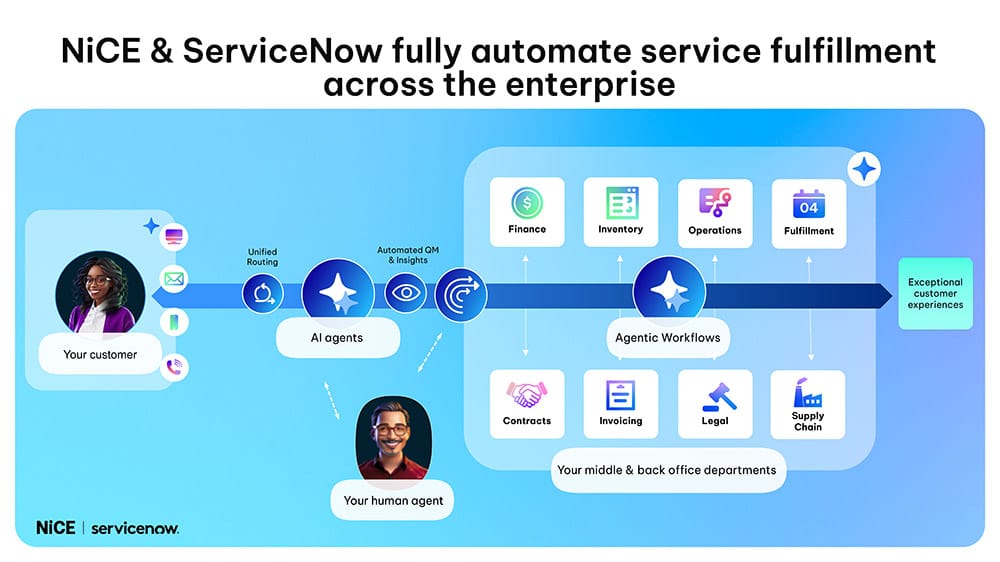
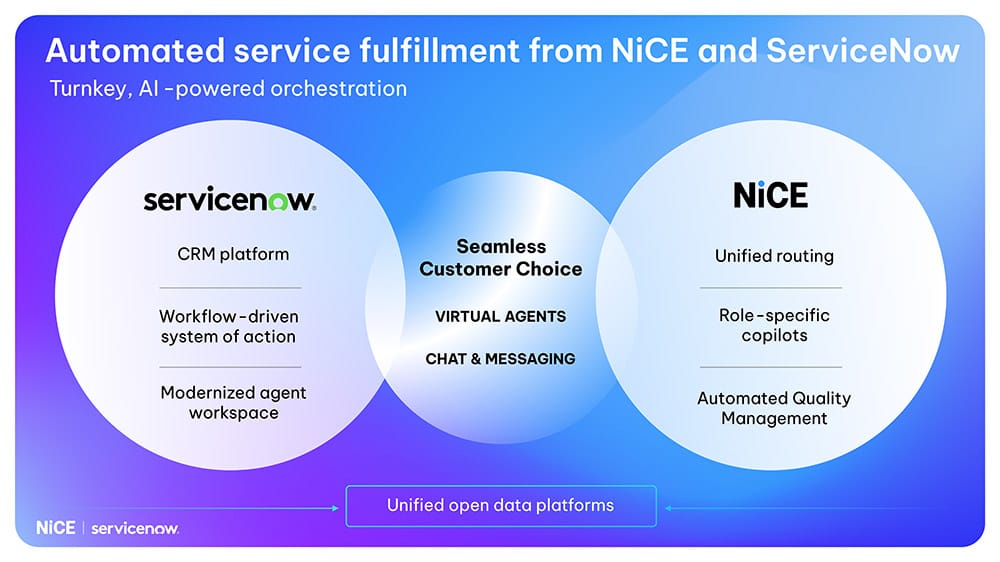
Customer service doesn’t break at the point of interaction. It breaks in the gap between systems. The contact center handles the request, while the back office resolves it. And everything in between relies on manual coordination. This “human middleware” is what slows service down, increases cost, and creates inconsistent experiences.The NiCE and ServiceNow partnership eliminates that gap.Together, we connect real-time customer engagement with the workflows and systems that actually deliver outcomes—bridging the front, middle, and back office into a single, unified operation.ServiceNow’s Customer Service Management (CSM) platform brings the system of action:
Orchestrating complex workflows across sales, service, and operations
Enabling AI-driven self-service and faster fulfillment
Optimizing resources—from agents to field technicians
Driving more personalized, connected customer relationships
NiCE brings the real-time intelligence and engagement layer.The result is enterprise-grade automation that doesn’t just manage interactions—it executes them end to end.
3. Turn AI into action across the enterprise
Customer service complexity shows up most clearly at the agent level with too many tools and channels and not enough visibility.NiCE & ServiceNow address this with:
A unified workspace across channels, bringing voice, chat, and digital interactions into a single, streamlined environment. With native call and chat controls and centralized routing logic, agents can manage interactions more efficiently, without switching between systems or losing context.
Intelligent routing and orchestration ensure every request is connected to the right employee or AI agent in real time, based on intent, sentiment, history, and SLAs, so workflows seamlessly across front, middle, and back office
Real-time intelligence for every role equips agents, supervisors, and leaders with immediate visibility into customer context and behavior, along with guided actions that improve decision-making and accelerate resolution
Continuous quality and performance optimization monitors interactions as they happen, identifying trends, risks, and gaps, and automatically improving workflows, coaching, and outcomes across the service lifecycle
Customer service is no longer defined by how well organizations manage interactions. It is defined by how effectively they deliver outcomes.
Orchestrated customer service connects AI, data, people, and workflows across the front, middle, and back office to resolve customer issues end to end. Instead of simply managing interactions, orchestrated service ensures that requests are routed, fulfilled, and completed across the systems and teams responsible for delivering outcomes.
Many AI customer service strategies fall short because they are built on disconnected systems or generic AI models. These tools can often respond to customers, summarize conversations, or assist agents, but they may not be able to take action across enterprise workflows. True customer service transformation requires AI that understands intent, makes decisions, and executes tasks through connected systems.
Agentic AI improves customer service by moving beyond simple automation to complete tasks and deliver resolutions. In customer service, agentic AI can understand customer intent, assess context, recommend or take action, and coordinate workflows across teams. This helps reduce manual handoffs, speed up resolution, and create more consistent customer experiences.
NiCE CXone and ServiceNow work together by connecting real-time customer engagement with enterprise workflow execution. NiCE provides the CX AI platform, intelligence, routing, and engagement layer, while ServiceNow Customer Service Management helps orchestrate workflows across service, operations, sales, and field teams. Together, they help organizations automate service fulfillment from customer intent to resolution.
Automated service fulfillment is the use of AI and workflow automation to complete customer service requests across the enterprise. Rather than relying on agents to manually coordinate between systems and departments, automated service fulfillment connects the right people, AI agents, data, and workflows to resolve issues faster and more efficiently.
AI can help eliminate service gaps by connecting customer interactions with the workflows and systems needed to resolve them. Intelligent routing, real-time context, unified agent workspaces, and workflow orchestration ensure that customer requests move seamlessly from the contact center to the right back-office team, employee, or AI agent without losing context or delaying resolution.