

Secure AI Agent Actions
Last updated: November 19, 2026
Secure AI agent actions are business or system operations protected by independent authorization, policy validation, limits, approval gates, and recovery controls before an AI agent is allowed to execute them. The central principle is that model reasoning can propose an action, but sensitive execution should be governed by deterministic controls that verify the action is allowed for that customer, resource, context, and risk level.
Why action security is central to agentic AI
The defining feature of an AI agent is the ability to move beyond answering questions and perform work. That work may change data, communicate externally, create transactions, or affect customers. The same autonomy that creates business value can create security risk when action execution depends entirely on probabilistic reasoning.
Secure action architecture separates recommendation from authorization. The agent can determine what it believes should happen, while policy and security services determine whether the operation is actually permitted.
Classify actions by impact
Create action classes such as read-only, low-impact reversible, customer-visible, financial, destructive, administrative, regulated, or irreversible. Each class can have its own requirements for identity, authentication, approval, transaction limits, logging, and rollback.
This prevents low-risk actions from being over-governed while ensuring high-impact actions receive stronger protection.
Enforce authorization outside the model
Before execution, verify user or customer identity, agent identity, resource ownership, permission scope, business policy, transaction limits, current state, and required approvals. The action service should reject requests that fail these controls even if the model is confident.
This protects the business when the model hallucinates, misunderstands intent, is manipulated, or calls the correct function with unsafe parameters.
Use confirmation and human approval strategically
Not every action needs a human. Approval should be based on consequence. Low-risk routine operations can execute automatically when deterministic checks pass. High-value, destructive, externally published, administrative, or regulated actions may require explicit confirmation or a human checkpoint.
Approval interfaces should show the proposed action, relevant context, affected resource, amount or scope, and reason so the reviewer can make a meaningful decision.
Design for reversibility and containment
Where possible, use drafts, staged changes, soft deletes, pending states, limited-duration changes, reversible transactions, or compensating actions. These patterns reduce the cost of mistakes and make autonomous workflows easier to trust.
Provide a fast method to disable a sensitive action class or revoke agent access without waiting for a full application deployment.
Audit and monitor privileged actions
Record agent identity, user context, action requested, parameters, policy decision, approvals, execution result, downstream effects, and relevant version information. Monitor for unusual action frequency, repeated denials, threshold probing, atypical resources, abnormal combinations, or actions outside the agent’s normal operating pattern.
Action telemetry should support both security investigations and continuous permission reduction.
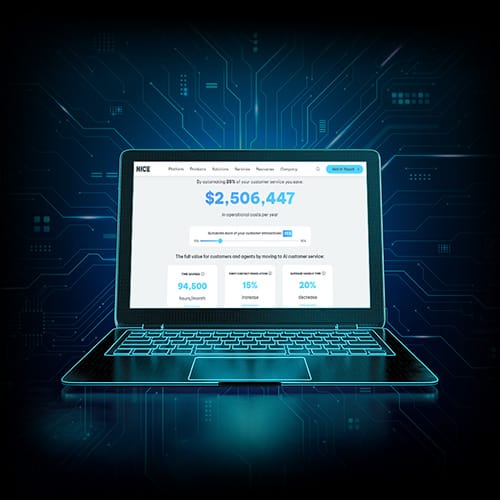
Discover the full value of AI in CX
Understand the benefits and cost savings you can achieve by embracing AI, from automation to augmentation.
Next step
Let agents automate meaningful work while keeping the final authority for sensitive actions in deterministic security and business controls.
Explore the AI Agent Security pillar
Frequently asked questions

Ready to experience the power of one platform?
Let us show you how NiCE can unify, automate and elevate your entire customer experience - with AI at the core and outcomes at the forefront.