Overview
Your contact center forecast is only as good as the model behind itMost WFM tools rely on a single forecasting method, even when it's the wrong one for your data. NiCE Workforce Management (IEX) uses AI to automatically select from four advanced models, so your forecasts are built on the method that best fits your history, not the one your software defaults to.What's inside
The whitepaper breaks down all four forecasting models in plain language: when to use each, what they're best at, and where they fall short.- Time series - weighted moving average: Proven for stable, interval-specific data. Best for near-term intraday accuracy.
- Time series - Box-Jenkins ARIMA: Iteratively identifies hidden patterns — powerful when no obvious trend is visible.
- Time series - Exponential smoothing: Automatically weights history for you, handling trend and seasonality simultaneously.
- Causal - Multilinear seasonal regression: Models cause-and-effect relationships — ideal for complex, cyclical patterns.
Best Pick — AI model selection
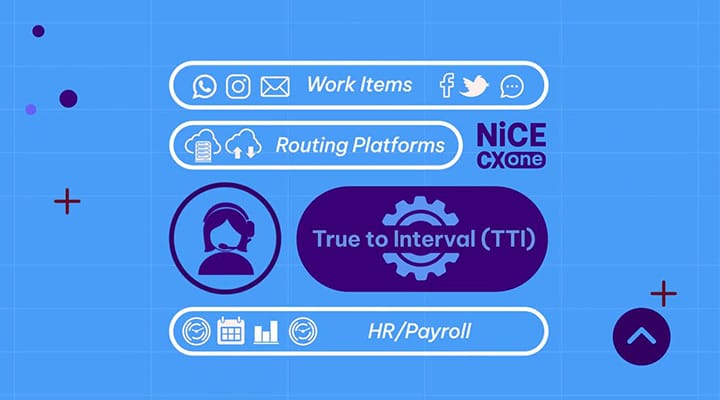
Not sure which model to use? NiCE WFM (IEX) can run all of the advanced models simultaneously and automatically select the one with the lowest forecast error. No manual tuning required.You'll also learn- True to Interval (TTI): How NiCE WFM (IEX) handles async digital channels, email, chat, and messaging, by tying handle time to when work actually occurs, not when contacts close.
- Model comparison table: A side-by-side accuracy breakdown across short-, medium-, and long-term forecasting horizons for all four models.
- Parameter guide: How nearly two dozen configurable options, from seasonal cycles to anomaly handling, behave differently across models.
- When to switch models: Research shows exponential smoothing outperforms ARIMA 55% of the time, and why that means you shouldn't lock into one method.