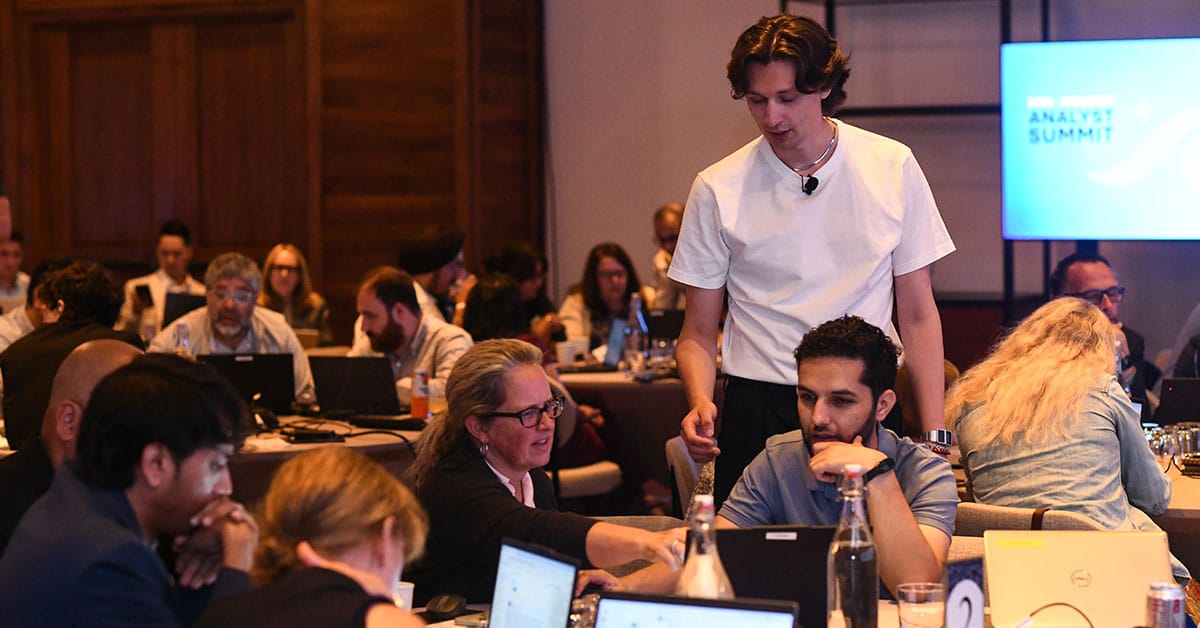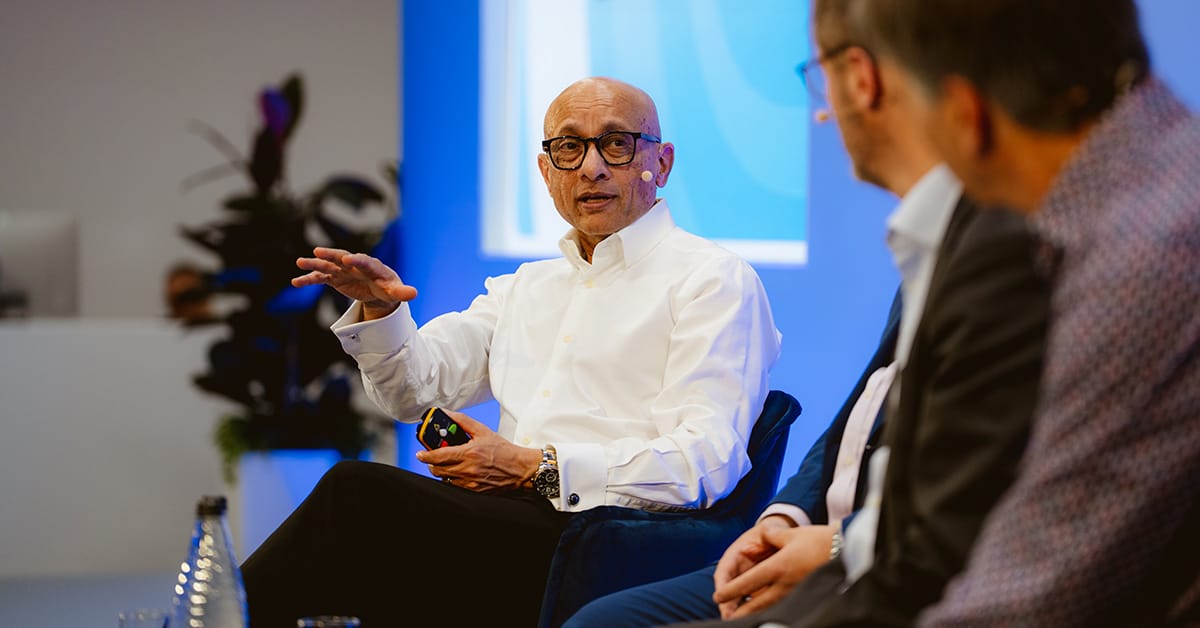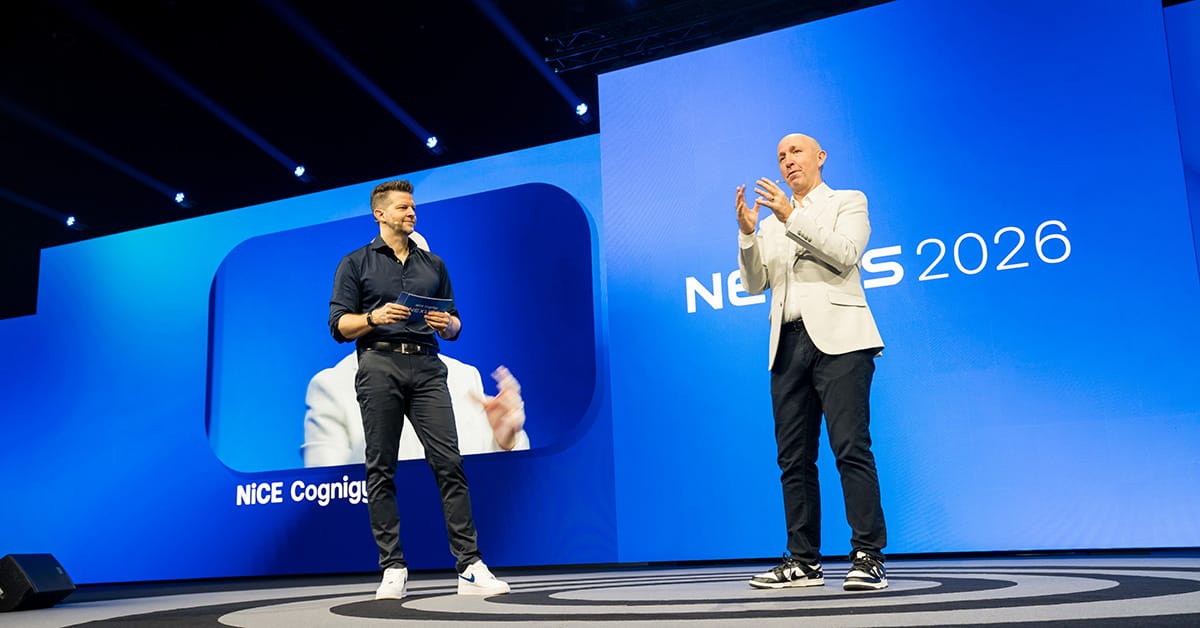

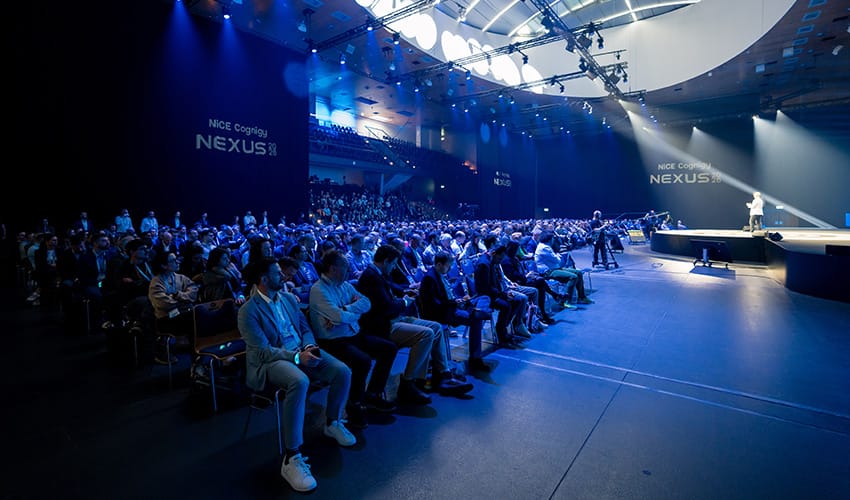
NiCE Cognigy’s Nexus 2026 made one thing clear: the agentic AI conversation has moved past theory. In Munich on March 11-12, more than 1,000 CX and AI leaders came together to talk about what is already working, what still needs discipline, and what it takes to scale AI in real enterprise environments.
Nexus 2026 brought together customer case studies, product announcements, live demos, and partner insight, all centered on one question: how do you turn AI from a promising tool into a dependable operating model for customer experience?
Here's what stood out from Nexus 2026 where the conversations focused on what happens when agentic AI stops being a future promise and becomes an operating reality.
1. 500% growth isn't a projection – it's already happened
NiCE Cognigy Chief AI Officer Philip Heltewig highlighted 500% growth in agentic deployments on the platform in the last year. Not 500% planned growth. Not projected. Deployed. Running. In production. The question now isn't whether enterprises are adopting agentic AI – it's whether they're doing it fast enough to stay competitive.
2. Customer stories replaced vendor promises
The standout difference from past events: customers went beyond describing pilots. They were reporting outcomes.
A major European insurer managing 50 million calls annually, now rolling out agentic AI across the group. A 40% reduction in inbound contact volume through proactive outbound automation. These numbers came from brands that committed to serious implementation work.
A large European retail group walked through a journey from classic NLU-based bots to a fine-tuned LLM handling roughly 150 conversation topics, now moving into a full multi-agent system managing 15 million customer cases annually.
Lufthansa Group described a shift that reduced handover rates by 20% with 72% of customer sessions now supported by AI. The focus wasn't containment for its own sake – it was routing customer needs through the right mix of automated and human expertise.
Generali used AI-driven conversation intelligence to mine 100,000 call recordings and identify 150 granular customer intents in a matter of weeks. That analytical foundation now feeds an end-to-end system targeting 65% automation.
PostNL provided another clear example of agentic AI moving from concept to execution. The company has launched multiple AI Agents, including a multilingual onboarding agent in Belgium that turns a complex registration process into a natural conversation and significantly reduces onboarding friction. PostNL also introduced a shipment creation agent, enabling customers to create validated shipping labels through a single prompt while AI orchestrates the underlying logistics workflow.
SKY added another compelling view of what agentic AI can do when service and engagement work together. The company showed how AI can understand customer intent, sentiment, and context in real time, resolve a service need naturally, and then extend the interaction into a relevant content recommendation. For SKY, that turns agentic AI into more than a containment tool. It becomes a way to make interactions more personal, increase viewing, and strengthen loyalty at scale.
Fabletics shared a still-evolving retention use case in which an agentic system is already pushing self-service save rates beyond what deterministic flows could deliver. The team is running structured A/B tests to validate uplift to determine real-world, hard-number results.
3. The path to results requires a strategic approach
The depth of work behind every compelling case study was the real story. A Fortune 100 insurer’s impressive agent assist program spans STT optimization, knowledge AI, process guidance, compliance coaching, and post-call analytics. One of Europe’s largest retail groups is running self-hosted LLMs in its own data centers, using fine-tuned models to balance performance with data sovereignty.
Every successful deployment reflected strategic thinking, governance frameworks and change management at scale – not just smart technology selection.

4. MCP integration makes AI talk to AI
NiCE Cognigy's embrace of Model Context Protocol (MCP) as a foundational architecture was the most strategically significant announcement. The company is positioning its platform as an MCP server, exposing workflows as tools that can be invoked by external AI agents via a standard protocol.
NiCE Cognigy Director of Product Marketing Sebastian Glock described MCP as an "integration revolution," replacing brittle point-to-point connectors with a semantic layer for tool discovery that requires minimal ongoing maintenance.
The practical meaning: prepare for customer service where AI talks to AI. These interactions will establish facts, negotiate options and escalate to humans only when judgment or empathy is required.
5. Automation discovery closes the loop from data to deployment
NiCE Cognigy introduced an automation discovery capability that analyzes engagement data—chats, voice, routing signals, and performance metrics—to identify automation opportunities and generate AI Agents from high-impact use cases. The result is a closed loop from engagement data to deployable AI Agents, accelerating time to value and aligning AI investment with measurable business outcomes.
6. Multivariate testing shifts AI evaluation from static QA to continuous performance engineering
Embedded Multivariate Testing was unveiled as an upcoming capability inside the existing Simulator to enable controlled side-by-side comparisons across prompts, guardrails, routing logic, fulfillment strategies, and foundation models.
This enhancement promises to help teams gain deeper performance insights before rollout, shifting from agent validation toward continuous optimization.
7. Voice, visual interfaces and backend workflows now operate as one coherent layer
NiCE Cognigy unifies voice, visual interfaces, structured forms, and backend workflows into one synchronized journey with shared context. AI Agents can initiate proactive interactions and transition seamlessly into live conversations. Integrated human handover and asynchronous agent unblocking enable AI and human experts to collaborate without disrupting the customer experience.
Openreach showcased a proactive AI agent that continuously adapts across 15 million customer journeys. Rather than waiting for customers to initiate contact, this system anticipates needs, triggers outreach, and adjusts flows based on live performance signals.
8. Conversation analytics moves from quantitative KPIs to qualitative intelligence
At Nexus 2026, NiCE Cognigy also announced a future Conversation Analyzer designed to apply LLM-based evaluation to production transcripts, moving beyond traditional KPI dashboards.
This capability is intended to help enterprises assess interactions against configurable quality parameters, track performance trends, and support compliance audits – transforming conversation data into qualitative insight for continuous, data-driven AI performance management.
9. The competitive threat isn't other CX platforms – it's standing still
A customer panel on Day One offered a line worth remembering: this is the slowest moment of change we will ever experience. From here, the acceleration is structural, driven by improvements in models, tooling and data infrastructure.
The shift in scale and ambition was obvious. Traditional CX platforms, hyperscalers and AI point solutions are converging on the same terrain.
“We are at the beginning of a structural shift in how enterprises operate,” said Scott Russell, CEO, NiCE. “In customer experience, AI is no longer a feature layered onto software - it is becoming the intelligence that runs it. The companies that win will be those that design for a hybrid workforce, where humans and AI systems work as one coordinated engine. Our role is to give enterprises the scale, resilience, and architectural foundation to turn agentic AI into a continuous source of growth, adaptability, and competitive advantage.”
10. Expertise separates working systems from expensive experiments
The questions that determine whether an AI program succeeds aren't primarily technical ones. Which processes are genuinely ready for automation versus augmentation? How do you design the right handover logic? How do you earn customer trust in proactive outbound before you scale it?
The acceleration is real and measurable. The open question is whether brands are converting that acceleration into durable operational change, not just better demos.
The mandate for CX leaders
What Nexus 2026 showed is that getting there now depends on more than adding AI to customer service. It takes the right platform, the right operating model, and the right partner to turn complexity into outcomes.
NiCE Cognigy made a strong case that this next phase of CX AI will belong to teams that can move fast, stay in control, and scale what works.
Access agentic AI that resolves customer needs instantly and proactively