These AI workflow automation FAQs address the questions most commonly asked of NiCE's intelligent automation consulting team — covering definitions, technology, implementation, ROI, and the strategic decisions that determine whether an automation program delivers compounding value or isolated wins.
Foundational Questions: What Is AI Workflow Automation?
The foundational questions about AI workflow automation all trace back to one distinction: what makes AI-powered automation different from the rule-based and RPA-based automation that came before it. The answer is adaptability — AI interprets variable inputs, makes judgment-based decisions, handles exceptions, and improves with use in ways that scripted automation cannot.
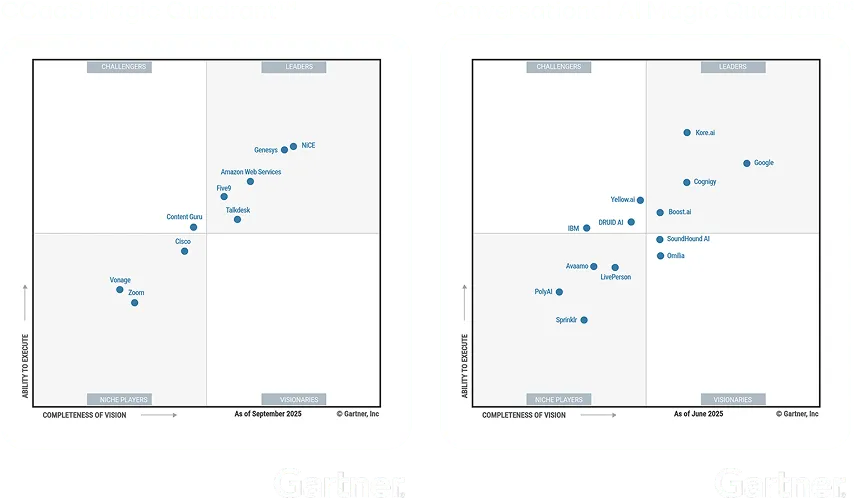
Two Leaders. One platform.
At NiCE, we’re setting the standard for AI-first customer experience.
The most consistent implementation guidance from NiCE: begin with one high-volume, clearly-defined workflow that has measurable outcomes and visible organizational pain. Prove ROI there first. Use that proof to fund and justify the next automation. Resist the temptation to automate everything at once — phased programs with early wins consistently outperform comprehensive deployments that take 18+ months to show results.
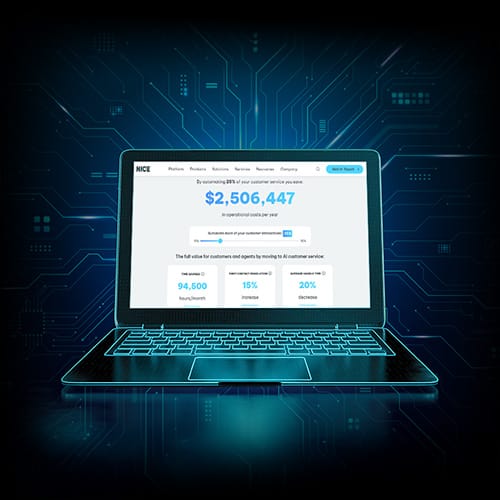
Discover the full value of AI in CX
Understand the benefits and cost savings you can achieve by embracing AI, from automation to augmentation.Calculate your savings
AI workflow automation is the use of artificial intelligence to design, execute, and optimize sequences of business tasks — enabling faster, more accurate, and more adaptable processes than rules-based automation. It handles variable inputs, makes judgment-based decisions, and improves over time. Applicable to 60–80% of business processes vs. 20–30% for traditional automation.
RPA automates structured, scripted UI tasks — it's brittle and breaks when inputs change. AI workflow automation handles unstructured inputs, variable process paths, and judgment-intensive decisions using machine learning and NLP. RPA addresses 20–30% of processes; AI extends coverage to 60–80%. Most mature programs use both.
AI workflow automation is effective for any high-volume process involving data interpretation, routing decisions, or judgment: customer service routing, invoice processing, compliance monitoring, lead scoring, HR onboarding, IT incident triage, and escalation management. If the process involves reading something ambiguous and deciding what to do with it, AI can automate it.
Platform costs range from tens of thousands annually for mid-market deployments to hundreds of thousands for enterprise programs. Integration development, change management, and ongoing optimization are frequently underestimated — budget 30–50% above platform cost for implementation. ROI typically ranges from 150–300% over three years, with payback in 6–18 months.
Not for most deployments. Modern platforms like NiCE CXone offer no-code and low-code builders for business users. Developer involvement is needed for complex custom integrations; data science expertise adds value for custom AI model training. Most organizations can automate 70–80% of their target workflows without a dedicated technical team.
Establish baselines before deployment, then measure: process cycle time reduction, error rate reduction, cost-per-transaction, employee hours reclaimed, and customer satisfaction scores (for customer-facing processes). NiCE customers report the most credible ROI cases are built on three metrics: throughput increase, error rate reduction, and cost-per-transaction — all measured before and after deployment.
Enterprise platforms like NiCE CXone are built to enterprise security standards: SOC 2 Type II compliance, end-to-end encryption, role-based access controls, comprehensive audit trails, and data residency options for regulatory requirements. Verify specific certifications and data handling practices during vendor evaluation — all reputable enterprise vendors will provide this documentation.
AI agents are the most advanced form of workflow automation — autonomous systems that plan and execute multi-step tasks toward a goal without a human specifying each step. NiCE research shows 85–90% autonomous task completion on bounded transaction types within 6 months of deployment. They represent the current frontier of enterprise workflow automation.
Identify one high-volume, high-friction process with clear success metrics. Map it in detail. Evaluate platforms against your AI requirements and integration needs. Run a proof-of-concept with measurable before/after metrics. Achieve ROI, then scale. Organizations following this sequence achieve full ROI 40% faster than those starting with platform selection.
The trajectory is toward fully agentic, generative automation — systems that identify their own optimization opportunities, design new process improvements, and operate across broader domains with less human configuration. NiCE's AI roadmap is centered on this evolution: building platforms where AI doesn't just execute workflows, but continuously improves them.
Ready to experience the power of one platform?
Let us show you how NiCE can unify, automate and elevate your entire customer experience - with AI at the core and outcomes at the forefront.Watch the demoContact Sales