



What is Customer Loyalty?
Last Updated September 17, 2026
Customer loyalty is a customer’s sustained preference for a company, reflected in behaviors such as repeat purchasing, renewal, continued use, and recommendation. Loyalty grows when a brand consistently delivers value and makes important interactions easy and trustworthy. Rewards programs can reinforce loyalty, but they cannot substitute for a product or service experience that repeatedly creates friction.
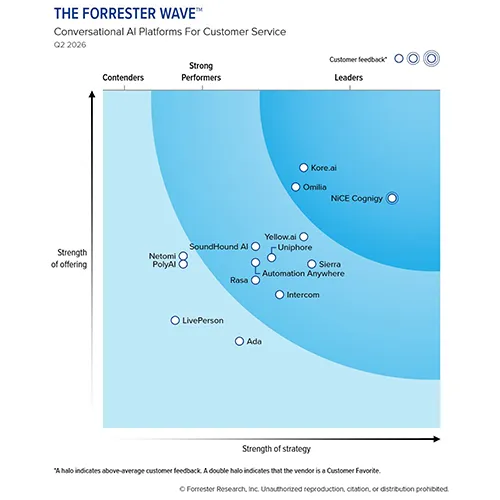
Named a Leader in The Forrester Wave™ 2026
Conversational AI Platforms
Ranked highest in the Strategy category. Above-average customer feedback among evaluated vendors.
Customer loyalty vs. customer satisfaction
Satisfaction is usually a reaction to a particular experience or period of time. Loyalty is a longer-term relationship outcome. A customer can be satisfied with one interaction and still switch providers, while a loyal customer may occasionally encounter a problem and stay because the overall relationship remains strong.
What drives customer loyalty
- Reliable product or service value.
- Easy, low-effort experiences.
- Consistent treatment across channels and time.
- Fast, accurate resolution when problems occur.
- Trust, transparency, and responsible use of customer data.
- Relevant personalization that helps rather than interrupts.
- Recognition of the customer’s history and relationship.
How customer service affects loyalty
Service interactions are disproportionately important because they often happen when the customer already has a problem, question, or decision to make. A fast and fair resolution can protect the relationship; repeated transfers, inconsistent answers, and forced repetition can weaken it. This makes routing, knowledge, agent support, self-service quality, and journey orchestration loyalty levers, not only operational tools.
How to measure customer loyalty
- Retention and renewal rate.
- Repeat purchase or repeat use.
- Churn and reasons for leaving.
- Share of wallet or expansion where measurable.
- Customer lifetime value.
- Recommendation measures such as NPS, interpreted with behavioral data.
- Service signals such as repeat contact, unresolved issues, complaints, and effort.
Service-led strategies to strengthen loyalty
- Identify the journeys most closely associated with churn, complaints, or repeat contact.
- Make recognition and context portable across channels so customers do not have to start over.
- Resolve the root cause of repeated issues rather than optimizing individual contacts in isolation.
- Use proactive service when the business can predict a problem or next need with reasonable confidence.
- Give agents the knowledge, authority, and real-time assistance needed to resolve issues without unnecessary escalation.
- Use customer feedback and interaction analytics together to understand what is driving loyalty and dissatisfaction.
Where AI can help
AI can support loyalty by making service faster, more consistent, and more proactive. Examples include AI agents for routine resolution, predictive routing, real-time agent assistance, interaction analytics, and proactive outreach. The key is relevance: automation that blocks customers or creates extra effort damages loyalty instead of improving it.
Also related
How NiCE is Redefining Customer Experience
NiCE offers the industry’s only unified AI platform for customer service automation. CXone revolutionizes how organizations automate customer service from start to finish—with channels, data, end-to-end workflows, and enterprise knowledge converging to improve customer experience at scale. With domain specific AI trained on the industry’s largest CX dataset, an open framework with endless integration possibilities, and a complete suite of advanced AI applications, CXone is one platform built for organizations of all sizes to deliver seamless customer service experiences, boost operational efficiency, and drive better outcomes.
Agentic Experience Automation
AI Agents for Sales and Marketing
AI Agents for Proactive Engagement
Engagement Orchestration
Workforce Empowerment
Contact us
If you would like to know more about our platform or just have additional questions about our products or services, please submit the contact form. For general questions or customer support please visit our Contact us page.